Bakhtiari Sedigheh, Jafari Soudeh, Taheri Jamileh Bigom, Kashi Tahereh Sadat Jafarzadeh, Namazi Zahra, Iman Maryam, Poorberafeyi Mohammad
Department of Oral Medicine, School of Dentistry, Shahid Beheshti University of Medical Sciences, Tehran, Iran.
Department of Dental Biomaterial, School of Dentistry, Tehran University of Medical Sciences, Tehran, Iran.
Open Access Maced J Med Sci. 2019 Apr 10;7(7):1067-1070. doi: 10.3889/oamjms.2019.245. eCollection 2019 Apr 15.
Candida species are the most common opportunistic fungal infections. Today, cinnamon plants have been considered for anti-Candida properties.
This study aimed to investigate the effectiveness of cinnamaldehyde extract (from cinnamon derivatives) on and species and comparison with nystatin.
In this study, cinnamaldehyde and nystatin were used. The specimens included and . Minimum inhibitory concentration (MIC) and minimum fungicidal concentration (MFC) were measured for each one by the microdilution method. This experiment was repeated three times.
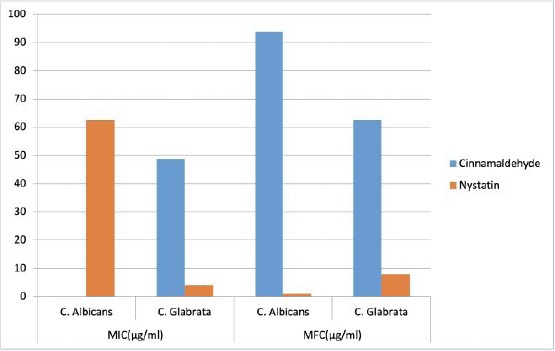
Cinnamaldehyde extract at a concentration of 62.5 μl/ml was able to prevent the growth of , at a concentration of 93.7 μl/ml, causing to disappear, at 48.8 μl/ml, to prevent the growth of , and in the concentration of 62.5 μl/ml, causes the loss of . In comparison, nystatin at 0.5 μg/ml concentration prevented the growth of , at concentrations of 1 μg/ml causing to be destroyed, at 4 μg/ml concentration to prevent the growth of , and at a concentration of 8 μg/ml causes the loss of . The results were the same every three times.
Although cinnamaldehyde extract had an effect on fungal growth in both and with a fatal effect; the effect on these two species was lower than nystatin.
念珠菌属是最常见的机会性真菌感染。如今,肉桂植物因其抗念珠菌特性而受到关注。
本研究旨在探讨肉桂醛提取物(来自肉桂衍生物)对白色念珠菌和热带念珠菌的有效性,并与制霉菌素进行比较。
在本研究中,使用了肉桂醛和制霉菌素。标本包括白色念珠菌和热带念珠菌。通过微量稀释法测量每种菌的最低抑菌浓度(MIC)和最低杀菌浓度(MFC)。本实验重复三次。
浓度为62.5μl/ml的肉桂醛提取物能够抑制白色念珠菌的生长,浓度为93.7μl/ml时可使白色念珠菌消失,浓度为48.8μl/ml时能抑制热带念珠菌的生长,浓度为62.5μl/ml时可使热带念珠菌消失。相比之下,浓度为0.5μg/ml的制霉菌素能抑制白色念珠菌的生长,浓度为1μg/ml时可破坏白色念珠菌,浓度为4μg/ml时能抑制热带念珠菌的生长,浓度为8μg/ml时可使热带念珠菌消失。三次实验结果均相同。
虽然肉桂醛提取物对白色念珠菌和热带念珠菌的真菌生长均有影响且具有致死作用;但对这两种菌的作用低于制霉菌素。