Departamento de Microbiología y Bioquímica, Instituto de Productos Lácteos de Asturias (IPLA-CSIC), Paseo Río Linares s/n, Villaviciosa, 33300 Asturias, Spain.
Servicios Científico-Técnicos, Instituto de Productos Lácteos de Asturias (IPLA-CSIC), Paseo Río Linares s/n, Villaviciosa, 33300 Asturias, Spain.
Nutrients. 2019 Apr 30;11(5):993. doi: 10.3390/nu11050993.
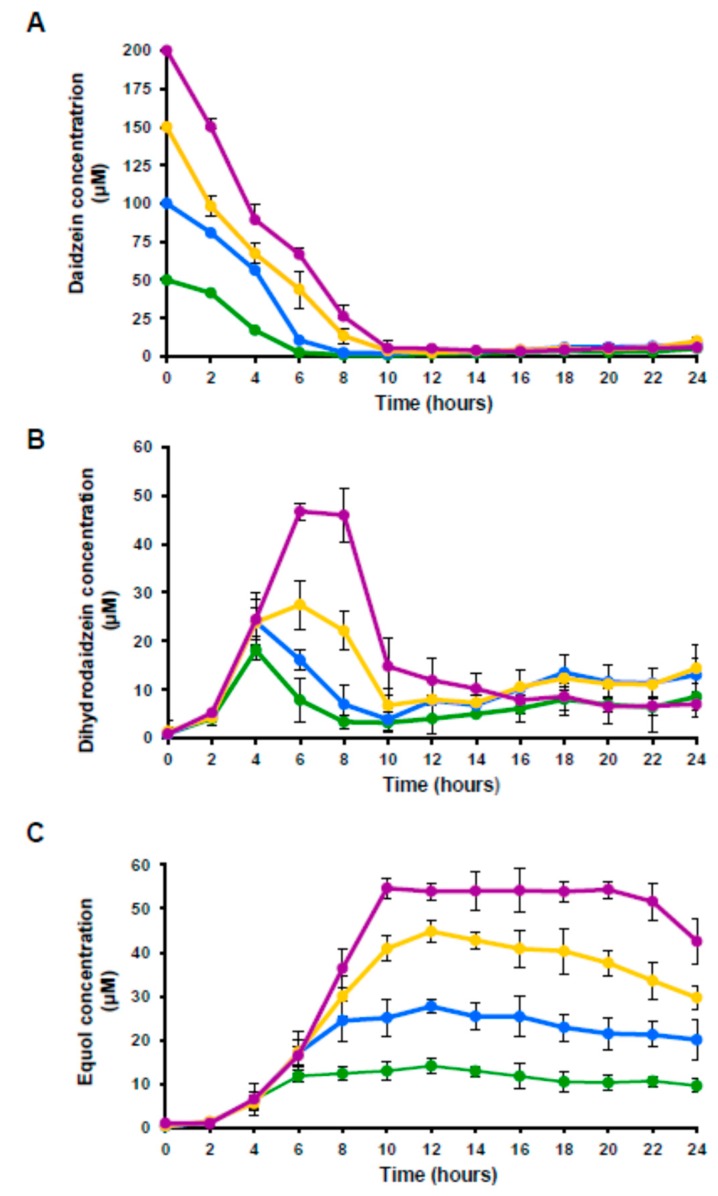
Given the emerging evidence of equol's benefit to human health, understanding its synthesis and regulation in equol-producing bacteria is of paramount importance. DSM19450 is a human intestinal bacterium -for which the whole genome sequence is publicly available- that produces equol from the daidzein isoflavone. In the present work, daidzein (between 50 to 200 μM) was completely metabolized by cultures of DSM19450 after 10 h of incubation. However, only about one third of the added isoflavone was transformed into dihydrodaidzein and then into equol. Transcriptional analysis of the ORFs and intergenic regions of the bacterium's equol gene cluster was therefore undertaken using RT-PCR and RT-qPCR techniques with the aim of identifying the genetic elements of equol biosynthesis and its regulation mechanisms. Compared to controls cultured without daidzein, the expression of all 13 contiguous genes in the equol cluster was enhanced in the presence of the isoflavone. Depending on the gene and the amount of daidzein in the medium, overexpression varied from 0.5- to about 4-log units. Four expression patterns of transcription were identified involving genes within the cluster. The genes , and , which code for daidzein reductase, dihydrodaidzein reductase and tetrahydrodaidzein reductase respectively, and which have been shown involved in equol biosynthesis, were among the most strongly expressed genes in the cluster. These expression patterns correlated with the location of four putative ρ-independent terminator sequences in the cluster. All the intergenic regions were amplified by RT-PCR, indicating the operon to be transcribed as a single RNA molecule. These findings provide new knowledge on the metabolic transformation of daidzein into equol by DSM19450, which might help in efforts to increase the endogenous formation of this compound and/or its biotechnological production.
鉴于黄豆苷元对人类健康的益处不断得到证实,了解其在产生黄豆苷元的细菌中的合成和调控至关重要。DSM19450 是一种人类肠道细菌,其全基因组序列公开,能够从染料木黄酮中将黄豆苷元转化而来。在本研究中,经过 10 小时的孵育,DSM19450 培养物完全代谢了 50 至 200 μM 的染料木黄酮。然而,只有约三分之一的添加异黄酮转化为二氢黄豆苷元和黄豆苷元。因此,使用 RT-PCR 和 RT-qPCR 技术对细菌黄豆苷元基因簇的 ORF 和基因间区进行了转录分析,目的是确定黄豆苷元生物合成的遗传元件及其调控机制。与不培养染料木黄酮的对照相比,异黄酮存在时,黄豆苷元基因簇中 13 个连续基因的表达均增强。根据基因和培养基中染料木黄酮的含量,过表达程度从 0.5 到约 4 个对数单位不等。鉴定了涉及簇内基因的 4 种转录表达模式。编码染料木黄酮还原酶、二氢黄豆苷元还原酶和四氢黄豆苷元还原酶的基因和 ,以及被证明参与黄豆苷元生物合成的基因,是簇中表达最强的基因之一。这些表达模式与簇中四个推定的 ρ 独立终止子序列的位置相关。通过 RT-PCR 扩增了所有基因间区,表明操纵子作为单个 RNA 分子转录。这些发现为 DSM19450 将染料木黄酮代谢转化为黄豆苷元提供了新知识,这可能有助于增加该化合物的内源性形成和/或其生物技术生产。