University of Delaware, Department of Behavioral Health and Nutrition, 206C McDowell Hall, Newark, DE 19716, USA.
University of Delaware, College of Health Sciences, STAR, Newark, DE 19716, USA.
Nutrients. 2019 May 8;11(5):1034. doi: 10.3390/nu11051034.
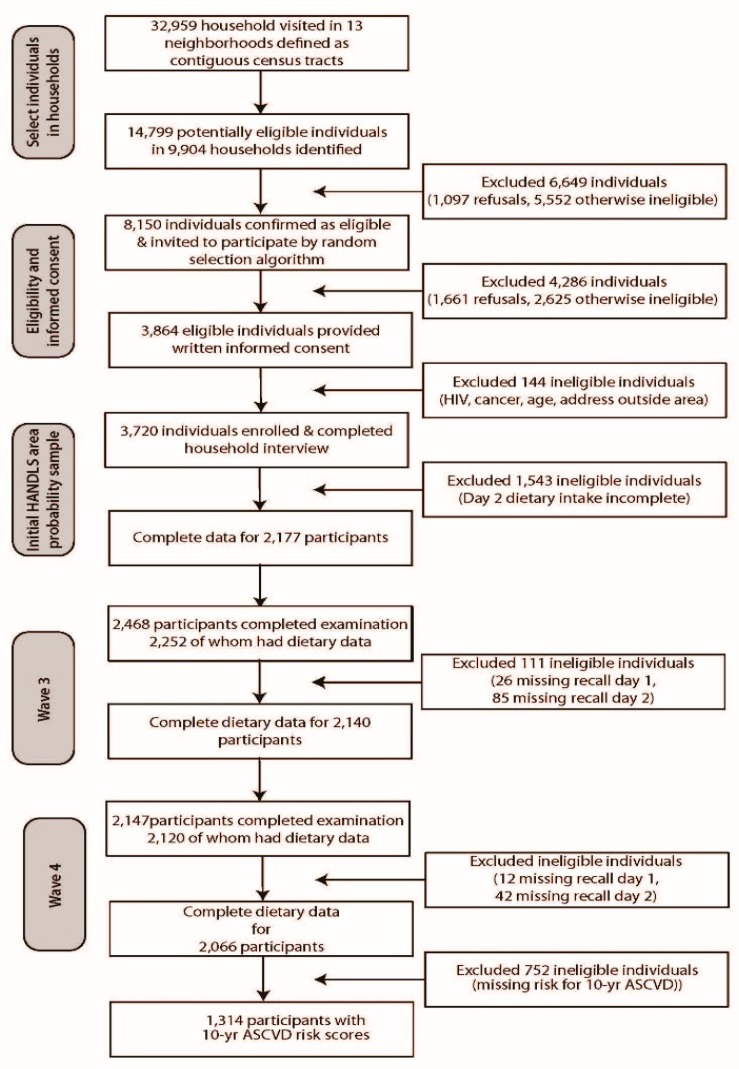
The study objectives were to measure dietary diversity (DD) of an urban US population and to determine if associations of 10 year atherosclerotic cardiovascular (ASCVD) risk with DD were independent of dietary quality. Participants were drawn from the Healthy Aging in Neighborhoods of Diversity across the Life Span (HANDLS) study, wave 4 ( = 2066, 1259 African Americans (AA), 807 Whites (W). Three DD measures were derived from 2 days of 24 h recall data collected with the USDA automated-multiple-pass-method. Count was based on consumption of at least half an equivalent of food from 21 subgroups. Evenness was calculated using Berry Index (BI) and BI-adjusted by food health values. Dissimilarity was calculated by Mahalanobis Distance. Diet quality was assessed by Mean Nutrient Adequacy (MAR) and DASH scores. Associations of DD and quality with ASCVD risk, calculated using 2013 American College of Cardiology and American Heart Association guidelines, were assessed with multivariable regression. Covariates included income, education, food security, and energy/kg weight. Count and MAR were positively associated whereas dissimilarity was negatively associated with ASCVD risk. There was no evidence that evenness contributed to cardiovascular health. The findings suggest more diversity in food attributes and diets rich in micronutrients rather than increased count support cardiovascular health.
本研究旨在测量美国城市人口的饮食多样性(DD),并确定 10 年动脉粥样硬化性心血管疾病(ASCVD)风险与 DD 的关联是否独立于饮食质量。参与者来自多样性跨越生命跨度的邻里健康老龄化(HANDLS)研究,第 4 波(n = 2066,1259 名非裔美国人(AA),807 名白人(W)。从 2 天的 24 小时回忆数据中得出了 3 个 DD 指标,这些数据是使用美国农业部自动多通道方法收集的。计数是基于至少半份来自 21 个亚组的食物消耗。均匀性是通过 Berry 指数(BI)和通过食物健康值调整的 BI 来计算的。不相似性是通过马哈拉诺比斯距离来计算的。饮食质量是通过平均营养素充足度(MAR)和 DASH 得分来评估的。使用 2013 年美国心脏病学会和美国心脏协会的指南,通过多变量回归评估了 DD 和质量与 ASCVD 风险的关联。协变量包括收入、教育、食品安全和每公斤体重的能量。计数和 MAR 与 ASCVD 风险呈正相关,而不相似性与 ASCVD 风险呈负相关。没有证据表明均匀性对心血管健康有贡献。研究结果表明,食物属性的多样性和富含微量营养素的饮食比增加计数更能支持心血管健康。