Graduate School of Life and Environmental Sciences, University of Tsukuba, Ibaraki, 305-8572, Japan.
Graduate School of Systems and Information Engineering, University of Tsukuba, Ibaraki, 305-8573, Japan.
Sci Rep. 2019 May 10;9(1):7251. doi: 10.1038/s41598-019-43587-8.
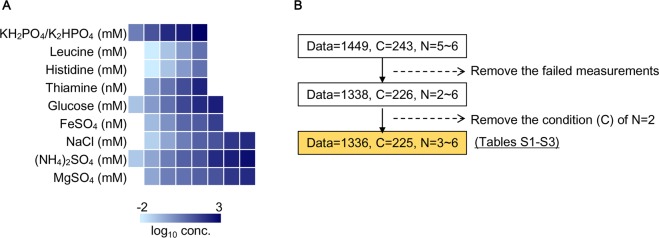
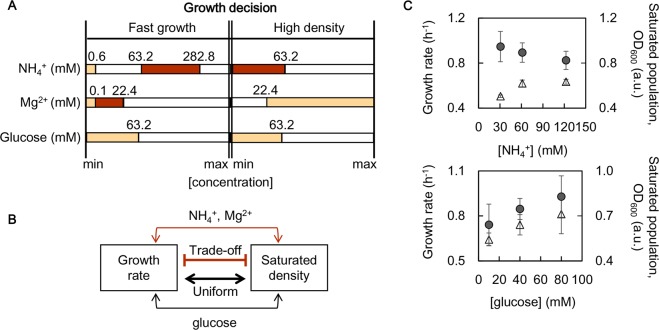
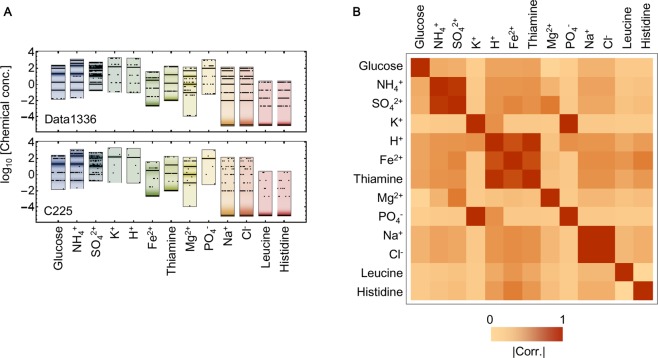
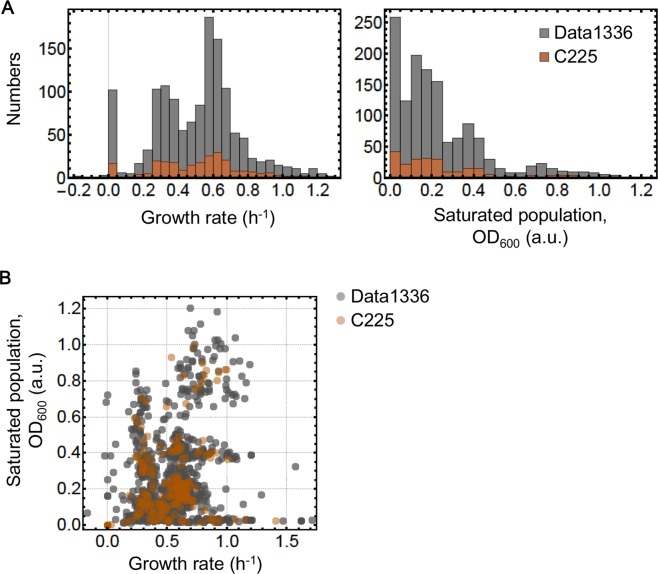
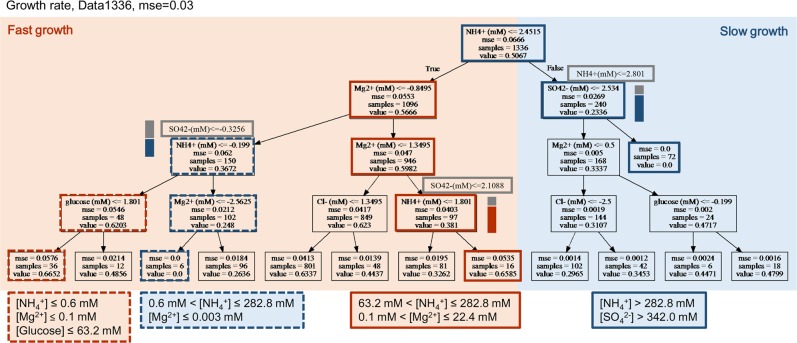
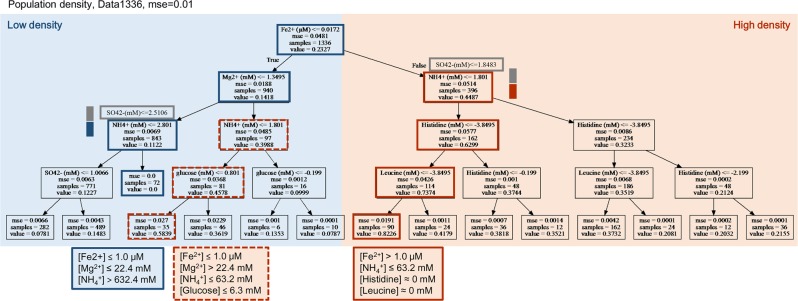
Predicting the contribution of media components to bacterial growth was first initiated by introducing machine learning to high-throughput growth assays. A total of 1336 temporal growth records corresponding to 225 different media, which were composed of 13 chemical components, were generated. The growth rate and saturated density of each growth curve were automatically calculated with the newly developed data processing program. To identify the decision making factors related to growth among the 13 chemicals, big datasets linking the growth parameters to the chemical combinations were subjected to decision tree learning. The results showed that the only carbon source, glucose, determined bacterial growth, but it was not the first priority. Instead, the top decision making chemicals in relation to the growth rate and saturated density were ammonium and ferric ions, respectively. Three chemical components (NH, Mg and glucose) commonly appeared in the decision trees of the growth rate and saturated density, but they exhibited different mechanisms. The concentration ranges for fast growth and high density were overlapped for glucose but distinguished for NH and Mg. The results suggested that these chemicals were crucial in determining the growth speed and growth maximum in either a universal use or a trade-off manner. This differentiation might reflect the diversity in the resource allocation mechanisms for growth priority depending on the environmental restrictions. This study provides a representative example for clarifying the contribution of the environment to population dynamics through an innovative viewpoint of employing modern data science within traditional microbiology to obtain novel findings.
通过将机器学习引入高通量生长测定,首次提出了预测培养基成分对细菌生长的贡献。共生成了 1336 个对应于 225 种不同培养基的时间生长记录,这些培养基由 13 种化学组分组成。使用新开发的数据处理程序自动计算每条生长曲线的生长率和饱和密度。为了确定 13 种化学物质中与生长相关的决策因素,将将生长参数与化学组合相关联的大数据集用于决策树学习。结果表明,唯一的碳源葡萄糖决定了细菌的生长,但不是首要因素。相反,与生长率和饱和密度相关的最重要的决策化学物质分别是铵和铁离子。三个化学组分(NH、Mg 和葡萄糖)通常出现在生长率和饱和密度的决策树中,但它们的作用机制不同。对于葡萄糖,快速生长和高密度的浓度范围重叠,但 NH 和 Mg 则有所区分。结果表明,这些化学物质在普遍使用或权衡使用的情况下,对于确定生长速度和生长最大值至关重要。这种分化可能反映了根据环境限制,资源分配机制在生长优先级方面的多样性。本研究通过在传统微生物学中采用现代数据科学的创新观点,提供了一个有代表性的例子,阐明了环境对种群动态的贡献。