Olcina Guillermo, Perez-Sousa Miguel Ángel, Escobar-Alvarez Juan Antonio, Timón Rafael
Sports Sciences Faculty, University of Extremadura, Cáceres 10003, Spain.
Education, Psychology and Sports Sciences Faculty, University of Huelva, Huelva 21007, Spain.
Sports (Basel). 2019 May 16;7(5):115. doi: 10.3390/sports7050115.
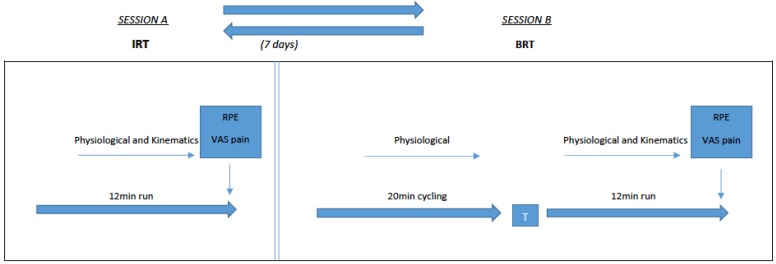
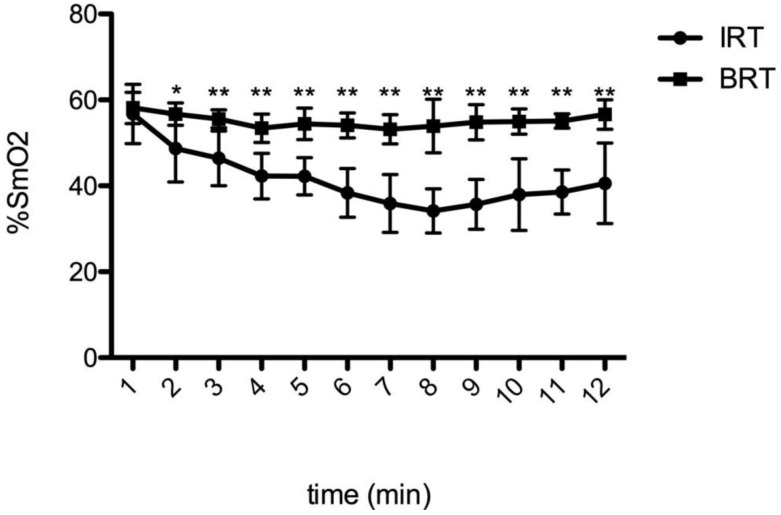
Running performance is a determinant factor for victory in Sprint and Olympic distance triathlon. Previous cycling may impair running performance in triathlons, so brick training becomes an important part of training. Wearable technology that is used by triathletes can offer several metrics for optimising training in real-time. The aim of this study was to analyse the effect of previous cycling on subsequent running performance in a field test, while using kinematics metrics and SmO provided by wearable devices that are potentially used by triathletes. Ten trained triathletes participated in a randomised crossover study, performing two trial sessions that were separated by seven days: the isolated run trial (IRT) and the bike-run trial (BRT). Running kinematics, physiological outcomes, and perceptual parameters were assessed before and after each running test. The running distance was significantly lower in the BRT when compared to the IRT, with a decrease in stride length of 0.1 m ( = 0.00) and higher %SmO ( = 0.00) in spite of the maximal intensity of exercise. No effects were reported in vertical oscillation, ground contact time, running cadence, and average heart rate. These findings may only be relevant to 'moderate level' triathletes, but not to 'elite' ones. Triathletes might monitor their %SmO and stride length during brick training and then compare it with isolated running to evaluate performance changes. Using wearable technology (near-infrared spectroscopy, accelerometry) for specific brick training may be a good option for triathletes.
跑步表现是短距离和奥运距离铁人三项比赛胜利的决定性因素。之前的骑行可能会损害铁人三项比赛中的跑步表现,因此转换训练成为训练的重要组成部分。铁人三项运动员使用的可穿戴技术可以提供多个指标以实时优化训练。本研究的目的是在一项实地测试中分析之前的骑行对后续跑步表现的影响,同时使用铁人三项运动员可能使用的可穿戴设备提供的运动学指标和肌肉氧合血红蛋白含量(SmO)。十名训练有素的铁人三项运动员参与了一项随机交叉研究,进行了两个相隔七天的试验阶段:单独跑步试验(IRT)和骑行-跑步试验(BRT)。在每次跑步测试前后评估跑步运动学、生理结果和感知参数。与IRT相比,BRT中的跑步距离显著更低,尽管运动强度达到最大,但步幅减少了0.1米(P = 0.00)且肌肉氧合血红蛋白含量百分比更高(P = 0.00)。在垂直振荡、地面接触时间、跑步节奏和平均心率方面未报告有影响。这些发现可能仅与“中等水平”的铁人三项运动员相关,而与“精英”运动员无关。铁人三项运动员在转换训练期间可能会监测他们的肌肉氧合血红蛋白含量百分比和步幅,然后将其与单独跑步进行比较以评估表现变化。使用可穿戴技术(近红外光谱、加速度计)进行特定的转换训练可能是铁人三项运动员的一个不错选择。