Soori Hamid, Khorasani-Zavareh Davoud
Department of Health in Emergencies and Disasters, School of Public Health and Safety, Shahid Beheshti University of Medical Sciences, Tehran, Iran. Email:
J Inj Violence Res. 2019 Jul;11(2):149-158. doi: 10.5249/jivr.v11i2.1122. Epub 2019 May 18.
The Eastern Mediterranean Region has the second highest road traffic fatality rate in the world. This article presents the epidemiology of road traffic injuries and the preventive measures in Eastern Mediterranean Region taken by the different World Health Organization member states compared to the rest of the world.
This is a secondary data analysis addressing the Global Status Report on Road Safety published by the World Health Organization in 2015. Data are from 180 countries covering 6.97 billion people of the world's population, of which 21 Eastern Mediterranean Region of World Health Organization member states with about 595 million population were included and were analyzed. From 22 countries in the region, 21 are presented and Syria has not reported any data on road traffic injuries.
Eastern Mediterranean Region member states contribute to 9.69% of all global fatal road traffic injuries (19.9 per 100 000 population compared to the same rate in the European region with 9.3), while these countries account for 7.4% of the world's population and have about 5.6% of the world's vehicles on their roads. More than 90% of the Eastern Mediterranean Region countries have passed mandatory seat-belt laws for both front-seat and rear-seat passengers and making helmet use obligatory; and only 27% have child restraint laws; half percent have an emergency room injury surveillance system. All countries have a national drink-driving law; and certain speed limits but there is no distinction between rural and urban areas, and the latter lack adequate speed restrictions.
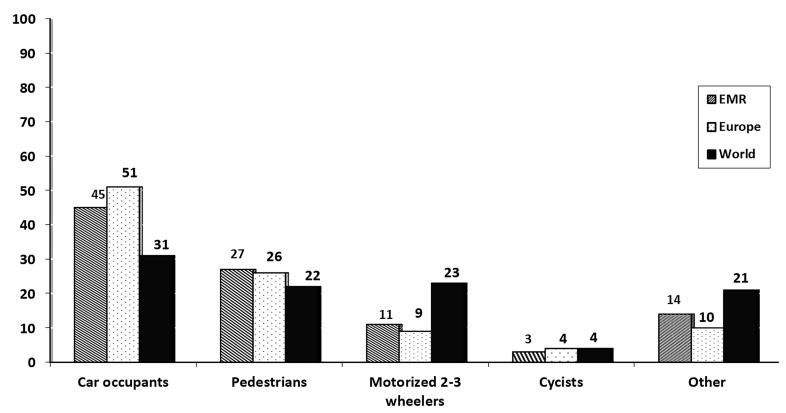
Although the Eastern Mediterranean Region member states have some important preventive measures recommended by World Health Organization, considerable efforts are still needed to optimize the enforcement of existing road safety laws. The maximum urban speed limit should be reduced in many countries. Sufficient attention should be paid to the needs of pedestrians, cyclists and motorcyclists, who together make up about 50% of Eastern Mediterranean Region road traffic deaths.
东地中海区域的道路交通死亡率在世界上排名第二。本文介绍了东地中海区域道路交通伤害的流行病学情况,以及世界卫生组织不同成员国与世界其他地区相比所采取的预防措施。
这是一项对世界卫生组织2015年发布的《全球道路安全状况报告》进行的二次数据分析。数据来自180个国家,覆盖全球69.7亿人口,其中包括世界卫生组织东地中海区域的21个成员国,约5.95亿人口,并对其进行了分析。该区域22个国家中,呈现了21个国家的数据,叙利亚未报告任何道路交通伤害数据。
东地中海区域成员国占全球道路交通事故死亡总数的9.69%(每10万人中有19.9人死亡,而欧洲区域这一比例为9.3),而这些国家占世界人口的7.4%,道路上的车辆约占世界车辆总数的5.6%。东地中海区域超过90%的国家已通过了针对前排和后排乘客的强制性安全带法律,并强制使用头盔;只有27%的国家有儿童约束法律;0.5%的国家有急诊室伤害监测系统。所有国家都有全国性的酒后驾车法律;以及某些速度限制,但没有区分农村和城市地区,且后者缺乏适当的速度限制。
尽管东地中海区域成员国已采取了世界卫生组织建议的一些重要预防措施,但仍需做出相当大的努力来优化现有道路安全法律的执行。许多国家应降低城市最高限速。应充分关注行人、骑自行车者和骑摩托车者的需求,他们加起来约占东地中海区域道路交通死亡人数的50%。