CerCo, CNRS, UMR 5549, Université de Toulouse, Toulouse, 31052 France.
Commun Biol. 2019 May 21;2:193. doi: 10.1038/s42003-019-0438-y. eCollection 2019.
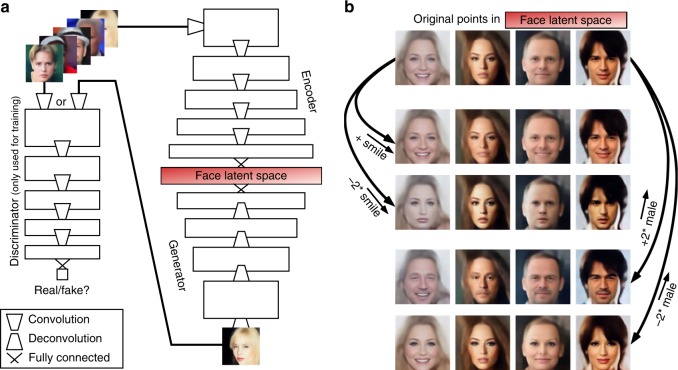
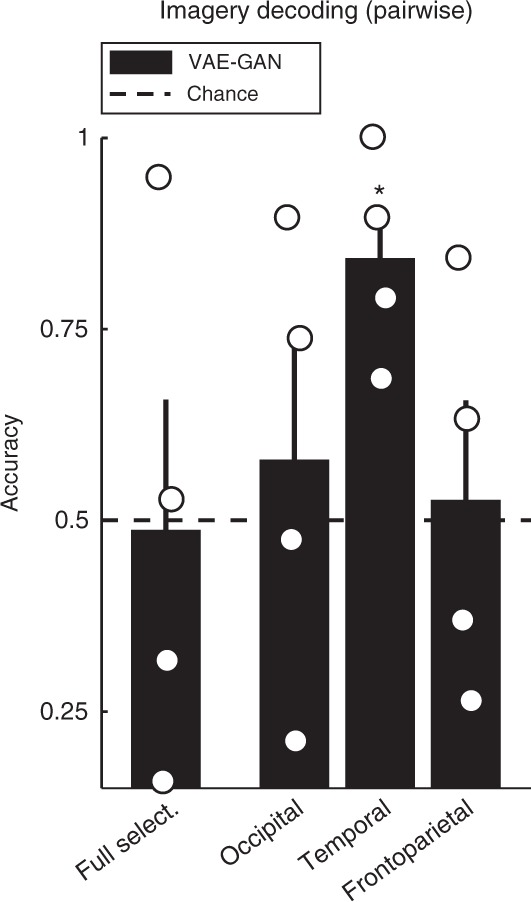
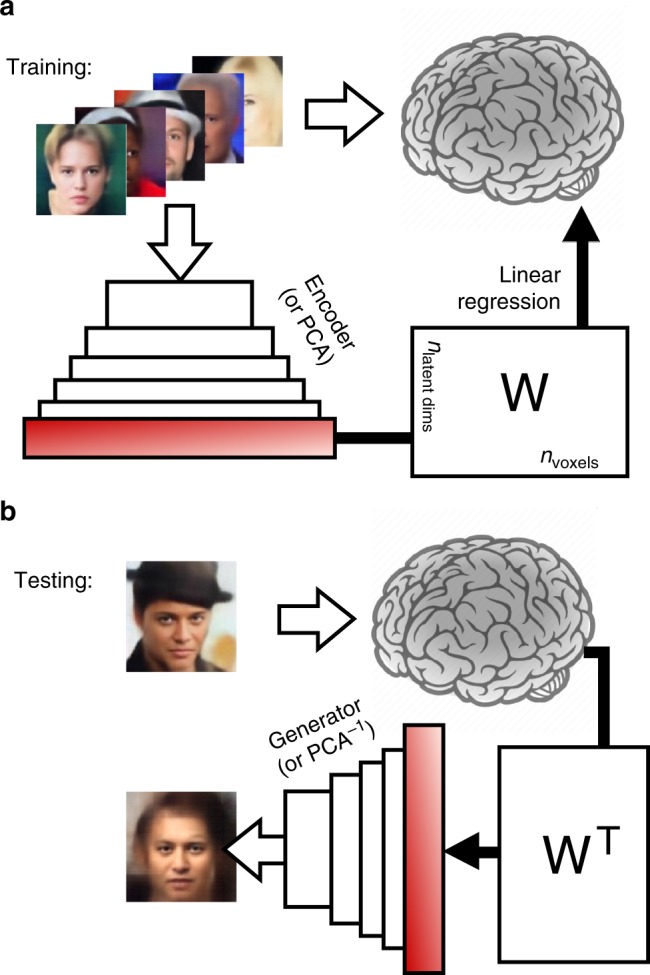
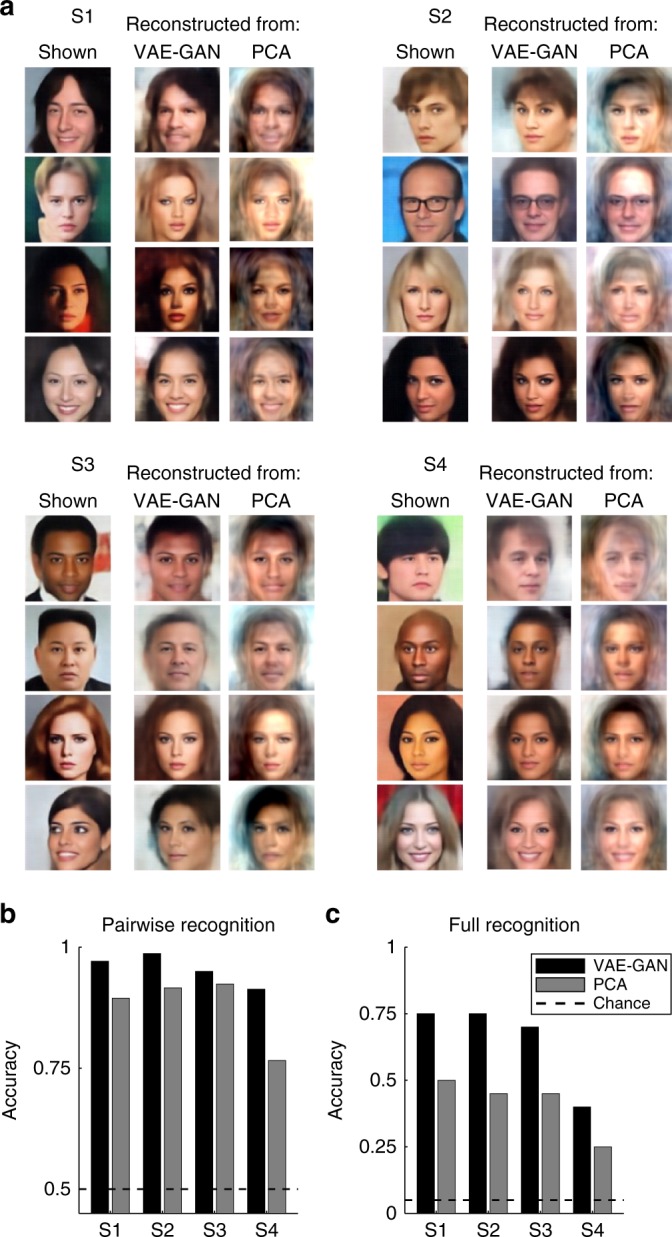
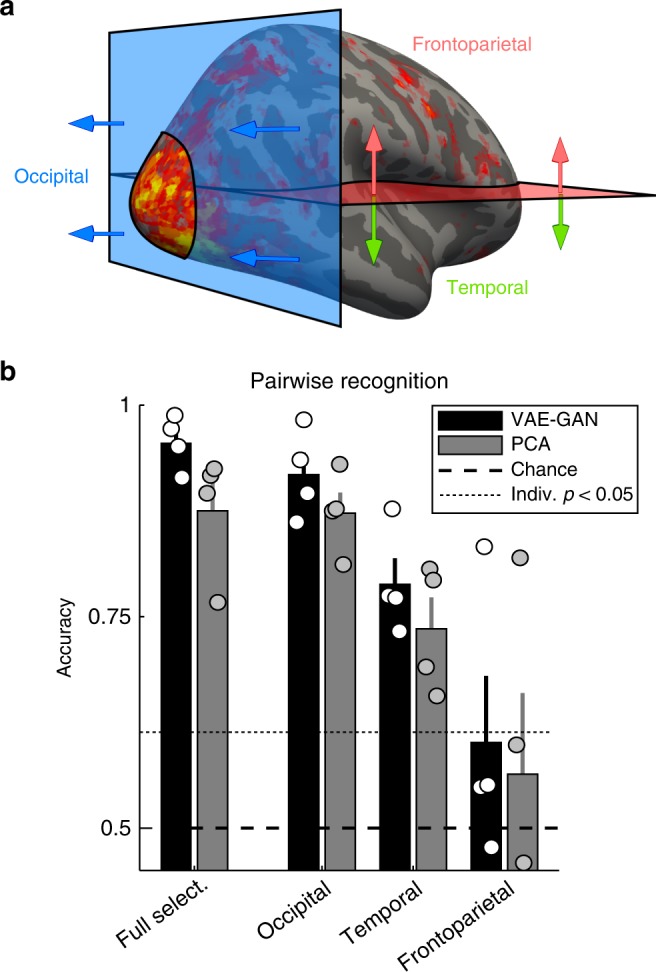
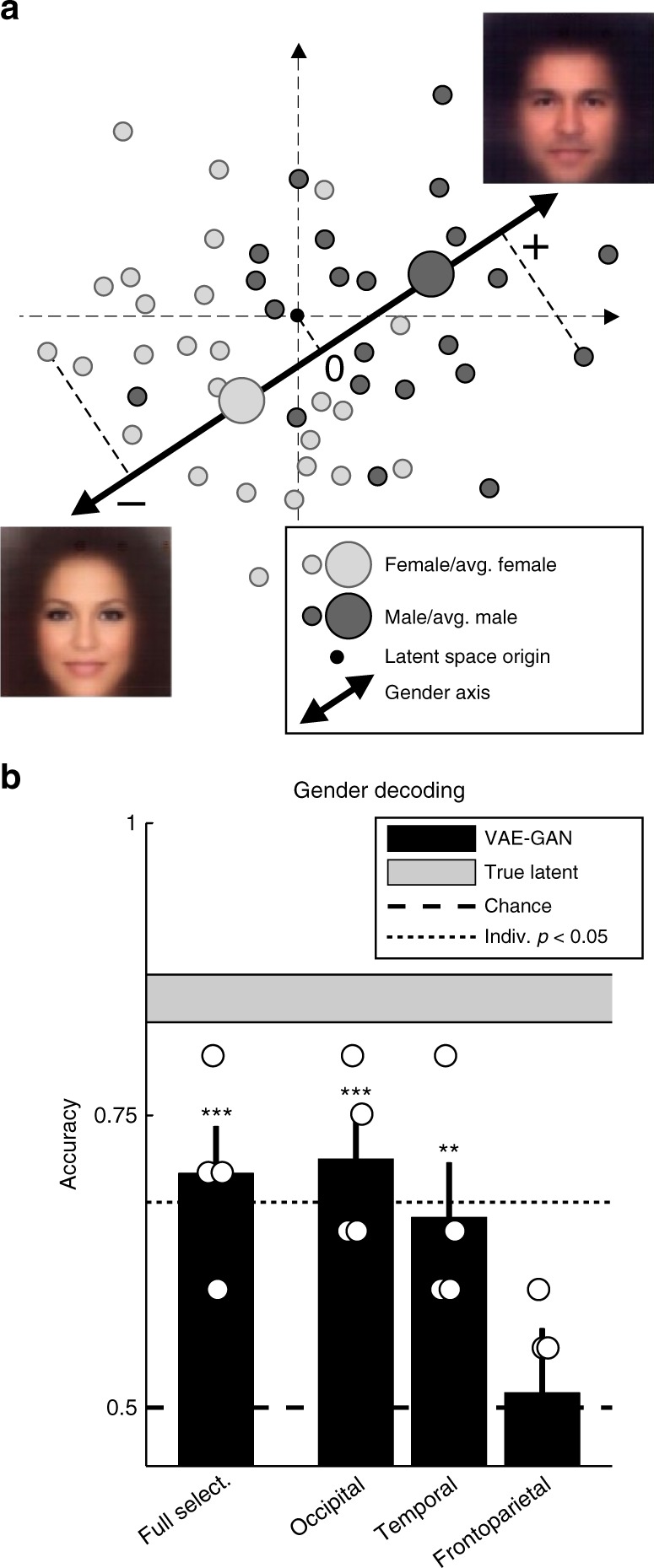
Although distinct categories are reliably decoded from fMRI brain responses, it has proved more difficult to distinguish visually similar inputs, such as different faces. Here, we apply a recently developed deep learning system to reconstruct face images from human fMRI. We trained a variational auto-encoder (VAE) neural network using a GAN (Generative Adversarial Network) unsupervised procedure over a large data set of celebrity faces. The auto-encoder latent space provides a meaningful, topologically organized 1024-dimensional description of each image. We then presented several thousand faces to human subjects, and learned a simple linear mapping between the multi-voxel fMRI activation patterns and the 1024 latent dimensions. Finally, we applied this mapping to novel test images, translating fMRI patterns into VAE latent codes, and codes into face reconstructions. The system not only performed robust pairwise decoding (>95% correct), but also accurate gender classification, and even decoded which face was imagined, rather than seen.
虽然可以从 fMRI 大脑反应中可靠地解码出不同的类别,但要区分视觉上相似的输入(例如不同的面孔)则更为困难。在这里,我们应用一种新开发的深度学习系统,从人类 fMRI 重建面部图像。我们使用 GAN(生成对抗网络)的无监督程序,在一个大型名人面孔数据集上训练了一个变分自动编码器(VAE)神经网络。自动编码器的潜在空间为每个图像提供了有意义的、拓扑组织的 1024 维描述。然后,我们向人类受试者展示了数千张面孔,并学习了多体素 fMRI 激活模式与 1024 个潜在维度之间的简单线性映射。最后,我们将该映射应用于新的测试图像,将 fMRI 模式转换为 VAE 潜在代码,并将代码转换为面部重建。该系统不仅可以进行稳健的成对解码(>95%正确),还可以进行准确的性别分类,甚至可以解码出想象的面孔,而不仅仅是看到的面孔。