Zheng Zebo, Xu Ningsheng, Oscurato Stefano L, Tamagnone Michele, Sun Fengsheng, Jiang Yinzhu, Ke Yanlin, Chen Jianing, Huang Wuchao, Wilson William L, Ambrosio Antonio, Deng Shaozhi, Chen Huanjun
State Key Laboratory of Optoelectronic Materials and Technologies, Guangdong Province Key Laboratory of Display Material and Technology, School of Electronics and Information Technology, Sun Yat-sen University, Guangzhou 510275, China.
Harvard John A. Paulson School of Engineering and Applied Sciences, Harvard University, Cambridge, MA 02138, USA.
Sci Adv. 2019 May 24;5(5):eaav8690. doi: 10.1126/sciadv.aav8690. eCollection 2019 May.
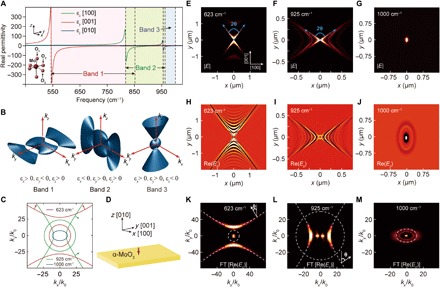
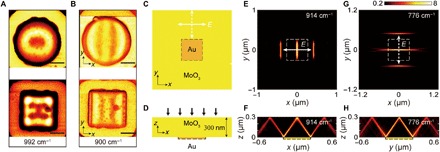
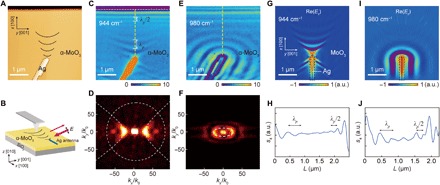
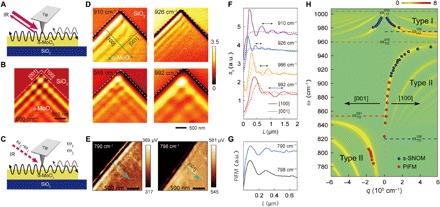
Hyperbolic media have attracted much attention in the photonics community due to their ability to confine light to arbitrarily small volumes and their potential applications to super-resolution technologies. The two-dimensional counterparts of these media can be achieved with hyperbolic metasurfaces that support in-plane hyperbolic guided modes upon nanopatterning, which, however, poses notable fabrication challenges and limits the achievable confinement. We show that thin flakes of a van der Waals crystal, α-MoO, can support naturally in-plane hyperbolic polariton guided modes at mid-infrared frequencies without the need for patterning. This is possible because α-MoO is a biaxial hyperbolic crystal with three different Reststrahlen bands, each corresponding to a different crystalline axis. These findings can pave the way toward a new paradigm to manipulate and confine light in planar photonic devices.
双曲线介质因其能够将光限制在任意小的体积内以及在超分辨率技术中的潜在应用,在光子学领域引起了广泛关注。这些介质的二维对应物可以通过超表面来实现,在纳米图案化后,超表面支持面内双曲线导模,然而,这带来了显著的制造挑战,并限制了可实现的限制效果。我们表明,范德华晶体α-MoO的薄片可以在中红外频率下自然地支持面内双曲线极化激元导模,而无需图案化。这是可能的,因为α-MoO是一种具有三个不同的Reststrahlen带的双轴双曲线晶体,每个带对应于不同的晶轴。这些发现可以为在平面光子器件中操纵和限制光的新范式铺平道路。