Department of Anesthesiology and Perioperative Medicine, The Second Affiliated Hospital and Yuying Children's Hospital of Wenzhou Medical University, Wenzhou, Zhejiang, China (mainland).
Department of Anesthesiology, Critical Care and Pain Medicine, The Second Affiliated Hospital and Yuying Children's Hospital of Wenzhou Medical University, Wenzhou, Zhejiang, China (mainland).
Med Sci Monit. 2019 May 30;25:4035-4040. doi: 10.12659/MSM.915640.
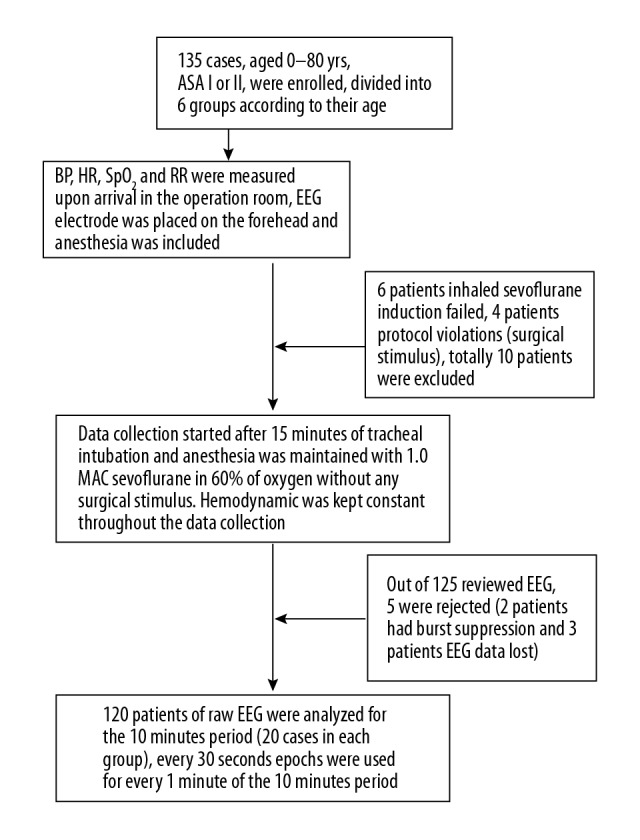
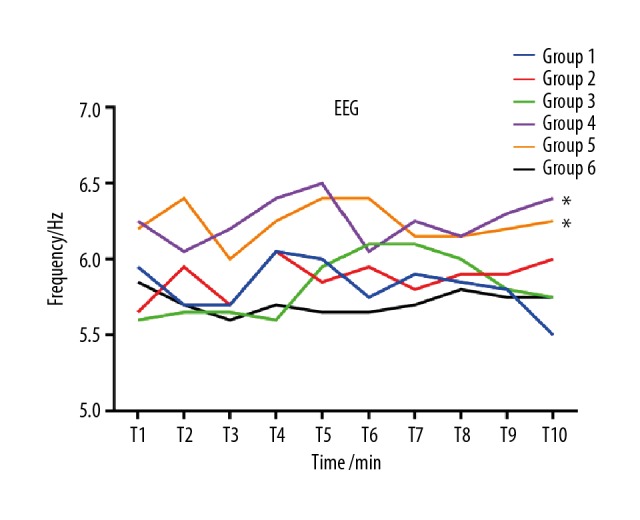
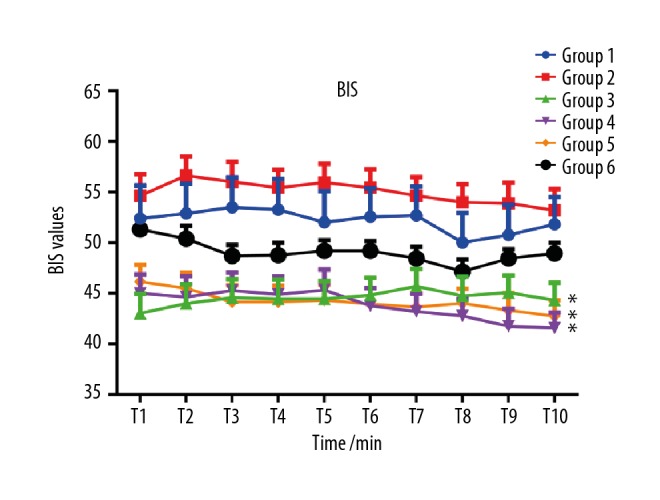
BACKGROUND Studies have reported that BIS is unreliable in children because its algorithm provides misleading information about the actual depth of anesthesia. Raw EEG analysis provides direct neurophysiologic measurement of cerebral activity. The relationship between age and EEG has rarely been reported, thus the aim of the present study was to compare raw electroencephalography (EEG) among different age groups of surgical patients under general anesthesia with 1.0 MAC sevoflurane. MATERIAL AND METHODS We enrolled 135 patients aged 0-80 years old (ASA physical status I or II) undergoing surgery, who were divided into 6 groups: 1-12 months old (group 1), 1-3 years old (group 2), 3-6 years old (group 3), 6-18 years old (group 4), 18-65 years old (group 5), and 65-80 years old (group 6). Different raw EEG waves (alpha, delta, and theta) were compared for all subjects. RESULTS The BIS values in groups 1 to 6 were 52.2±12.7, 55.0±8.0, 44.5±7.3, 43.8±7.3, 44.2±6.2, and 49.1±6.2 respectively. Compared with groups 1 and 2 (52.2±12.7, 55.0±8.0), BIS values of groups 3, 4, and 5 (44.5±7.3, 43.8±7.3, 44.2±6.2, respectively) were lower (P<0.05). Theta frequency was observed in the 6 groups. The EEG frequencies in groups 1 to 6 were 6.0 (5.5-6.0), 6.0 (5.5-6.0), 6.0 (5.5-6.0), 6.0 (6.0-7.0), 6.3 (6.0-7.0), and 6.0 (5.1-6.0), respectively. Compared with group 6, EEG frequencies in groups 4 and 5 were higher (P<0.05). BIS value was significantly correlated with EEG frequency (R²=0.063, P<0.01). CONCLUSIONS Analyzing raw EEG waves provides more accurate judgement of depth of anesthesia, especially in pediatric cases in which monitors often provide misleading values.
研究表明,BIS 在儿童中不可靠,因为其算法提供了关于实际麻醉深度的误导信息。原始脑电图分析提供了大脑活动的直接神经生理测量。年龄与脑电图之间的关系很少有报道,因此本研究旨在比较全身麻醉下 1.0 MAC 七氟醚下不同年龄组手术患者的原始脑电图(EEG)。
我们纳入了 135 名年龄在 0-80 岁(ASA 身体状况 I 或 II)的手术患者,将其分为 6 组:1-12 个月(组 1)、1-3 岁(组 2)、3-6 岁(组 3)、6-18 岁(组 4)、18-65 岁(组 5)和 65-80 岁(组 6)。对所有受试者的不同原始 EEG 波(α、δ 和θ)进行了比较。
组 1 至 6 的 BIS 值分别为 52.2±12.7、55.0±8.0、44.5±7.3、43.8±7.3、44.2±6.2 和 49.1±6.2。与组 1 和 2(52.2±12.7、55.0±8.0)相比,组 3、4 和 5(44.5±7.3、43.8±7.3、44.2±6.2)的 BIS 值较低(P<0.05)。6 组均观察到θ频率。组 1 至 6 的 EEG 频率分别为 6.0(5.5-6.0)、6.0(5.5-6.0)、6.0(5.5-6.0)、6.0(6.0-7.0)、6.3(6.0-7.0)和 6.0(5.1-6.0)。与组 6 相比,组 4 和 5 的 EEG 频率较高(P<0.05)。BIS 值与 EEG 频率显著相关(R²=0.063,P<0.01)。
分析原始 EEG 波可提供更准确的麻醉深度判断,尤其是在监测器经常提供误导值的儿科病例中。