Division of Environmental Science and Engineering, Pohang University of Science and Technology (POSTECH), 77 Chengam-ro, Nam-gu, Pohang 37673, Korea.
Division of Integrative Biosciences and Biotechnology, Pohang University of Science and Technology (POSTECH), 77 Chengam-ro, Nam-gu, Pohang 37673, Korea.
Mar Drugs. 2019 May 30;17(6):318. doi: 10.3390/md17060318.
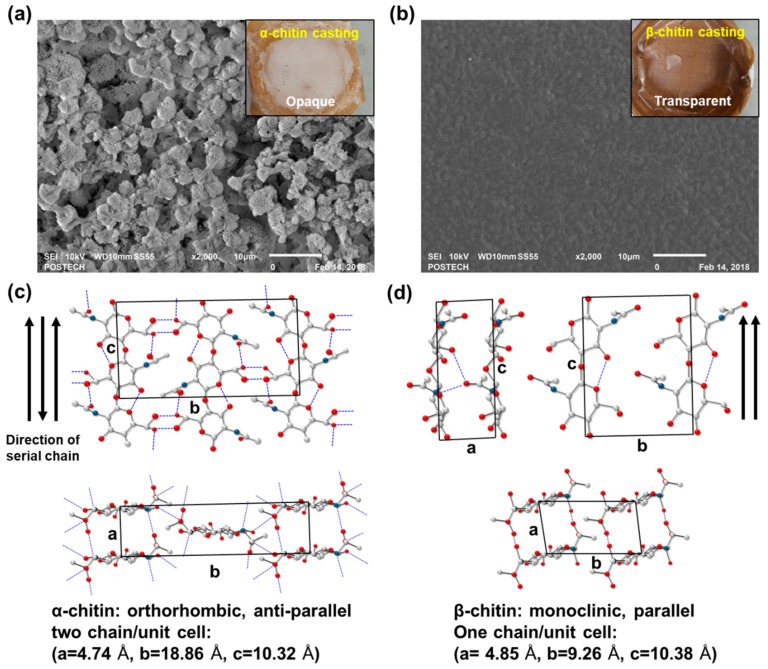
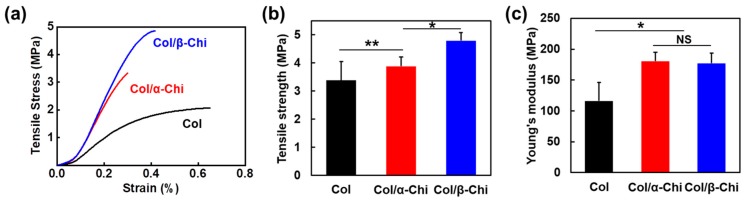
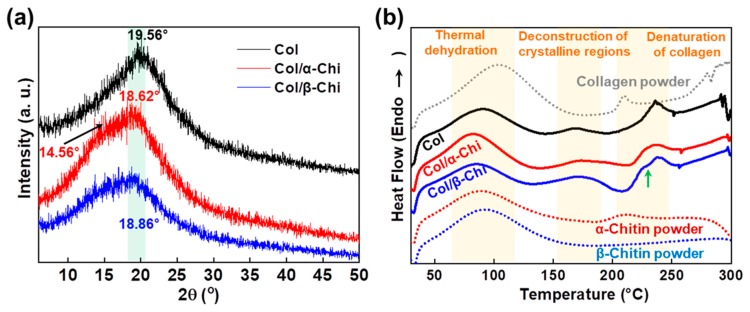
Although collagens from vertebrates are mainly used in regenerative medicine, the most elusive issue in the collagen-based biomedical scaffolds is its insufficient mechanical strength. To solve this problem, electrospun collagen composites with chitins were prepared and molecular interactions which are the cause of the mechanical improvement in the composites were investigated by two-dimensional correlation spectroscopy (2DCOS). The electrospun collagen is composed of two kinds of polymorphs, α- and β-chitin, showing different mechanical enhancement and molecular interactions due to different inherent configurations in the crystal structure, resulting in solvent and polymer susceptibility. The collagen/α-chitin has two distinctive phases in the composite, but β-chitin composite has a relatively homogeneous phase. The β-chitin composite showed better tensile strength with ~41% and ~14% higher strength compared to collagen and α-chitin composites, respectively, due to a favorable secondary interaction, i.e., inter- rather than intra-molecular hydrogen bonds. The revealed molecular interaction indicates that β-chitin prefers to form inter-molecular hydrogen bonds with collagen by rearranging their uncrumpled crystalline regions, unlike α-chitin.
尽管脊椎动物胶原蛋白主要用于再生医学,但基于胶原蛋白的生物医学支架中最棘手的问题是其机械强度不足。为了解决这个问题,制备了具有壳聚糖的静电纺丝胶原复合材料,并通过二维相关光谱(2DCOS)研究了导致复合材料机械性能提高的分子相互作用。静电纺丝胶原由两种多晶型物,α-和β-壳聚糖组成,由于晶体结构中固有构型的不同,表现出不同的机械增强和分子相互作用,从而导致溶剂和聚合物的敏感性。胶原/α-壳聚糖在复合材料中有两个明显的相,但β-壳聚糖复合材料具有相对均匀的相。β-壳聚糖复合材料的拉伸强度比胶原和α-壳聚糖复合材料分别提高了约 41%和 14%,这是由于有利的二级相互作用,即分子间而非分子内氢键。揭示的分子相互作用表明,β-壳聚糖通过重新排列其未卷曲的结晶区,优先与胶原形成分子间氢键,而不同于α-壳聚糖。