Huang Huachen, Song Shanshan, Banerjee Suneel, Jiang Tong, Zhang Jinwei, Kahle Kristopher T, Sun Dandan, Zhang Zhongling
1 Department of Neurology, The First Affiliate Hospital, Harbin Medical University, Harbin, Heilongjiang, China.
2Department of Neurology, University of Pittsburgh, Pittsburgh, PA, USA.
Aging Dis. 2019 Jun 1;10(3):626-636. doi: 10.14336/AD.2018.0928. eCollection 2019 Jun.
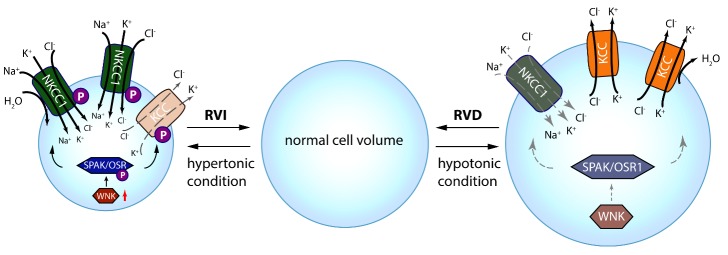
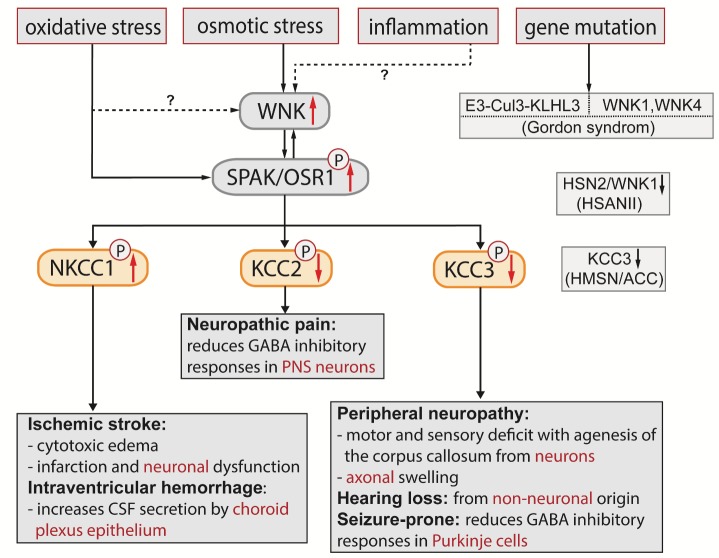
In recent years, cation-chloride cotransporters (CCCs) have drawn attention in the medical neuroscience research. CCCs include the family of Na-coupled Cl importers (NCC, NKCC1, and NKCC2), K-coupled Cl exporters (KCCs), and possibly polyamine transporters (CCC9) and CCC interacting protein (CIP1). For decades, CCCs have been the targets of several commonly used diuretic drugs, including hydrochlorothiazide, furosemide, and bumetanide. Genetic mutations of NCC and NKCC2 cause congenital renal tubular disorders and lead to renal salt-losing hypotension, secondary hyperreninemia, and hypokalemic metabolic alkalosis. New studies reveal that CCCs along with their regulatory WNK (Kinase with no lysine (K)), and SPAK (Ste20-related proline-alanine-rich kinase)/OSR1(oxidative stress-responsive kinase-1) are essential for regulating cell volume and maintaining ionic homeostasis in the nervous system, especially roles of the WNK-SPAK-NKCC1 signaling pathway in ischemic brain injury and hypersecretion of cerebrospinal fluid in post-hemorrhagic hydrocephalus. In addition, disruption of Cl exporter KCC2 has an effect on synaptic inhibition, which may be involved in developing pain, epilepsy, and possibly some neuropsychiatric disorders. Interference with KCC3 leads to peripheral nervous system neuropathy as well as axon and nerve fiber swelling and psychosis. The WNK-SPAK/OSR1-CCCs complex emerges as therapeutic targets for multiple neurological diseases. This review will highlight these new findings.
近年来,阳离子-氯离子协同转运体(CCCs)在医学神经科学研究中受到关注。CCCs包括钠耦联氯离子转运体家族(NCC、NKCC1和NKCC2)、钾耦联氯离子转运体(KCCs),可能还包括多胺转运体(CCC9)和CCC相互作用蛋白(CIP1)。几十年来,CCCs一直是几种常用利尿剂的作用靶点,包括氢氯噻嗪、呋塞米和布美他尼。NCC和NKCC2的基因突变会导致先天性肾小管疾病,并引发肾性失盐性低血压、继发性高肾素血症和低钾性代谢性碱中毒。新的研究表明,CCCs及其调节因子WNK(无赖氨酸(K)激酶)和SPAK(与Ste20相关的富含脯氨酸-丙氨酸的激酶)/OSR1(氧化应激反应激酶-1)对于调节细胞体积和维持神经系统的离子稳态至关重要,尤其是WNK-SPAK-NKCC1信号通路在缺血性脑损伤和出血后脑积水脑脊液分泌过多中的作用。此外,氯离子转运体KCC2的破坏会影响突触抑制,这可能与疼痛、癫痫以及可能的一些神经精神疾病的发生有关。干扰KCC3会导致周围神经系统神经病变以及轴突和神经纤维肿胀和精神病。WNK-SPAK/OSR1-CCCs复合物成为多种神经系统疾病的治疗靶点。本综述将重点介绍这些新发现。