Laboratory of Applied Radio Engineering for Humanosphere, Research Institute for Sustainable Humanosphere, Kyoto University, Uji, Kyoto, Japan.
Department of Electrical & Electronic Engineering, Graduate Schools of Science and Engineering, Tokyo Metropolitan University, 1-1, Hachioji, Tokyo, Japan.
J Radiat Res. 2019 Jul 1;60(4):417-423. doi: 10.1093/jrr/rrz017.
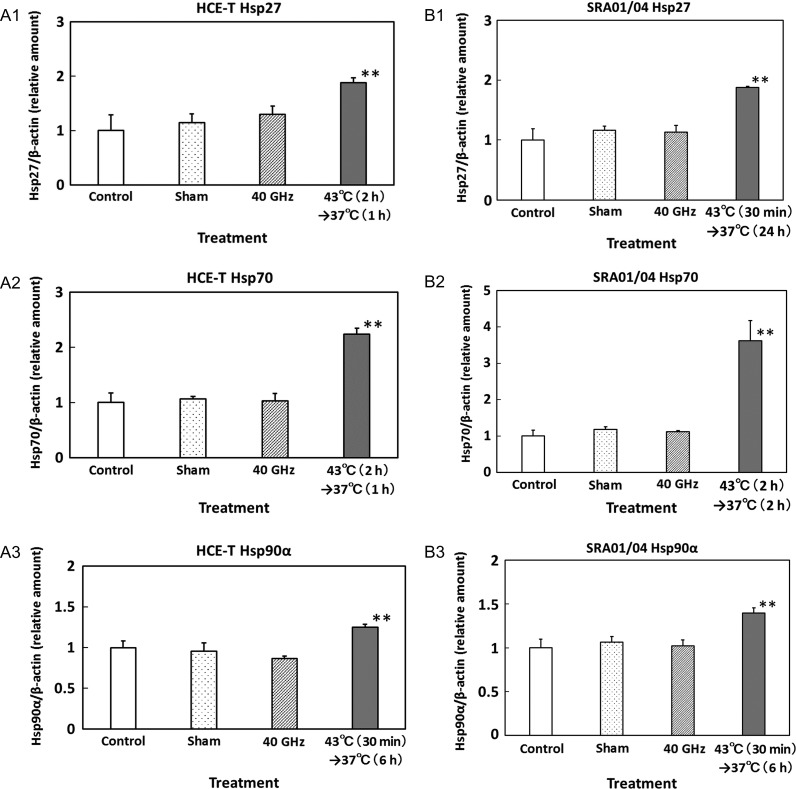
Millimeter waves are used in various fields, and the risks of this wavelength range for human health must be carefully evaluated. In this study, we investigated the effects of millimeter waves on genotoxicity and heat shock protein expression in human corneal epithelial (HCE-T) and human lens epithelial (SRA01/04) cells. We exposed the cells to 40-GHz millimeter waves at 1 mW/cm2 for 24 h. We observed no statistically significant increase in the micronucleus (MN) frequency or the level of DNA strand breaks in cells exposed to 40-GHz millimeter waves relative to sham-exposed and incubator controls. Heat shock protein (Hsp) expression also exhibited no statistically significant response to the 40-GHz exposure. These results indicate that exposure to 40 GHz millimeter waves under these conditions has little or no effect on MN formation, DNA strand breaks, or Hsp expression in HCE-T or SRA01/04 cells.
毫米波被应用于多个领域,因此必须对该波长范围对人类健康的风险进行仔细评估。在这项研究中,我们调查了毫米波对人眼角膜上皮(HCE-T)和人晶状体上皮(SRA01/04)细胞遗传毒性和热休克蛋白表达的影响。我们将细胞暴露于 1 mW/cm2 的 40GHz 毫米波下 24 小时。与假暴露和孵育对照相比,我们未观察到暴露于 40GHz 毫米波的细胞微核(MN)频率或 DNA 链断裂有统计学意义的增加。热休克蛋白(Hsp)的表达对 40GHz 暴露也没有表现出统计学上的显著反应。这些结果表明,在这些条件下,暴露于 40GHz 毫米波对 HCE-T 或 SRA01/04 细胞的 MN 形成、DNA 链断裂或 Hsp 表达几乎没有影响或没有影响。