Laboratory of Kinesiology, Biomechanics and Ergonomics (KIBIOMER Lab.), Research Central Services, University of Almería, Almería, Spain.
Health Research Centre, University of Almería, Almería, Spain.
PLoS One. 2019 Jun 14;14(6):e0218209. doi: 10.1371/journal.pone.0218209. eCollection 2019.
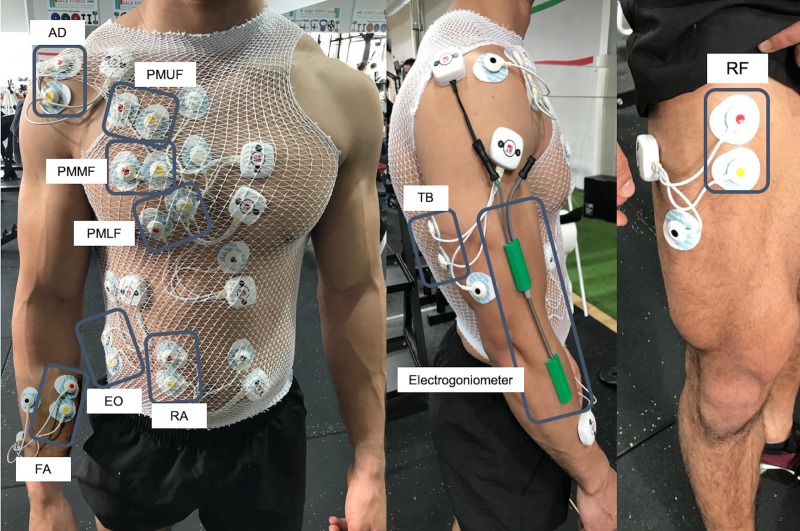
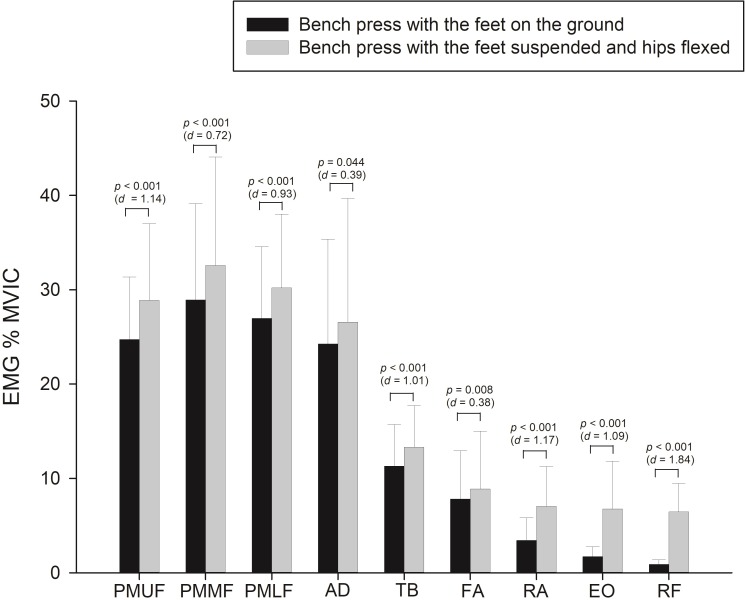
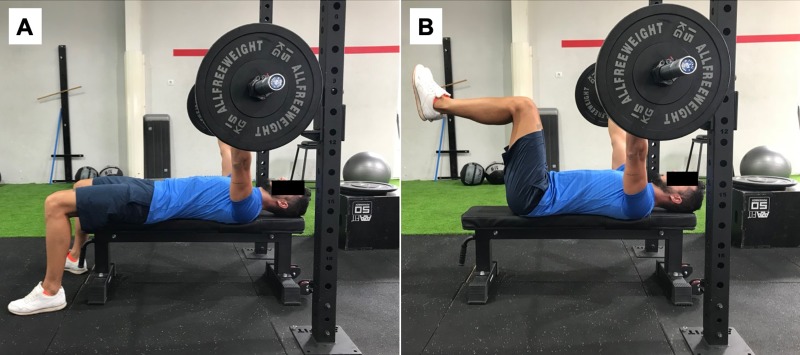
The present study aimed to evaluate and compare the levels of electromyographic activation in the pectoralis major, anterior deltoid, triceps brachii, forearm, rectus abdominis, external oblique, and rectus femoris muscles during a horizontal bench press in two situations: 1) with the feet on the ground; and 2) with active hip flexion and 90° of knee flexion. Twenty young men were familiarized with the procedure and the calculation of one-rep max (1RM). In a second session, electromyographic activity values were recorded in both bench press situations (with the feet on the ground vs active hip flexion and knees at 90°) at 60% 1RM. Performing the bench press with the hips and knees flexed produced significantly greater muscle activation of all elevated muscles (p < 0.01; d > 0.5). The pectoralis major showed the greatest activation, followed by the anterior deltoid and the triceps brachii. In addition, the greater activation of the abdominal muscles occurs due to the need to stabilize the core while performing the bench press with hip and knee flexion as well as the lumbar spine due to traction of the hip flexors.
本研究旨在评估和比较两种情况下水平卧推时胸大肌、三角肌前束、肱三头肌、前臂、腹直肌、腹外斜肌和股直肌的肌电激活水平:1)双脚着地;2)主动髋关节弯曲和膝关节弯曲 90°。20 名年轻男性熟悉了程序和 1 次最大重复(1RM)的计算。在第二次会议中,在 60% 1RM 时,在两种卧推情况下(双脚着地与主动髋关节弯曲和膝关节弯曲 90°)记录肌电图活动值。髋关节和膝关节弯曲进行卧推会显著增加所有抬高肌肉的肌肉激活(p < 0.01;d > 0.5)。胸大肌的激活最大,其次是三角肌前束和肱三头肌。此外,由于需要在髋关节和膝关节弯曲以及腰椎受到髋关节屈肌的牵引时稳定核心,因此腹部肌肉的激活更大。