• 文献检索
  • 文档翻译
  • 深度研究
  • 学术资讯
  • Suppr Zotero 插件Zotero 插件
  • 邀请有礼
  • 套餐&价格
  • 历史记录
应用&插件
Suppr Zotero 插件Zotero 插件浏览器插件Mac 客户端Windows 客户端微信小程序
定价
高级版会员购买积分包购买API积分包
服务
文献检索文档翻译深度研究API 文档MCP 服务
关于我们
关于 Suppr公司介绍联系我们用户协议隐私条款
关注我们

Suppr 超能文献

核心技术专利:CN118964589B侵权必究
粤ICP备2023148730 号-1Suppr @ 2026

文献检索

告别复杂PubMed语法,用中文像聊天一样搜索,搜遍4000万医学文献。AI智能推荐,让科研检索更轻松。

立即免费搜索

文件翻译

保留排版,准确专业,支持PDF/Word/PPT等文件格式,支持 12+语言互译。

免费翻译文档

深度研究

AI帮你快速写综述,25分钟生成高质量综述,智能提取关键信息,辅助科研写作。

立即免费体验

识别高危患者:应用再入院预测模型的最佳时机。

Identifying patients at highest-risk: the best timing to apply a readmission predictive model.

机构信息

Clalit Research Institute, Clalit Health Services, Shoham 2, Ramat Gan, Israel.

Cheryl Spencer Department of Nursing, Faculty of Social Welfare and Health Sciences, University of Haifa, 31905, Haifa, Israel.

出版信息

BMC Med Inform Decis Mak. 2019 Jun 26;19(1):118. doi: 10.1186/s12911-019-0836-6.

DOI:10.1186/s12911-019-0836-6
PMID:31242886
原文链接:https://pmc.ncbi.nlm.nih.gov/articles/PMC6595564/
Abstract

BACKGROUND

Most of readmission prediction models are implemented at the time of patient discharge. However, interventions which include an early in-hospital component are critical in reducing readmissions and improving patient outcomes. Thus, at-discharge high-risk identification may be too late for effective intervention. Nonetheless, the tradeoff between early versus at-discharge prediction and the optimal timing of the risk prediction model application remains to be determined. We examined a high-risk patient selection process with readmission prediction models using data available at two time points: at admission and at the time of hospital discharge.

METHODS

An historical prospective study of hospitalized adults (≥65 years) discharged alive from internal medicine units in Clalit's (the largest integrated payer-provider health fund in Israel) general hospitals in 2015. The outcome was all-cause 30-day emergency readmissions to any internal medicine ward at any hospital. We used the previously validated Preadmission Readmission Detection Model (PREADM) and developed a new model incorporating PREADM with hospital data (PREADM-H). We compared the percentage of overlap between the models and calculated the positive predictive value (PPV) for the subgroups identified by each model separately and by both models.

RESULTS

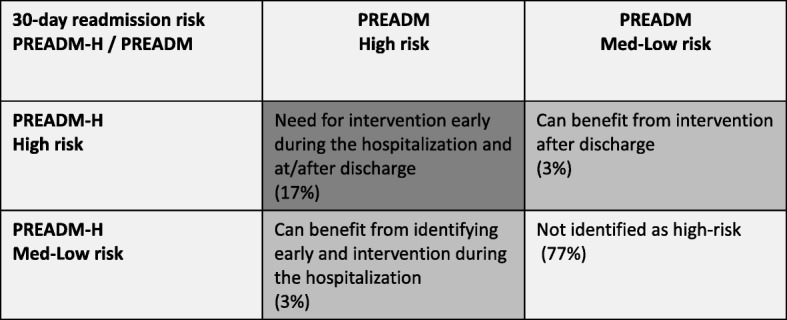
The final cohort included 35,156 index hospital admissions. The PREADM-H model included 17 variables with a C-statistic of 0.68 (95% CI: 0.67-0.70) and PPV of 43.0% in the highest-risk categories. Of patients categorized by the PREADM-H in the highest-risk decile, 78% were classified similarly by the PREADM. The 22% (n = 229) classified by the PREADM-H at the highest decile, but not by the PREADM, had a PPV of 37%. Conversely, those classified by the PREADM into the highest decile but not by the PREADM-H (n = 218) had a PPV of 31%.

CONCLUSIONS

The timing of readmission risk prediction makes a difference in terms of the population identified at each prediction time point - at-admission or at-discharge. Our findings suggest that readmission risk identification should incorporate a two time-point approach in which preadmission data is used to identify high-risk patients as early as possible during the index admission and an "all-hospital" model is applied at discharge to identify those that incur risk during the hospital stay.

摘要

背景

大多数再入院预测模型都是在患者出院时实施的。然而,包括早期院内治疗的干预措施对于降低再入院率和改善患者预后至关重要。因此,出院时的高风险识别对于有效的干预可能为时已晚。尽管如此,早期与出院时预测的权衡以及风险预测模型应用的最佳时机仍有待确定。我们使用在两个时间点可用的数据,即入院时和出院时,检查了一个使用再入院预测模型的高危患者选择过程。

方法

这是一项对 2015 年在克拉利特(以色列最大的综合支付方-服务提供方健康基金)综合医院内科单元出院存活的≥65 岁住院成年人进行的历史前瞻性研究。结局为任何内科病房的全因 30 天急诊再入院。我们使用了先前验证过的入院前再入院检测模型(PREADM),并开发了一个新的模型,该模型将 PREADM 与医院数据相结合(PREADM-H)。我们比较了模型之间的重叠百分比,并分别计算了每个模型和两个模型确定的亚组的阳性预测值(PPV)。

结果

最终队列包括 35156 例指数住院患者。PREADM-H 模型包含 17 个变量,C 统计量为 0.68(95%置信区间:0.67-0.70),风险最高类别中的 PPV 为 43.0%。在 PREADM-H 模型中被归类为最高风险十分位数的患者中,有 78%的患者被 PREADM 归类为相似类别。在 PREADM-H 模型中被归类为最高风险十分位数的 22%(n=229)患者,而不是 PREADM,则其 PPV 为 37%。相反,在 PREADM 模型中被归类为最高风险十分位数但未被 PREADM-H 模型归类的患者(n=218)的 PPV 为 31%。

结论

再入院风险预测的时间会影响每个预测时间点(入院时或出院时)确定的人群。我们的研究结果表明,再入院风险识别应采用两时间点方法,即使用入院前数据尽早识别高危患者,并在出院时应用“全院”模型来识别在住院期间产生风险的患者。

https://cdn.ncbi.nlm.nih.gov/pmc/blobs/f92c/6595564/416b30ef3245/12911_2019_836_Fig3_HTML.jpg
https://cdn.ncbi.nlm.nih.gov/pmc/blobs/f92c/6595564/19a6a08a4029/12911_2019_836_Fig1_HTML.jpg
https://cdn.ncbi.nlm.nih.gov/pmc/blobs/f92c/6595564/73564dd3c0c8/12911_2019_836_Fig2_HTML.jpg
https://cdn.ncbi.nlm.nih.gov/pmc/blobs/f92c/6595564/416b30ef3245/12911_2019_836_Fig3_HTML.jpg
https://cdn.ncbi.nlm.nih.gov/pmc/blobs/f92c/6595564/19a6a08a4029/12911_2019_836_Fig1_HTML.jpg
https://cdn.ncbi.nlm.nih.gov/pmc/blobs/f92c/6595564/73564dd3c0c8/12911_2019_836_Fig2_HTML.jpg
https://cdn.ncbi.nlm.nih.gov/pmc/blobs/f92c/6595564/416b30ef3245/12911_2019_836_Fig3_HTML.jpg

相似文献

1
Identifying patients at highest-risk: the best timing to apply a readmission predictive model.识别高危患者:应用再入院预测模型的最佳时机。
BMC Med Inform Decis Mak. 2019 Jun 26;19(1):118. doi: 10.1186/s12911-019-0836-6.
2
Predicting 30-day readmissions with preadmission electronic health record data.利用入院前电子健康记录数据预测30天再入院情况。
Med Care. 2015 Mar;53(3):283-9. doi: 10.1097/MLR.0000000000000315.
3
Preventing Hospital Readmissions: Healthcare Providers' Perspectives on "Impactibility" Beyond EHR 30-Day Readmission Risk Prediction.预防医院再入院:医疗保健提供者对 EHR 30 天再入院风险预测之外的“可影响性”的看法。
J Gen Intern Med. 2020 May;35(5):1484-1489. doi: 10.1007/s11606-020-05739-9. Epub 2020 Mar 5.
4
Predicting all-cause readmissions using electronic health record data from the entire hospitalization: Model development and comparison.利用整个住院期间的电子健康记录数据预测全因再入院:模型开发与比较。
J Hosp Med. 2016 Jul;11(7):473-80. doi: 10.1002/jhm.2568. Epub 2016 Feb 29.
5
READMIT: a clinical risk index to predict 30-day readmission after discharge from acute psychiatric units.再入院:一种预测急性精神科病房出院后30天再入院情况的临床风险指数。
J Psychiatr Res. 2015 Feb;61:205-13. doi: 10.1016/j.jpsychires.2014.12.003. Epub 2014 Dec 13.
6
Using machine learning to predict paediatric 30-day unplanned hospital readmissions: a case-control retrospective analysis of medical records, including written discharge documentation.使用机器学习预测儿科 30 天内非计划性住院再入院率:病历回顾性病例对照研究,包括书面出院记录。
Aust Health Rev. 2021 Jun;45(3):328-337. doi: 10.1071/AH20062.
7
Evaluation of prediction strategy and care coordination for COPD readmissions.慢性阻塞性肺疾病再入院的预测策略与护理协调评估
Hosp Pract (1995). 2016 Aug;44(3):123-8. doi: 10.1080/21548331.2016.1210472. Epub 2016 Jul 19.
8
Predicting readmission risk following coronary artery bypass surgery at the time of admission.预测冠状动脉搭桥手术后入院时的再入院风险。
Cardiovasc Revasc Med. 2017 Mar;18(2):95-99. doi: 10.1016/j.carrev.2016.10.012. Epub 2016 Oct 29.
9
Functional status before and during acute hospitalization and readmission risk identification.急性住院期间及之前的功能状态与再入院风险识别
J Hosp Med. 2016 Sep;11(9):636-41. doi: 10.1002/jhm.2595. Epub 2016 Apr 30.
10
Inflammatory Bowel Disease: Predictors and Causes of Early and Late Hospital Readmissions.炎症性肠病:早晚期住院再入院的预测因素和原因。
Inflamm Bowel Dis. 2017 Oct;23(10):1832-1839. doi: 10.1097/MIB.0000000000001242.

引用本文的文献

1
Transformative Insights into Community-Acquired Pressure Injuries Among the Elderly: A Big Data Analysis.老年人社区获得性压疮的变革性见解:一项大数据分析
Healthcare (Basel). 2025 Jan 15;13(2):153. doi: 10.3390/healthcare13020153.
2
Development and validation of 'Patient Optimizer' (POP) algorithms for predicting surgical risk with machine learning.用于通过机器学习预测手术风险的“患者优化器”(POP)算法的开发与验证
BMC Med Inform Decis Mak. 2024 Mar 11;24(1):70. doi: 10.1186/s12911-024-02463-w.
3
A bias evaluation checklist for predictive models and its pilot application for 30-day hospital readmission models.

本文引用的文献

1
Estimating the causal effects of chronic disease combinations on 30-day hospital readmissions based on observational Medicaid data.基于观察性医疗补助数据估计慢性病组合对 30 天内医院再入院的因果效应。
J Am Med Inform Assoc. 2018 Jun 1;25(6):670-678. doi: 10.1093/jamia/ocx141.
2
Effectiveness of interventions utilising telephone follow up in reducing hospital readmission within 30 days for individuals with chronic disease: a systematic review.利用电话随访干预措施减少慢性病患者30天内再入院率的有效性:一项系统评价
BMC Health Serv Res. 2016 Aug 18;16(1):403. doi: 10.1186/s12913-016-1650-9.
3
Utility of models to predict 28-day or 30-day unplanned hospital readmissions: an updated systematic review.
预测模型的偏倚评估清单及其在 30 天住院再入院模型中的初步应用。
J Am Med Inform Assoc. 2022 Jul 12;29(8):1323-1333. doi: 10.1093/jamia/ocac065.
4
Identifying Children at Readmission Risk: At-Admission versus Traditional At-Discharge Readmission Prediction Model.识别有再次入院风险的儿童:入院时与传统出院时再次入院预测模型的比较
Healthcare (Basel). 2021 Oct 7;9(10):1334. doi: 10.3390/healthcare9101334.
5
Current Trends in Readmission Prediction: An Overview of Approaches.再入院预测的当前趋势:方法概述
Arab J Sci Eng. 2021 Aug 16:1-18. doi: 10.1007/s13369-021-06040-5.
6
Early Prediction of Unplanned 30-Day Hospital Readmission: Model Development and Retrospective Data Analysis.非计划30天再入院的早期预测:模型开发与回顾性数据分析
JMIR Med Inform. 2021 Mar 23;9(3):e16306. doi: 10.2196/16306.
7
Machine-Learning vs. Expert-Opinion Driven Logistic Regression Modelling for Predicting 30-Day Unplanned Rehospitalisation in Preterm Babies: A Prospective, Population-Based Study (EPIPAGE 2).机器学习与专家意见驱动的逻辑回归模型在预测早产儿30天内非计划再入院中的应用:一项基于人群的前瞻性研究(EPIPAGE 2)
Front Pediatr. 2021 Feb 3;8:585868. doi: 10.3389/fped.2020.585868. eCollection 2020.
8
Preventing Hospital Readmissions: Healthcare Providers' Perspectives on "Impactibility" Beyond EHR 30-Day Readmission Risk Prediction.预防医院再入院:医疗保健提供者对 EHR 30 天再入院风险预测之外的“可影响性”的看法。
J Gen Intern Med. 2020 May;35(5):1484-1489. doi: 10.1007/s11606-020-05739-9. Epub 2020 Mar 5.
9
Assess the Performance and Cost-Effectiveness of LACE and HOSPITAL Re-Admission Prediction Models as a Risk Management Tool for Home Care Patients: An Evaluation Study of a Medical Center Affiliated Home Care Unit in Taiwan.评估 LACE 和 HOSPITAL 再入院预测模型在家庭护理患者风险管理工具中的性能和成本效益:对中国台湾某医疗中心附属医院家庭护理单元的评估研究。
Int J Environ Res Public Health. 2020 Feb 2;17(3):927. doi: 10.3390/ijerph17030927.
预测28天或30天非计划住院再入院的模型效用:一项更新的系统评价
BMJ Open. 2016 Jun 27;6(6):e011060. doi: 10.1136/bmjopen-2016-011060.
4
Opportunities and challenges in developing risk prediction models with electronic health records data: a systematic review.利用电子健康记录数据开发风险预测模型的机遇与挑战:一项系统综述
J Am Med Inform Assoc. 2017 Jan;24(1):198-208. doi: 10.1093/jamia/ocw042. Epub 2016 May 17.
5
Explaining Racial Disparities in Child Asthma Readmission Using a Causal Inference Approach.使用因果推断方法解释儿童哮喘再入院中的种族差异。
JAMA Pediatr. 2016 Jul 1;170(7):695-703. doi: 10.1001/jamapediatrics.2016.0269.
6
International Validity of the HOSPITAL Score to Predict 30-Day Potentially Avoidable Hospital Readmissions.用于预测30天潜在可避免医院再入院的HOSPITAL评分的国际有效性
JAMA Intern Med. 2016 Apr;176(4):496-502. doi: 10.1001/jamainternmed.2015.8462.
7
Predicting all-cause readmissions using electronic health record data from the entire hospitalization: Model development and comparison.利用整个住院期间的电子健康记录数据预测全因再入院:模型开发与比较。
J Hosp Med. 2016 Jul;11(7):473-80. doi: 10.1002/jhm.2568. Epub 2016 Feb 29.
8
Nonelective Rehospitalizations and Postdischarge Mortality: Predictive Models Suitable for Use in Real Time.非选择性再入院和出院后死亡率:适用于实时使用的预测模型。
Med Care. 2015 Nov;53(11):916-23. doi: 10.1097/MLR.0000000000000435.
9
Real-time prediction of mortality, readmission, and length of stay using electronic health record data.利用电子健康记录数据对死亡率、再入院率和住院时间进行实时预测。
J Am Med Inform Assoc. 2016 May;23(3):553-61. doi: 10.1093/jamia/ocv110. Epub 2015 Sep 15.
10
Electronic medical record-based multicondition models to predict the risk of 30 day readmission or death among adult medicine patients: validation and comparison to existing models.基于电子病历的多病情模型预测成年内科患者30天再入院或死亡风险:验证及与现有模型比较
BMC Med Inform Decis Mak. 2015 May 20;15:39. doi: 10.1186/s12911-015-0162-6.