Departamento de Ciências Médicas, Universidade Federal do Ceará (UFC), Fortaleza, CE, Brazil.
Hospital de Saúde Mental Professor Frota Pinto, Fortaleza, CE, Brazil.
Braz J Psychiatry. 2020 Jan-Feb;42(1):68-71. doi: 10.1590/1516-4446-2019-0489.
Circadian dysregulation plays an important role in the etiology of mood disorders. Evening chronotype is frequent in these patients. However, prospective studies about the influence of chronotype on mood symptoms have reached unclear conclusions in patients with bipolar disorder (BD). The objective of this study was to investigate relationship between chronotype and prognostic factors for BD.
At the baseline, 80 euthymic BD patients answered a demographic questionnaire and clinical scales to evaluate anxiety, functioning and chronotype. Circadian preference was measured using the Morningness-Eveningness Questionnaire, in which lower scores indicate eveningness. Mood episodes and hospitalizations were evaluated monthly for 18 months.
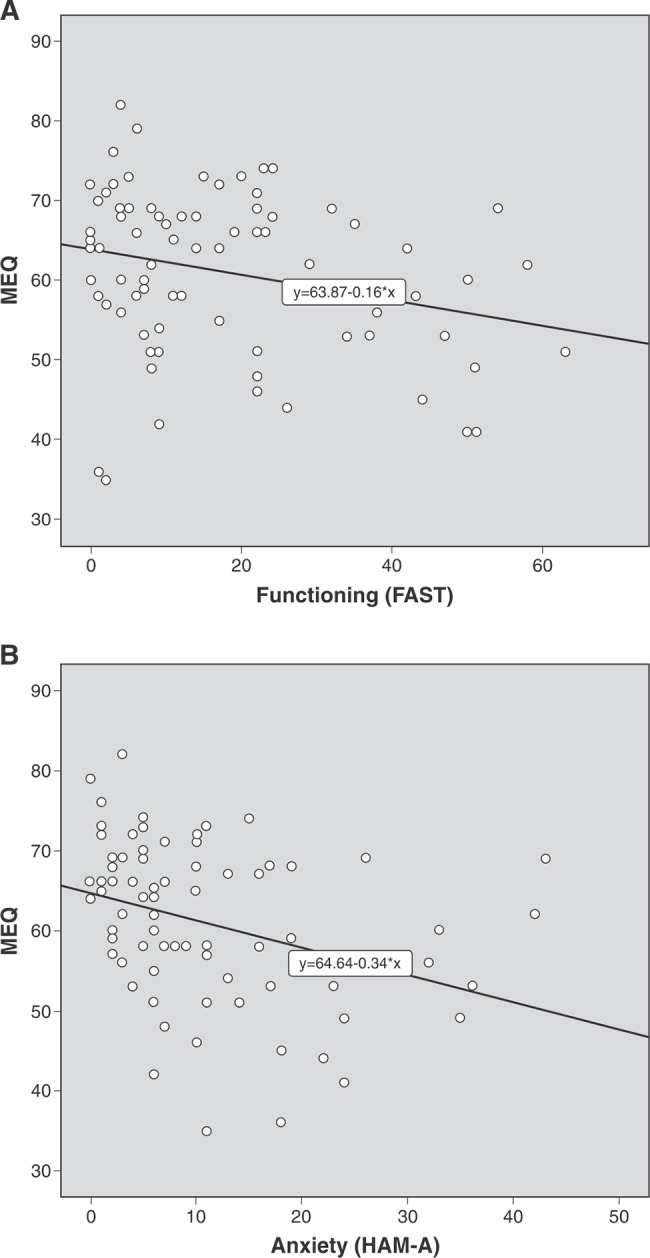
Among the BD patients, 14 (17.5%) were definitely morning type, 35 (43.8%), moderately morning, 27 (33.7%) intermediate (neither) and 4 (5%) moderately evening. Eveningness was associated with obesity or overweight (p = 0.03), greater anxiety (p = 0.002) and better functioning (p = 0.01), as well as with mood episodes (p = 0.04), but not with psychiatric hospitalizations (p = 0.82). This group tended toward depressive episodes (p = 0.06), but not (hypo)mania (p = 0.56).
This study indicated that evening chronotype predicts a poor prognostic for BD. It reinforces the relevance of treating rhythm disruptions even during euthymia to improve patient quality of life and prevent mood episodes.
昼夜节律失调在心境障碍的病因学中起着重要作用。这些患者中经常出现夜间型。然而,关于昼夜型对双相情感障碍(BD)患者情绪症状影响的前瞻性研究得出的结论并不明确。本研究旨在探讨昼夜型与 BD 的预后因素之间的关系。
在基线时,80 名病情稳定的 BD 患者回答了一份人口统计学问卷和临床量表,以评估焦虑、功能和昼夜型。昼夜节律偏好使用 Morningness-Eveningness Questionnaire 进行测量,得分越低表示夜间型。每月评估 18 个月的情绪发作和住院情况。
在 BD 患者中,14 名(17.5%)为明确的晨型,35 名(43.8%)为中度晨型,27 名(33.7%)为中间型(既不是晨型也不是夜型),4 名(5%)为中度夜型。夜型与肥胖或超重有关(p=0.03),与焦虑程度更高(p=0.002)和功能更好有关(p=0.01),与情绪发作有关(p=0.04),但与精神科住院无关(p=0.82)。该组倾向于出现抑郁发作(p=0.06),但不是轻躁狂(p=0.56)。
本研究表明,夜间型昼夜型预示着 BD 的预后不良。它强调了即使在病情稳定时也要治疗节律紊乱,以改善患者的生活质量并预防情绪发作。