Department of Physiology and Biochemistry, The University of Jordan, Amman, Jordan
School of Medicine, The University of Jordan, Amman, Jordan
Turk J Med Sci. 2019 Aug 8;49(4):1047-1053. doi: 10.3906/sag-1812-167.
BACKGROUND/AIM: Autism spectrum disorder (ASD) describes a range of neurodevelopmental disabilities that impair behavior and communication. Although it is relatively prevalent, the pathophysiology is still subject to speculation and debate. The aim of this study is to identify a possible association between interleukin-6, -8, -9, and -10 and tumor necrosis factor alpha (TNF-α) in autism among Jordanian children by comparing the plasma levels of these cytokines in autistic children with those of their unaffected siblings and unrelated healthy controls.
In this study, 80 Jordanian children under the age of 12 with diagnosed autism were selected. For comparison, 51 unaffected siblings and 86 unrelated healthy controls were also recruited. Venous blood was collected and interleukin levels in all three groups were investigated.
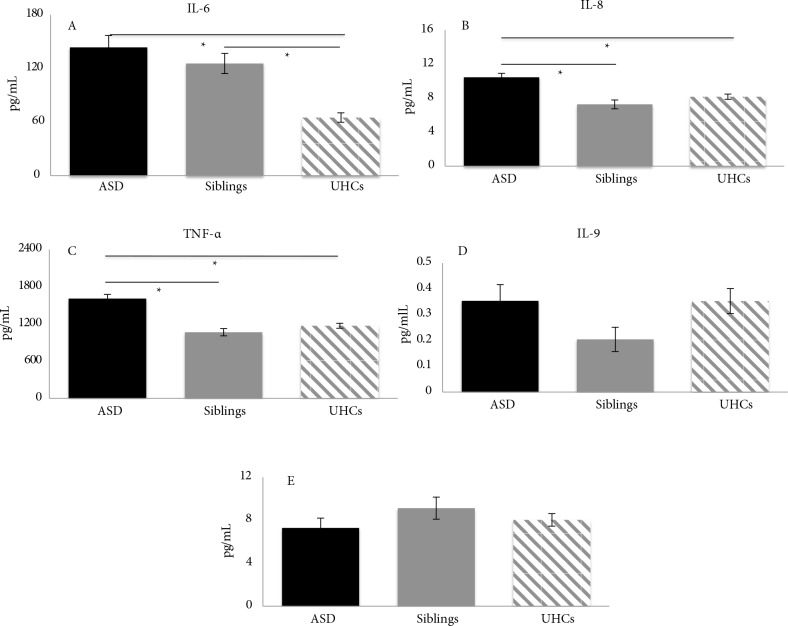
Interleukin-6 was found to be significantly higher in the plasma of both autistic children and their siblings compared with the unrelated healthy control group (P < 0.05). As for interleukin-8 and TNF-α, plasma levels were significantly higher exclusively in autistic children compared to their siblings and unaffected control subjects (P < 0.001, P < 0.001). There was no significant difference between plasma levels of the previously mentioned cytokines in the siblings and the unrelated control group. As for interleukin-9 and interleukin-10, no significant differences were found between all three groups (P = 0.15, P = 0.35).
We found that interleukin-8 and TNF-α were exclusively elevated in autistic Jordanian children, while interleukin-6 was elevated in both autistic children and their siblings, potentially dismissing its significance. These results may lead to a better understanding of the disorder’s pathophysiology, early testing, and diagnosis.
背景/目的:自闭症谱系障碍(ASD)描述了一系列神经发育障碍,这些障碍会损害行为和沟通能力。尽管它相对普遍,但病理生理学仍存在推测和争议。本研究旨在通过比较自闭症儿童与未受影响的兄弟姐妹和无相关健康对照者的血浆中这些细胞因子的水平,来确定白细胞介素-6、-8、-9 和 -10 以及肿瘤坏死因子-α(TNF-α)与约旦儿童自闭症之间的可能关联。
本研究选择了 80 名年龄在 12 岁以下的患有自闭症的约旦儿童。为了进行比较,还招募了 51 名未受影响的兄弟姐妹和 86 名无相关的健康对照者。采集静脉血并研究所有三组的白细胞介素水平。
发现自闭症儿童及其兄弟姐妹的血浆中白细胞介素-6 明显高于无相关健康对照组(P < 0.05)。至于白细胞介素-8 和 TNF-α,仅在自闭症儿童的血浆中,其水平明显高于其兄弟姐妹和未受影响的对照组(P < 0.001,P < 0.001)。在兄弟姐妹和无相关对照组之间,上述细胞因子的血浆水平没有显着差异。至于白细胞介素-9 和白细胞介素-10,三组之间没有发现显着差异(P = 0.15,P = 0.35)。
我们发现白细胞介素-8 和 TNF-α仅在自闭症约旦儿童中升高,而白细胞介素-6 在自闭症儿童及其兄弟姐妹中均升高,可能排除了其意义。这些结果可能有助于更好地了解该疾病的病理生理学、早期检测和诊断。