Department of Medicine, University of Massachusetts Medical School, Worcester, MA, USA.
Singapore Immunology Network, Agency for Science, Technology and Research (A*STAR), Singapore.
EBioMedicine. 2019 Jul;45:314-327. doi: 10.1016/j.ebiom.2019.06.052. Epub 2019 Jul 4.
Mycobacterium tuberculosis has co-evolved with the human host, adapting to exploit the immune system for persistence and transmission. While immunity to tuberculosis (TB) has been intensively studied in the lung and lymphoid system, little is known about the participation of adipose tissues and non-immune cells in the host-pathogen interaction during this systemic disease.
C57BL/6J mice were aerosol infected with M. tuberculosis Erdman and presence of the bacteria and the fitness of the white and brown adipose tissues, liver and skeletal muscle were studied compared to uninfected mice.
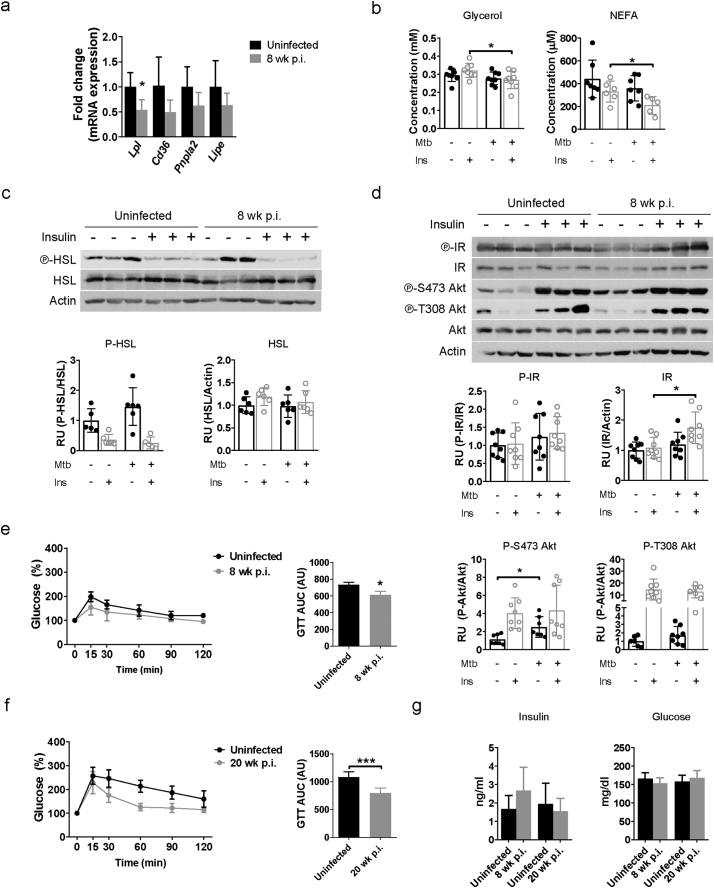
M. tuberculosis infection in mice stimulated immune cell infiltration in visceral, and brown adipose tissue. Despite the absence of detectable bacterial dissemination to fat tissues, adipocytes produced localized pro-inflammatory signals that disrupted adipocyte lipid metabolism, resulting in adipocyte hypertrophy. Paradoxically, this resulted in increased insulin sensitivity and systemic glucose tolerance. Adipose tissue inflammation and enhanced glucose tolerance also developed in obese mice after aerosol M. tuberculosis infection. We found that infection induced adipose tissue Akt signaling, while inhibition of the Akt activator mTORC2 in adipocytes reversed TB-associated adipose tissue inflammation and cell hypertrophy.
Our study reveals a systemic response to aerosol M. tuberculosis infection that regulates adipose tissue lipid homeostasis through mTORC2/Akt signaling in adipocytes. Adipose tissue inflammation in TB is not simply a passive infiltration with leukocytes but requires the mechanistic participation of adipocyte signals.
结核分枝杆菌与人类宿主共同进化,适应了利用免疫系统来保持生存和传播。虽然结核病(TB)的免疫已在肺部和淋巴系统中得到深入研究,但对于脂肪组织和非免疫细胞在全身性疾病期间宿主-病原体相互作用中的参与了解甚少。
C57BL/6J 小鼠用结核分枝杆菌 Erdman 气溶胶感染,与未感染的小鼠相比,研究了细菌的存在以及白色和棕色脂肪组织、肝脏和骨骼肌的适应性。
M. tuberculosis 在小鼠中的感染刺激了内脏和棕色脂肪组织中的免疫细胞浸润。尽管脂肪组织中未检测到细菌扩散,但脂肪细胞产生了局部促炎信号,破坏了脂肪细胞的脂质代谢,导致脂肪细胞肥大。矛盾的是,这导致了胰岛素敏感性和全身葡萄糖耐量的增加。肥胖小鼠经气溶胶 M. tuberculosis 感染后,也出现了脂肪组织炎症和增强的葡萄糖耐量。我们发现感染诱导了脂肪组织 Akt 信号转导,而抑制脂肪细胞中的 Akt 激活剂 mTORC2 则逆转了与 TB 相关的脂肪组织炎症和细胞肥大。
我们的研究揭示了一种全身性的对气溶胶 M. tuberculosis 感染的反应,该反应通过脂肪细胞中的 mTORC2/Akt 信号转导来调节脂肪组织的脂质稳态。TB 中的脂肪组织炎症不仅仅是白细胞的被动浸润,还需要脂肪细胞信号的机制参与。