Panari Chiara, Caricati Luca, Pelosi Annalisa, Rossi Chiara
Department of Economics, University of Parma.
Acta Biomed. 2019 Jul 8;90(6-S):60-67. doi: 10.23750/abm.v90i6-S.8481.
The study aims at identifying the antecedents and consequences of emotional exhaustion in health professionals and, particularly, examining the process that leads from a hindrance demand, like role ambiguity, to exhaustion and job satisfaction. Emotional exhaustion is a phenomenon that affect health professionals with negative consequence on job satisfaction, and literature has underlined that job demands could be may be a cause of this chronic stress. However, the relationship among job demands, work engagement and exhaustion has produced results not always converging.
A self-report questionnaire was administered to 66 health professionals.
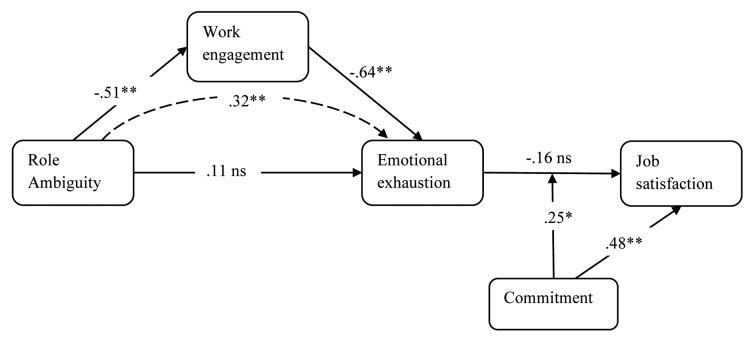
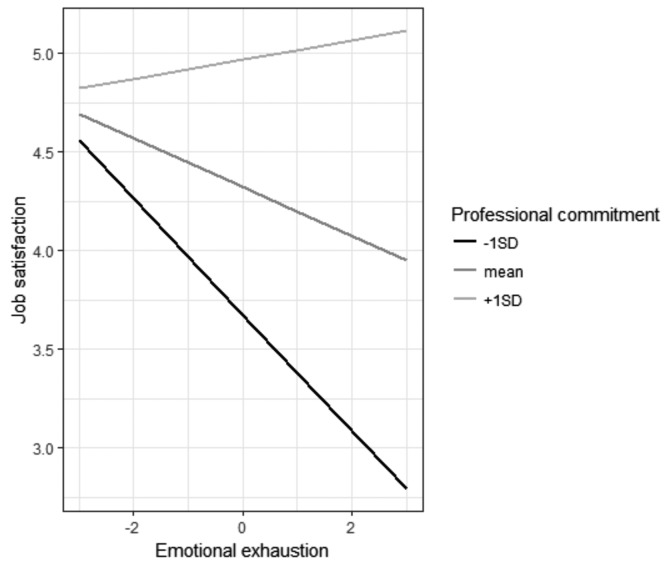
The results showed that the effect of role ambiguity on emotional exhaustion was mediated by work engagement and the emotional exhaustion impairs job satisfaction when workers are not committed to their profession.
Role ambiguity represents a psychosocial risk factor that influence workers' wellbeing diminishing the level of motivation and this process leads to emotional exhaustion. However, professional commitment appears to be a resource that can protect professionals preventing a decrease in satisfaction. These findings suggest that human resource management should remove hindrance stressors and enhance the mission of Healthcare Professionals in order to increase employees' work engagement and prevent exhaustion.
本研究旨在确定卫生专业人员情绪耗竭的前因和后果,特别是研究从诸如角色模糊等阻碍性需求到耗竭和工作满意度的过程。情绪耗竭是一种影响卫生专业人员的现象,会对工作满意度产生负面影响,并且文献强调工作需求可能是这种慢性压力的一个原因。然而,工作需求、工作投入和耗竭之间的关系所产生的结果并不总是一致的。
对66名卫生专业人员进行了一份自填式问卷的调查。
结果表明,角色模糊对情绪耗竭的影响是通过工作投入来介导的,并且当员工对其职业缺乏投入时,情绪耗竭会损害工作满意度。
角色模糊是一种社会心理风险因素,它会影响员工的幸福感,降低动机水平,而这一过程会导致情绪耗竭。然而,职业投入似乎是一种资源,可以保护专业人员防止满意度下降。这些发现表明,人力资源管理应该消除阻碍性压力源,并强化医疗保健专业人员的使命,以提高员工的工作投入并防止耗竭。