Institute of Pharmacology and Toxicology, University of Zürich, Zürich, Switzerland.
Sleep & Health Zürich, University Center of Competence, University of Zürich, Zürich Switzerland.
Sleep. 2019 Oct 21;42(11). doi: 10.1093/sleep/zsz161.
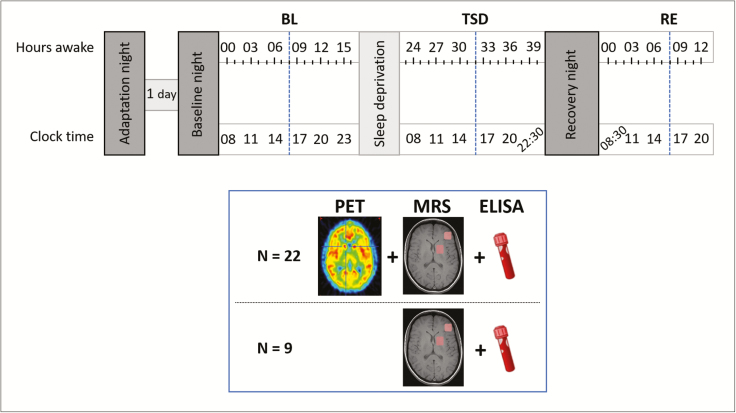
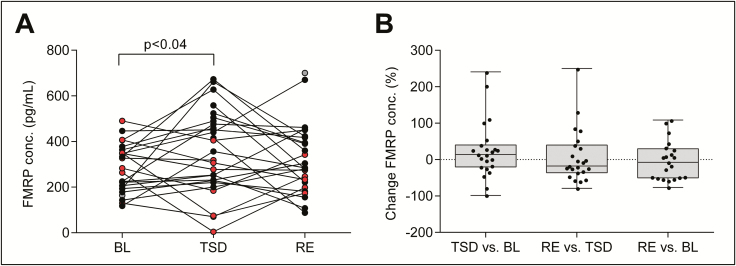
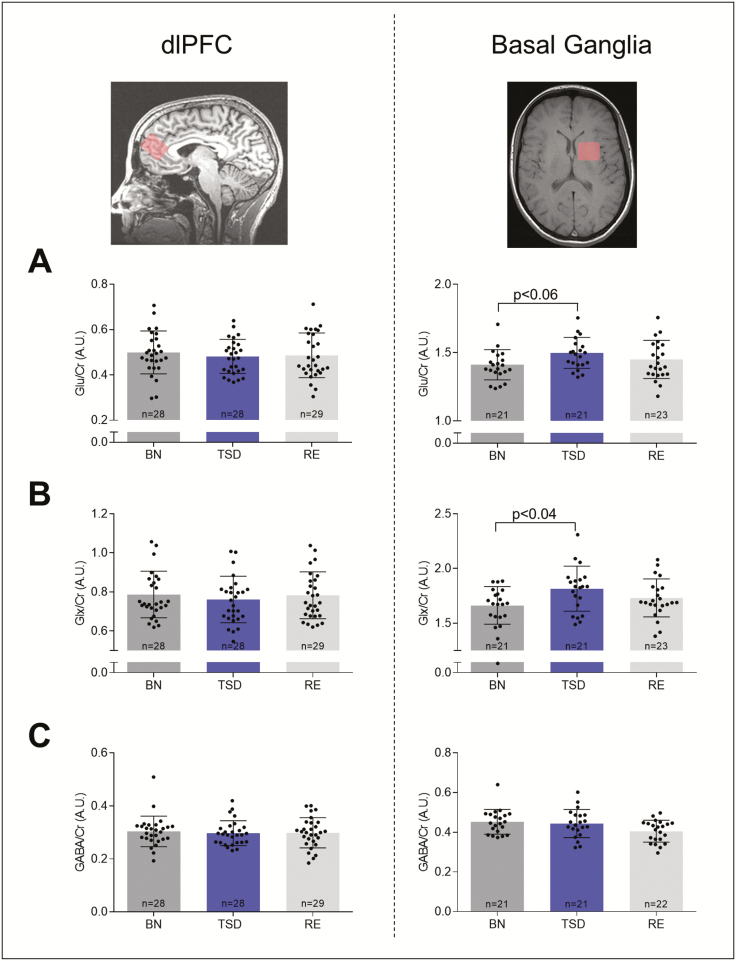
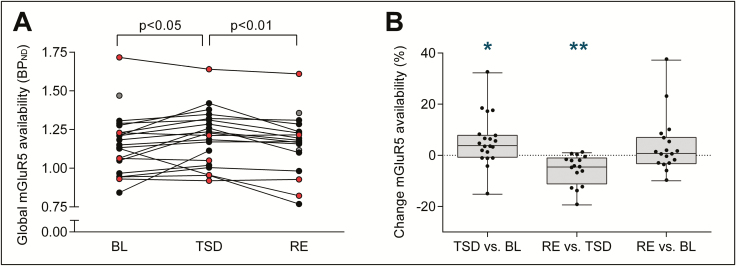
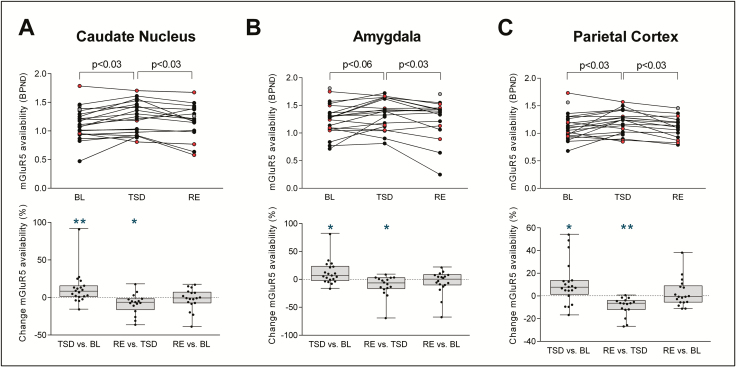
Sleep and brain glutamatergic signaling are homeostatically regulated. Recovery sleep following prolonged wakefulness restores efficient functioning of the brain, possibly by keeping glutamatergic signaling in a homeostatic range. Evidence in humans and mice suggested that metabotropic glutamate receptors of subtype-5 (mGluR5) contribute to the brain's coping mechanisms with sleep deprivation. Here, proton magnetic resonance spectroscopy in 31 healthy men was used to quantify the levels of glutamate (Glu), glutamate-to-glutamine ratio (GLX), and γ-amino-butyric-acid (GABA) in basal ganglia (BG) and dorsolateral prefrontal cortex on 3 consecutive days, after ~8 (baseline), ~32 (sleep deprivation), and ~8 hours (recovery sleep) of wakefulness. Simultaneously, mGluR5 availability was quantified with the novel radioligand for positron emission tomography, [18F]PSS232, and the blood levels of the mGluR5-regulated proteins, fragile X mental retardation protein (FMRP) and brain-derived neurotrophic factor (BDNF) were determined. The data revealed that GLX (p = 0.03) in BG (for Glu: p < 0.06) and the serum concentration of FMRP (p < 0.04) were increased after sleep loss. Other brain metabolites (GABA, N-acetyl-aspartate, choline, glutathione) and serum BDNF levels were not altered by sleep deprivation (pall > 0.6). By contrast, the night without sleep enhanced whole-brain, BG, and parietal cortex mGluR5 availability, which was normalized by recovery sleep (pall < 0.05). The findings provide convergent multimodal evidence that glutamatergic signaling is affected by sleep deprivation and recovery sleep. They support a role for mGluR5 and FMRP in sleep-wake regulation and warrant further studies to investigate their causality and relevance for regulating human sleep in health and disease. Clinical Trial Registration: www.clinicaltrials.gov (study identifier: NCT03813082).
睡眠和大脑谷氨酸能信号传递是受体内平衡调节的。长时间清醒后恢复的睡眠可以使大脑恢复有效功能,这可能是通过将谷氨酸能信号维持在体内平衡范围内来实现的。人类和小鼠的证据表明,代谢型谷氨酸受体 5(mGluR5)有助于大脑应对睡眠剥夺。在这里,质子磁共振波谱法(MRS)在 31 名健康男性中被用于连续 3 天(清醒后约 8 小时(基线)、约 32 小时(睡眠剥夺)和约 8 小时(恢复睡眠))在基底神经节(BG)和背外侧前额叶皮层(DLPFC)中定量谷氨酸(Glu)、谷氨酸-谷氨酰胺比(GLX)和γ-氨基丁酸(GABA)的水平。同时,用新型正电子发射断层扫描(PET)放射性配体[18F]PSS232定量 mGluR5 的可用性,并测定 mGluR5 调节蛋白脆性 X 智力迟钝蛋白(FMRP)和脑源性神经营养因子(BDNF)的血液水平。研究结果表明,BG 中的 GLX(p = 0.03)(对于 Glu:p < 0.06)和血清中 FMRP 浓度(p < 0.04)在睡眠剥夺后增加。其他脑代谢物(GABA、N-乙酰天冬氨酸、胆碱、谷胱甘肽)和血清 BDNF 水平不受睡眠剥夺影响(pall > 0.6)。相反,没有睡眠的夜晚增强了全脑、BG 和顶叶皮层的 mGluR5 可用性,这种改变在恢复睡眠后恢复正常(pall < 0.05)。这些发现提供了多模态证据,表明谷氨酸能信号受睡眠剥夺和恢复睡眠的影响。它们支持 mGluR5 和 FMRP 在睡眠-觉醒调节中的作用,并需要进一步研究来探讨它们在调节健康和疾病中的因果关系和相关性。