Borchert Juliane, Levchuk Ievgen, Snoek Lavina C, Rothmann Mathias Uller, Haver Renée, Snaith Henry J, Brabec Christoph J, Herz Laura M, Johnston Michael B
Department of Physics , University of Oxford , Clarendon Laboratory, Parks Road , Oxford OX1 3PU , United Kingdom.
Materials for Electronics and Energy Technology (i-MEET) , Friedrich-Alexander-Universität Erlangen-Nürnberg , Martensstraße 7 , 91058 Erlangen , Germany.
ACS Appl Mater Interfaces. 2019 Aug 14;11(32):28851-28857. doi: 10.1021/acsami.9b07619. Epub 2019 Jul 30.
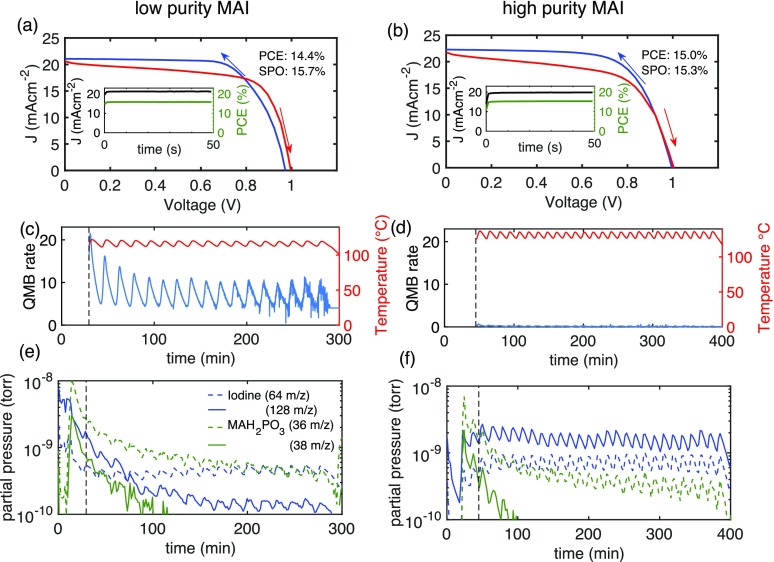
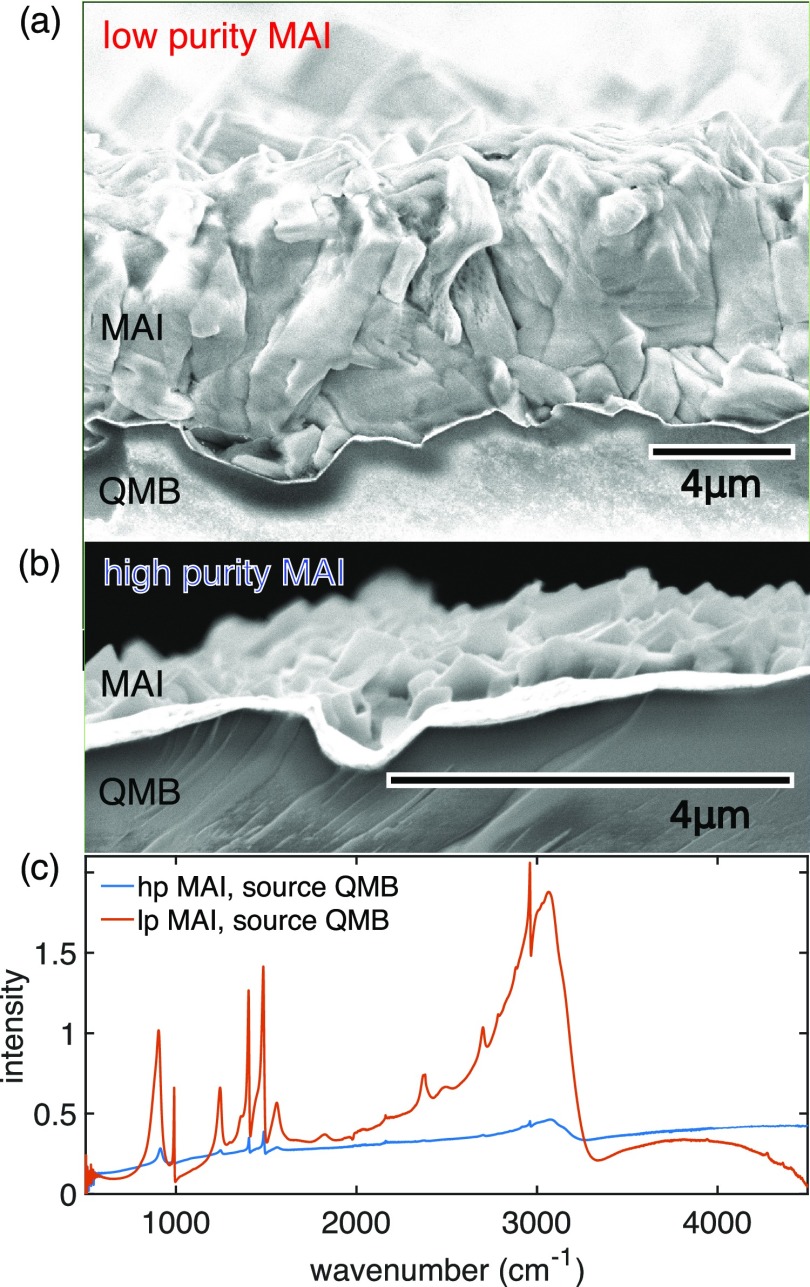
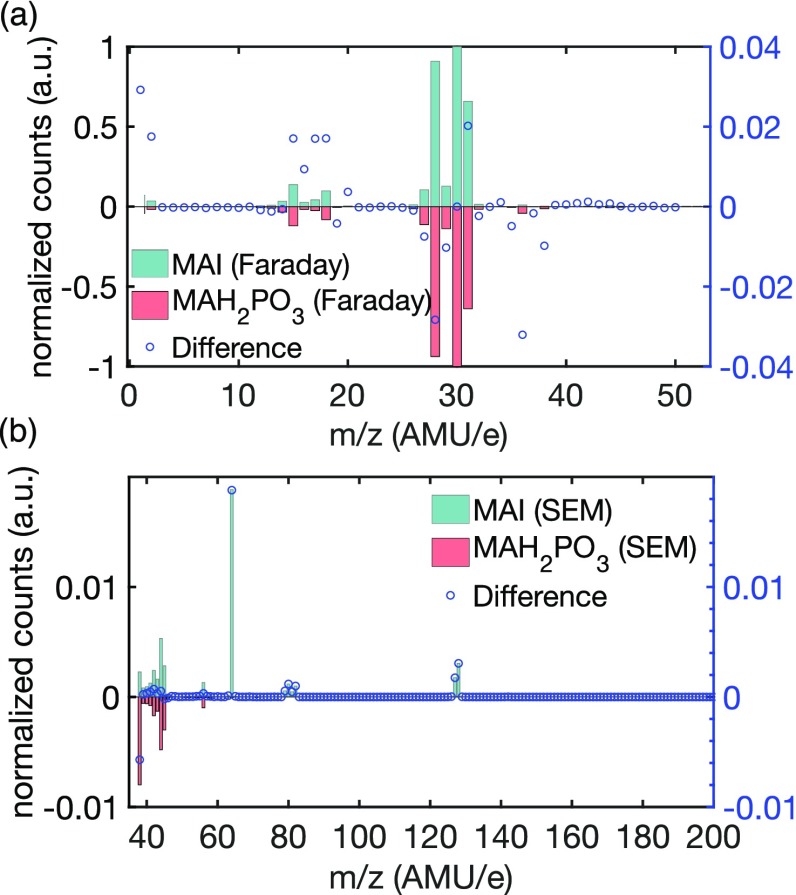
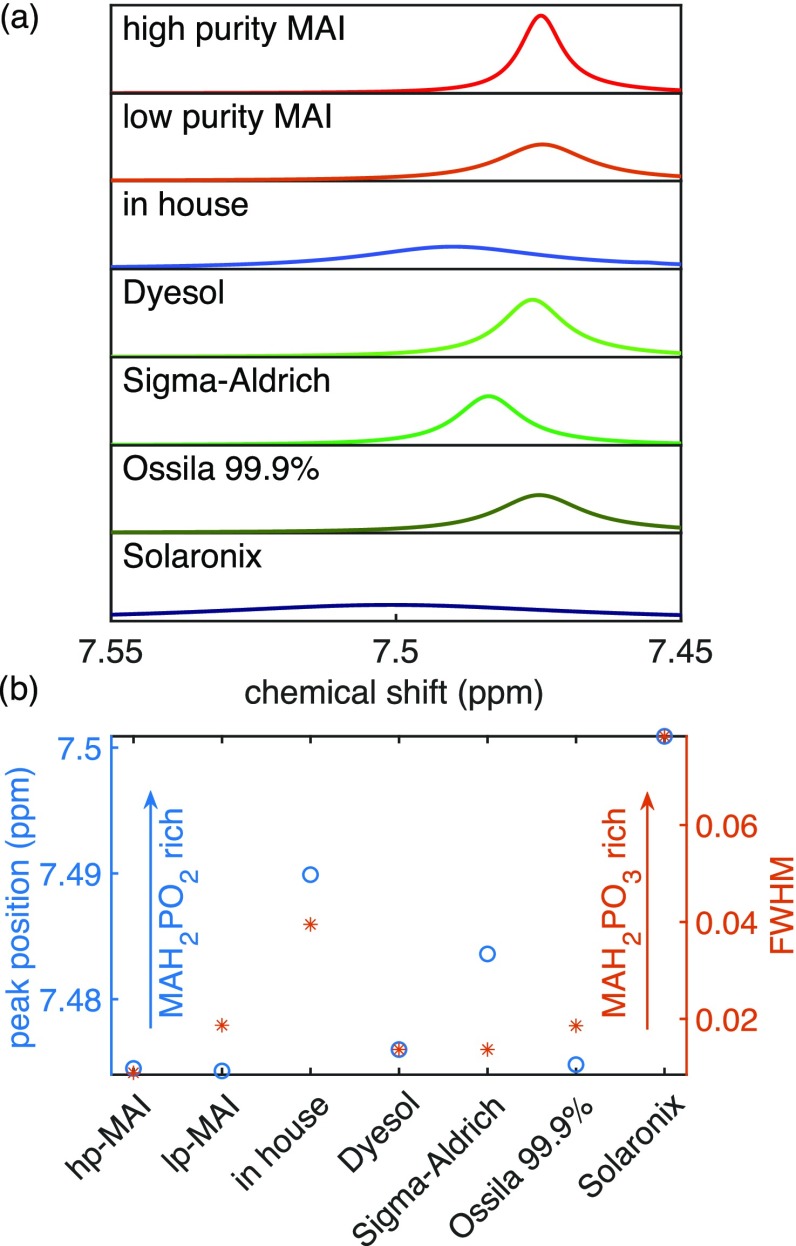
Metal halide perovskite semiconductors have the potential to enable low-cost, flexible, and efficient solar cells for a wide range of applications. Physical vapor deposition by co-evaporation of precursors is a method that results in very smooth and pinhole-free perovskite thin films and allows excellent control over film thickness and composition. However, for a deposition method to become industrially scalable, reproducible process control and high device yields are essential. Unfortunately, to date, the control and reproducibility of evaporating organic precursors such as methylammonium iodide (MAI) have proved extremely challenging. We show that the established method of controlling the evaporation rate of MAI with quartz microbalances (QMBs) is critically sensitive to the concentration of the impurities MAHPO and MAHPO that are usually present in MAI after synthesis. Therefore, controlling the deposition rate of MAI with QMBs is unreliable since the concentration of such impurities typically varies from one batch of MAI to another and even during the course of a deposition. However once reliable control of MAI deposition is achieved, we find that the presence of precursor impurities during perovskite deposition does not degrade the solar cell performance. Our results indicate that as long as precursor deposition rates are well controlled, physical vapor deposition will allow high solar cell device yields even if the purity of precursors changes from one run to another.
金属卤化物钙钛矿半导体有潜力实现低成本、柔性且高效的太阳能电池,适用于广泛的应用。通过前驱体共蒸发进行物理气相沉积是一种能得到非常光滑且无针孔的钙钛矿薄膜的方法,并且能对薄膜厚度和成分进行出色的控制。然而,对于一种沉积方法要实现工业规模可扩展性,可重复的工艺控制和高器件成品率至关重要。不幸的是,迄今为止,蒸发有机前驱体如甲基碘化铵(MAI)的控制和可重复性已被证明极具挑战性。我们表明,用石英微量天平(QMB)控制MAI蒸发速率的既定方法对合成后MAI中通常存在的杂质MAHPO和MAHPO的浓度极为敏感。因此,用QMB控制MAI的沉积速率是不可靠的,因为此类杂质的浓度通常在一批MAI与另一批之间甚至在沉积过程中都会变化。然而,一旦实现了对MAI沉积的可靠控制,我们发现钙钛矿沉积过程中前驱体杂质的存在并不会降低太阳能电池的性能。我们的结果表明,只要前驱体沉积速率得到良好控制,即使前驱体的纯度在一次运行与另一次运行之间有所变化,物理气相沉积也将实现高太阳能电池器件成品率。