Florez-Cuadros Melina, Berkebile Dennis, Brewer Gary, Taylor David B
Department of Entomology, University of Nebraska - Lincoln, Lincoln, NE 68583-0816, USA.
Current affiliation: Centro Integral de Investigaciones (CIVIF), Leticia, Amazonas, Colombia.
Insects. 2019 Jul 16;10(7):207. doi: 10.3390/insects10070207.
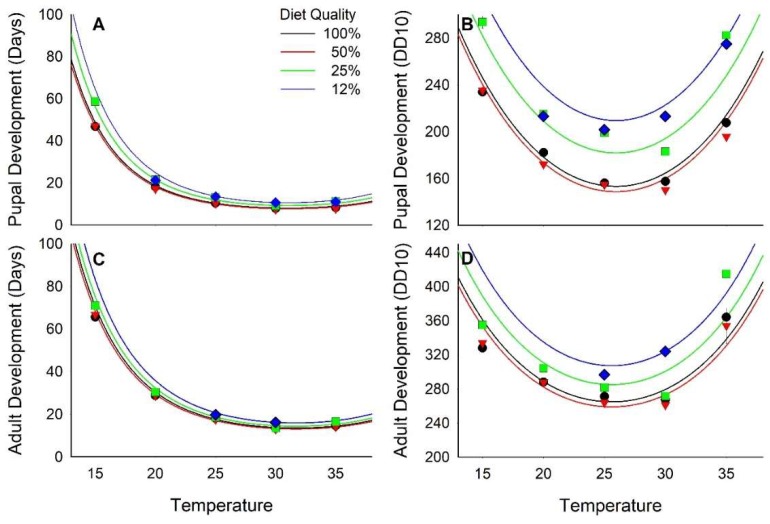
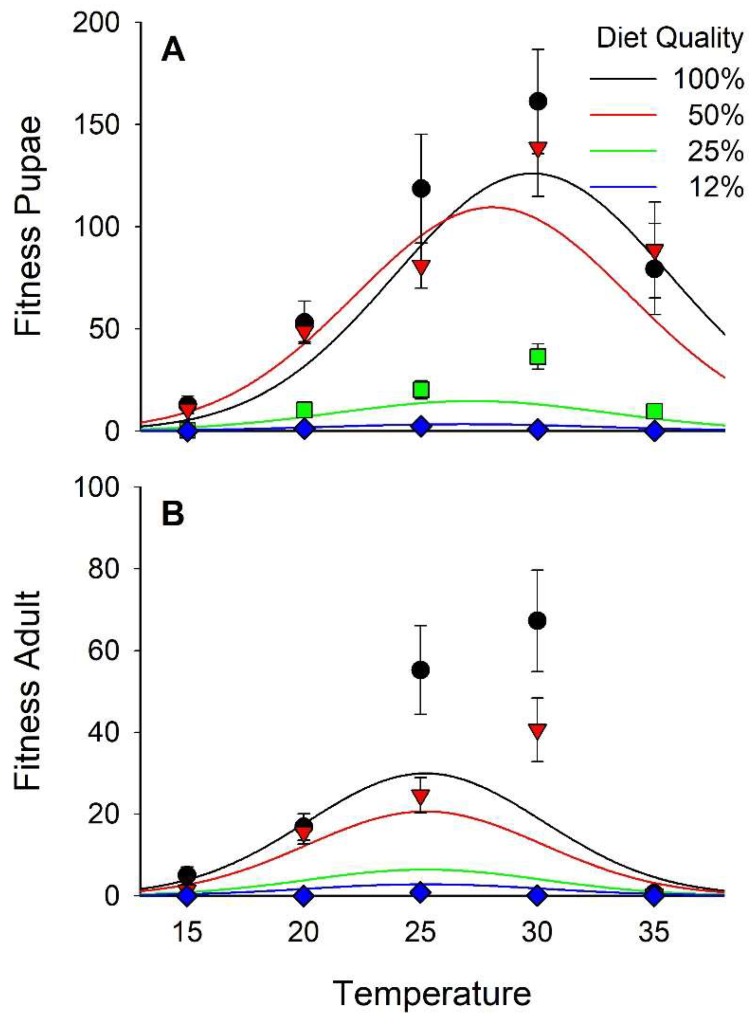
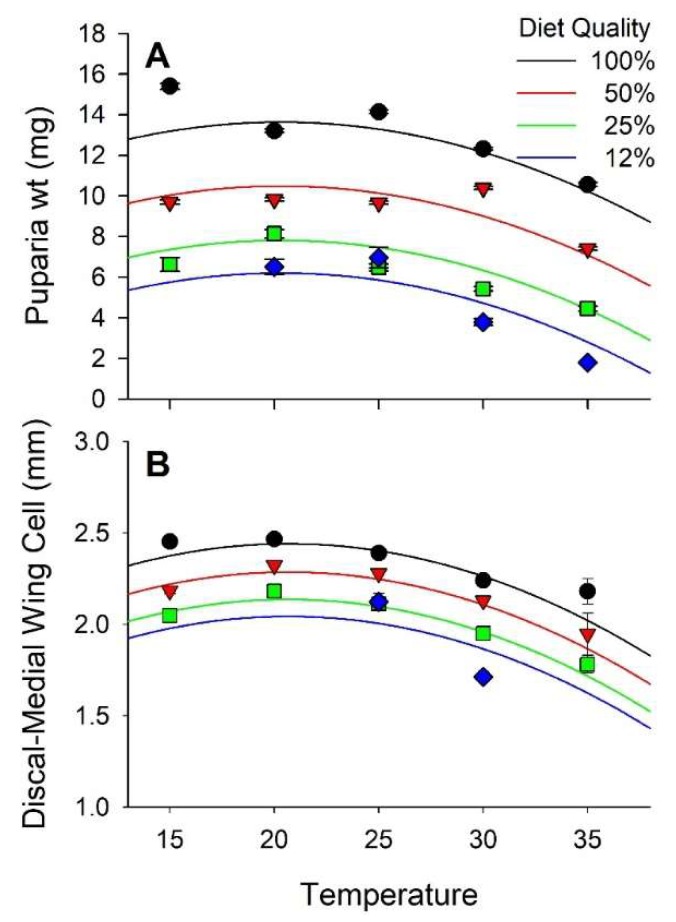
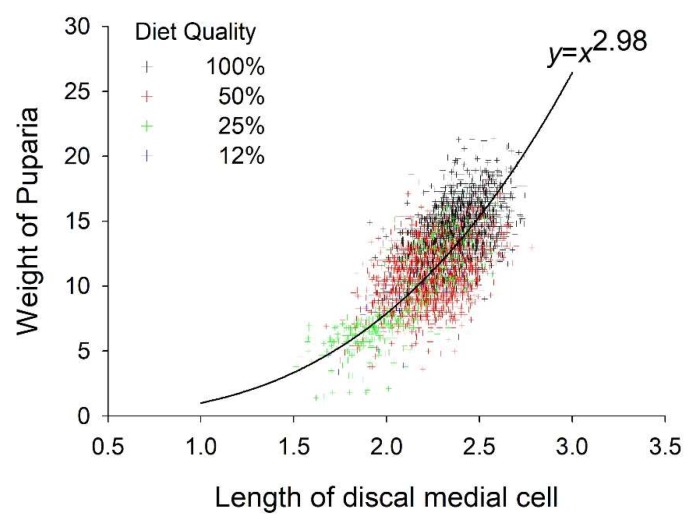
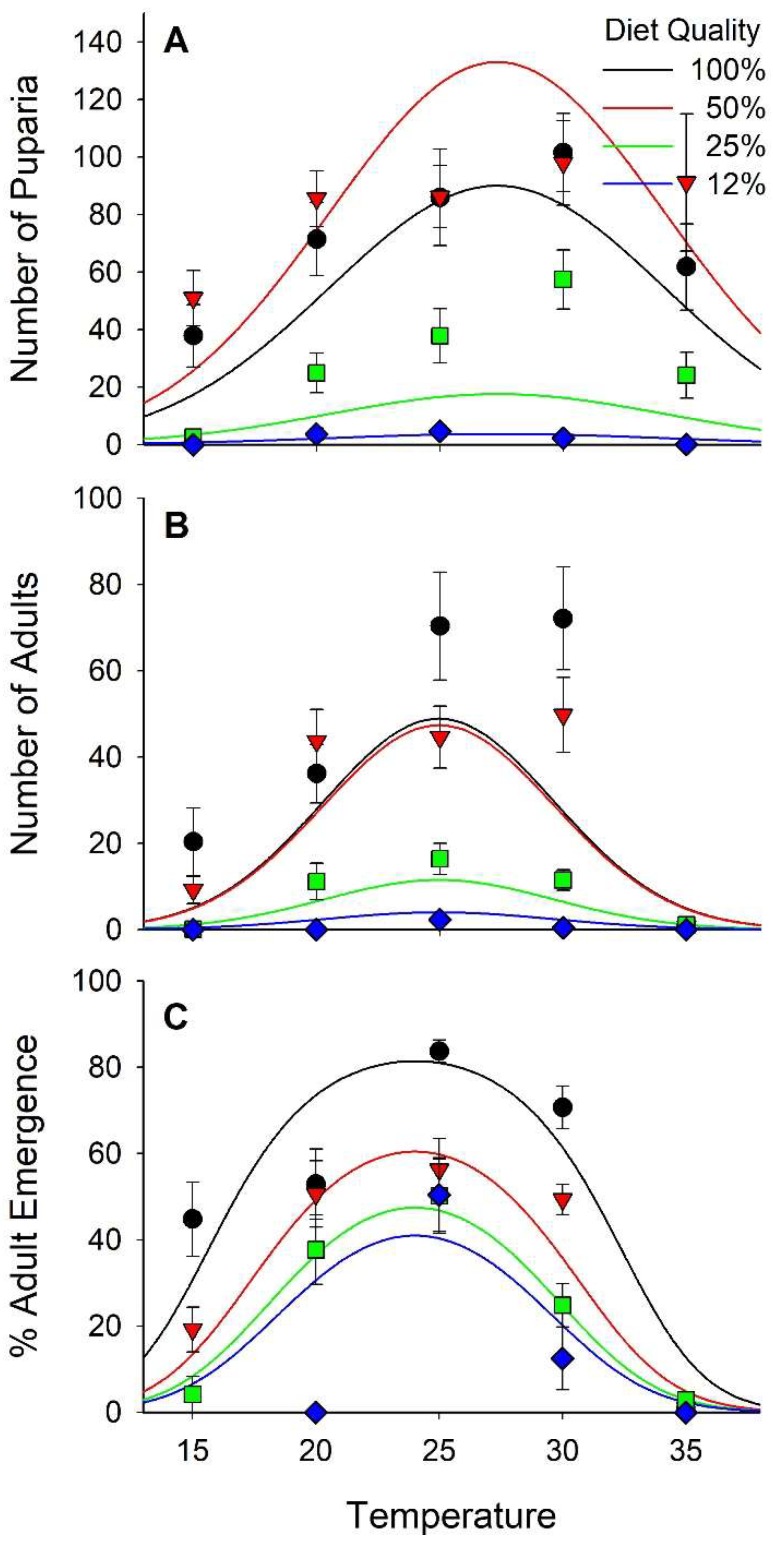
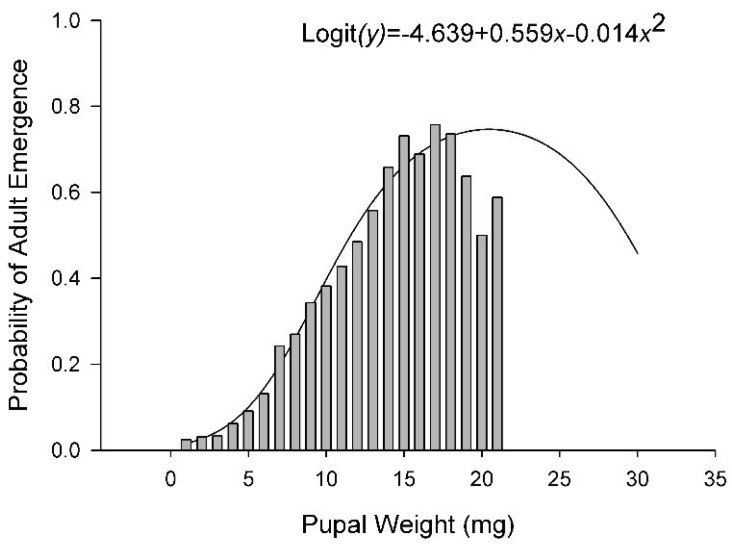
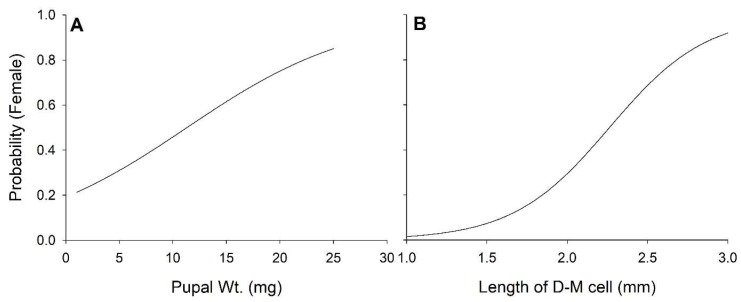
The effects of diet quality and temperature on the development time and size of stable flies, (L.), was evaluated. Both development time and size varied relative to diet quality and temperature, and their effects were additive. Diet quality and temperature made similar contributions to the variance in size whereas temperature was responsible for >97% of the variance in development time. Regression analysis predicted the shortest development time, egg to adult, to be 12.7 days at 32 °C and 70% nutrients. Egg to adult development varied curvilinearly relative to diet quality and temperature on the degree day 10 (DD) scale taking 261 DD at 30 °C and 50% nutrients. The thermal threshold was 11.5 °C with a thermal constant of 248. Very few stable flies developed to adult on the poorest diet (12.5% nutrients) and adults emerged from fewer than 1% of the puparia at 35 °C. The heaviest pupae (15.4 mg) were produced with the 100% diet at 15 °C and adults had a higher probability of emerging successfully from heavier puparia. The length of the discal-medial cell of adult wings had a cubic relationship with puparia weight and peaked at 21 °C. Egg to pupariation survival was predicted to peak at 27 °C and 71% diet whereas puparia to adult survival peaked at 24 °C and 100% diet. Diet quality and temperature had no effect on sex ratio and the rate of development did not differ between the sexes. Female stable flies were ≈5% larger than males. Composite metrics for egg to pupariation and egg to adult fitness were developed. The optimum for puparia fitness was 29 °C and 78% diet quality and for adult fitness 25 °C and 83% diet quality. Diet accounted for 31% of the variance in pupal fitness and 24% of the variance in adult fitness whereas temperature accounted for 17% and 20%, respectively.
评估了饮食质量和温度对厩螫蝇(Stomoxys calcitrans (L.))发育时间和大小的影响。发育时间和大小均随饮食质量和温度而变化,且二者的影响是相加的。饮食质量和温度对大小差异的贡献相似,而温度则导致了发育时间差异的97%以上。回归分析预测,从卵到成虫的最短发育时间在32℃和70%营养水平下为12.7天。在度日10(DD)尺度上,从卵到成虫的发育随饮食质量和温度呈曲线变化,在30℃和50%营养水平下需要261 DD。热阈值为11.5℃,热常数为248。在最差的饮食(12.5%营养)条件下,很少有厩螫蝇发育为成虫,在35℃时,成虫从不到1%的蛹中羽化而出。在15℃下,100%的饮食产生的蛹最重(15.4毫克),较重的蛹羽化出成虫的成功率更高。成虫翅膀盘状中细胞的长度与蛹重呈三次关系,在21℃时达到峰值。从卵到化蛹的存活率预计在27℃和71%的饮食条件下达到峰值,而从蛹到成虫的存活率在24℃和100%的饮食条件下达到峰值。饮食质量和温度对性别比例没有影响,两性之间的发育速度没有差异。雌性厩螫蝇比雄性大约大5%。制定了从卵到化蛹和从卵到成虫适合度的综合指标。蛹适合度的最佳条件是29℃和78%的饮食质量,成虫适合度的最佳条件是25℃和83%的饮食质量。饮食分别占蛹适合度差异的31%和成虫适合度差异的24%,而温度分别占17%和20%。