Department of Respiratory Medicine, Nottingham University Hospitals NHS Trust, Nottingham, United Kingdom.
Division of Epidemiology and Public Health, University of Nottingham, Nottingham, United Kingdom.
PLoS One. 2019 Jul 18;14(7):e0220204. doi: 10.1371/journal.pone.0220204. eCollection 2019.
To summarise and quantify the effect of tobacco smoking on the risk of developing community acquired pneumonia (CAP) in adults.
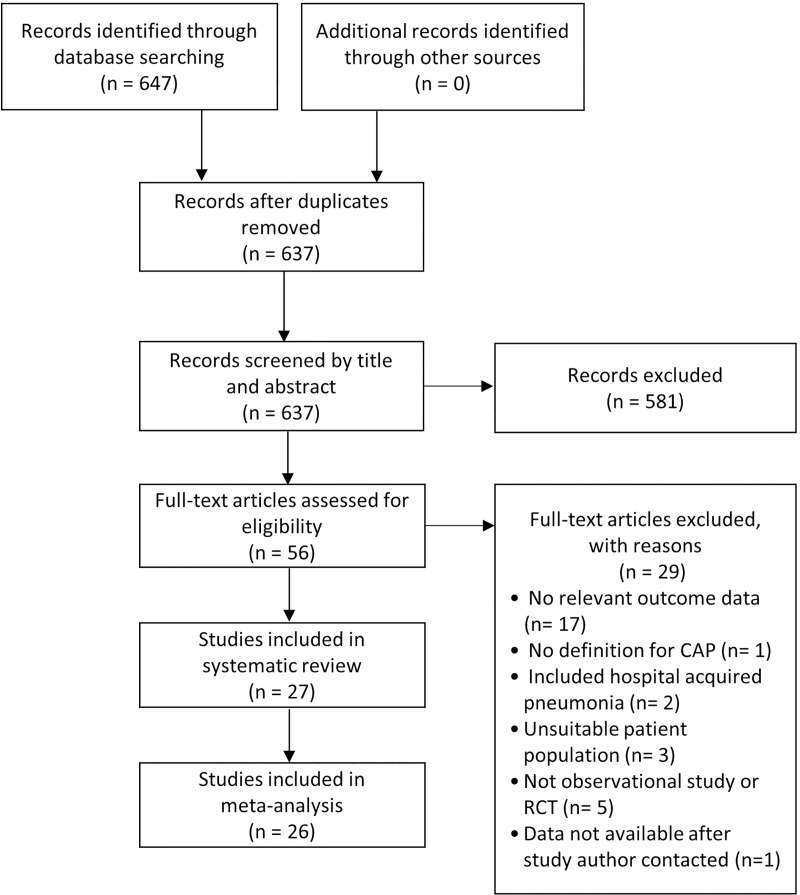
We systematically searched MEDLINE, Embase, CINAHL, PsychINFO and Web of Science, from inception to October 2017, to identify case-control and cohort studies and reported in accordance with the Preferred Reporting Items for Systematic Reviews and Meta-Analysis (PRISMA) checklist. The review protocol was registered with the PROSPERO database (CRD42018093943). Study quality was assessed by the Newcastle-Ottawa Scale. Pooled odds ratios (ORs) or hazard ratios (HRs) were estimated using a random-effects model.
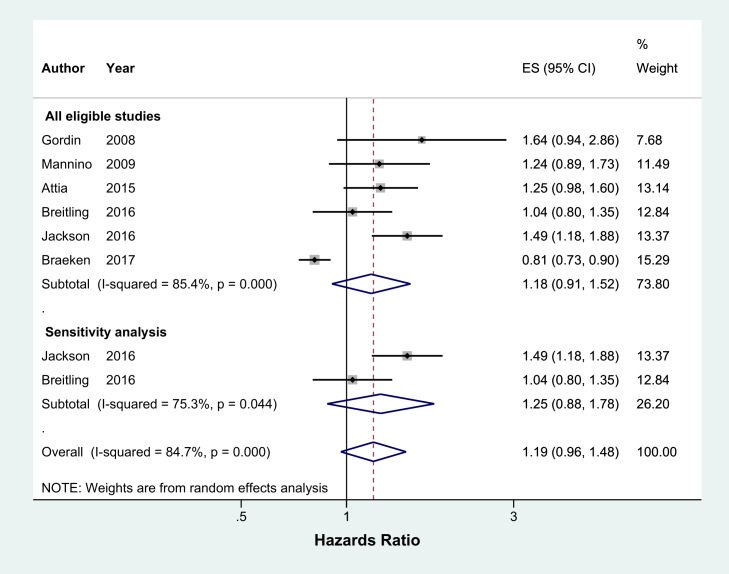
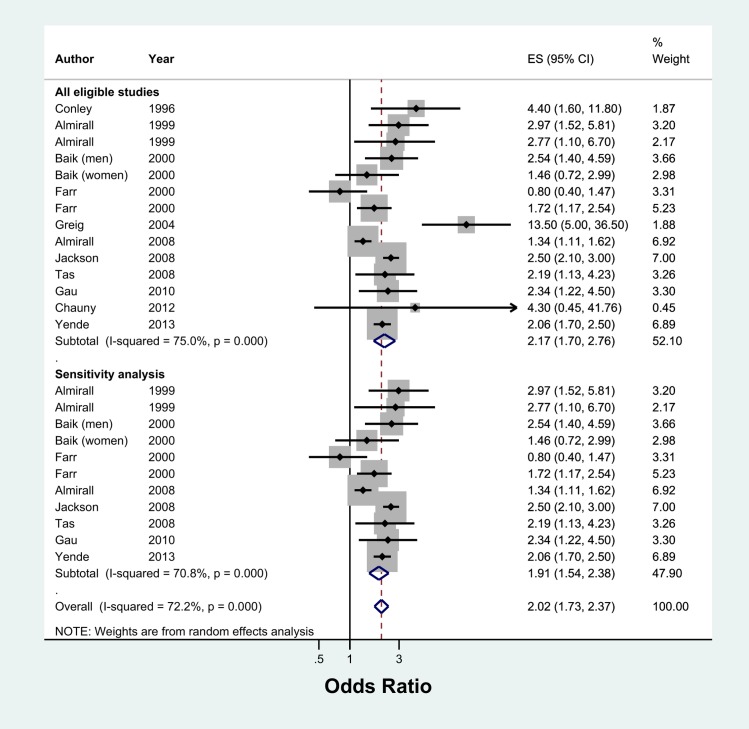
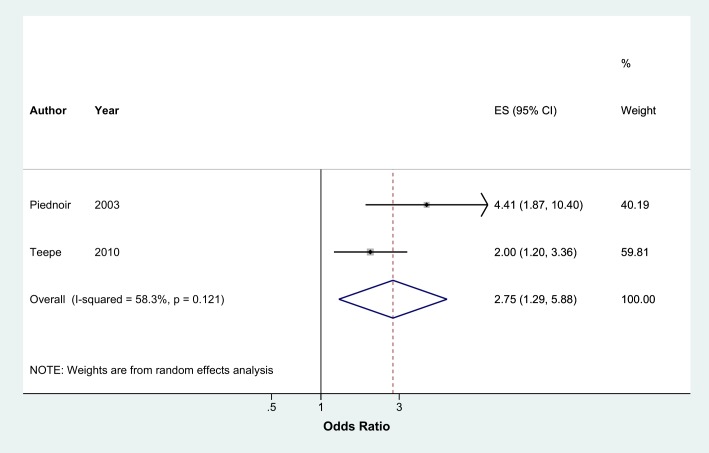
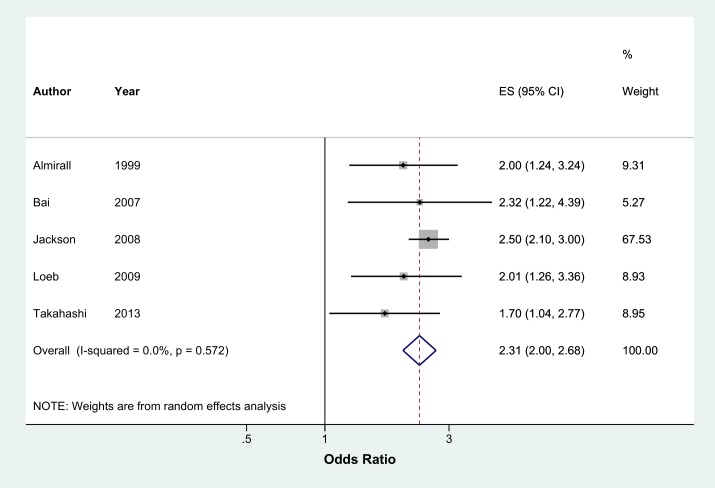
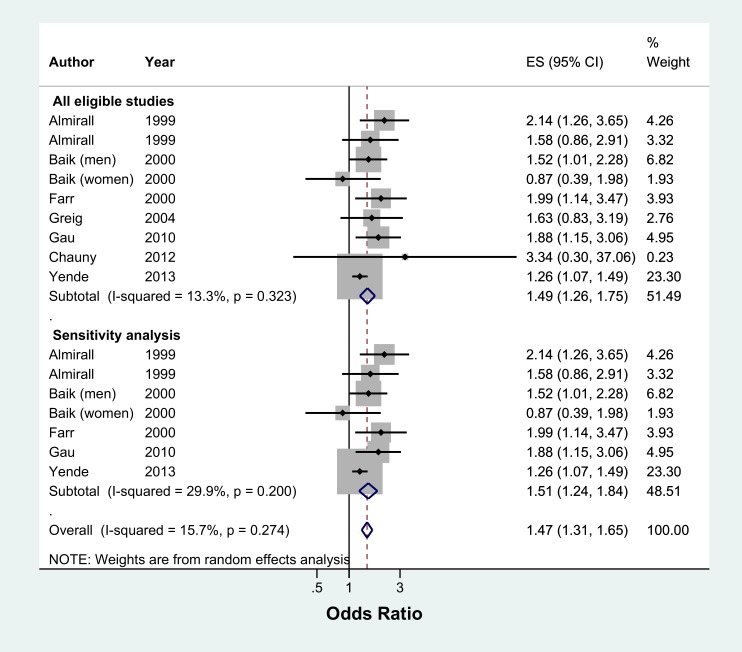
Of 647 studies identified, 27 studies were included (n = 460,592 participants) in the systematic review. Most of the included studies were of moderate quality with a median score of six (IQR 6-7). Meta-analysis showed that current smokers (pooled OR 2.17, 95% CI 1.70-2.76, n = 13 studies; pooled HR 1.52, 95% CI 1.13-2.04, n = 7 studies) and ex-smokers (pooled OR 1.49, 95% CI 1.26-1.75, n = 8 studies; pooled HR 1.18, 95% CI 0.91-1.52, n = 6 studies) were more likely to develop CAP compared to never smokers. Although the association between passive smoking and risk of CAP in adults of all ages was not statistically significant (pooled OR 1.13, 95% CI 0.94-1.36, n = 5 studies), passive smoking in adults aged ≥65 years was associated with a 64% increased risk of CAP (pooled OR 1.64; 95% CI 1.17-2.30, n = 2 studies). Dose-response analyses of data from five studies revealed a significant trend; current smokers who smoked higher amount of tobacco had a higher risk of CAP.
Tobacco smoke exposure is significantly associated with the development of CAP in current smokers and ex-smokers. Adults aged > 65 years who are passive smokers are also at higher risk of CAP. For current smokers, a significant dose-response relationship is evident.
总结和量化吸烟对成年人社区获得性肺炎(CAP)发病风险的影响。
我们系统地检索了 MEDLINE、Embase、CINAHL、PsychINFO 和 Web of Science,从建库到 2017 年 10 月,以确定病例对照和队列研究,并按照系统评价和荟萃分析的首选报告项目(PRISMA)清单进行报告。该综述方案已在 PROSPERO 数据库(CRD42018093943)中注册。使用纽卡斯尔-渥太华量表评估研究质量。使用随机效应模型估计合并的优势比(OR)或风险比(HR)。
在 647 项研究中,有 27 项研究(n=460592 名参与者)被纳入系统评价。大多数纳入的研究质量中等,中位数评分为 6 分(IQR 6-7 分)。荟萃分析显示,当前吸烟者(合并 OR 2.17,95%CI 1.70-2.76,n=13 项研究;合并 HR 1.52,95%CI 1.13-2.04,n=7 项研究)和曾经吸烟者(合并 OR 1.49,95%CI 1.26-1.75,n=8 项研究;合并 HR 1.18,95%CI 0.91-1.52,n=6 项研究)比从不吸烟者更容易患 CAP。虽然所有年龄段成年人被动吸烟与 CAP 风险之间的关联没有统计学意义(合并 OR 1.13,95%CI 0.94-1.36,n=5 项研究),但≥65 岁的成年人被动吸烟与 CAP 风险增加 64%相关(合并 OR 1.64;95%CI 1.17-2.30,n=2 项研究)。五项研究的数据进行的剂量-反应分析显示出显著的趋势;吸烟量较高的当前吸烟者患 CAP 的风险更高。
吸烟暴露与当前吸烟者和曾经吸烟者 CAP 的发生显著相关。≥65 岁的被动吸烟成年人患 CAP 的风险也更高。对于当前吸烟者,存在显著的剂量-反应关系。