Department of Environment and Forest Engineering, School of Engineering and Applied Science, National University of Mongolia, Ulaanbaatar 210646, Mongolia.
Department of Transdisciplinary Science and Engineering, School of Environment and Society, Tokyo Institute of Technology, Tokyo 145-0066, Japan.
Int J Environ Res Public Health. 2019 Jul 17;16(14):2552. doi: 10.3390/ijerph16142552.
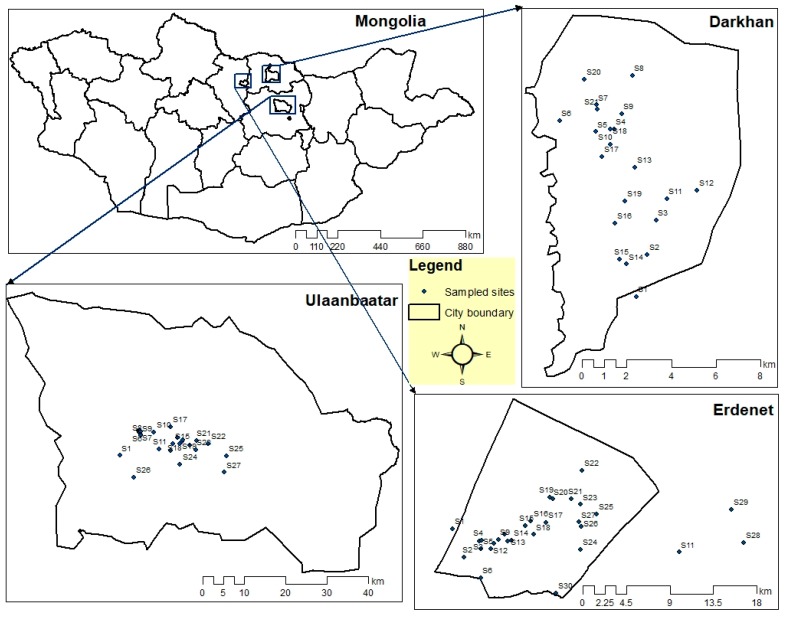
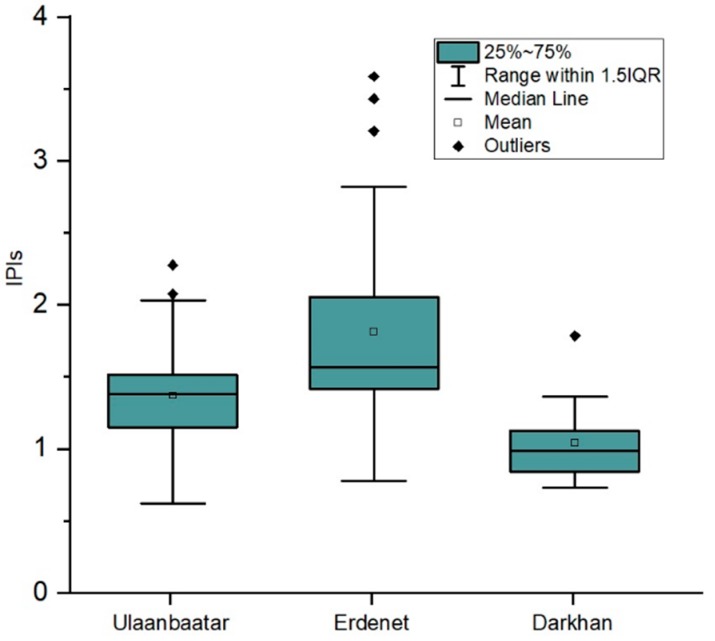
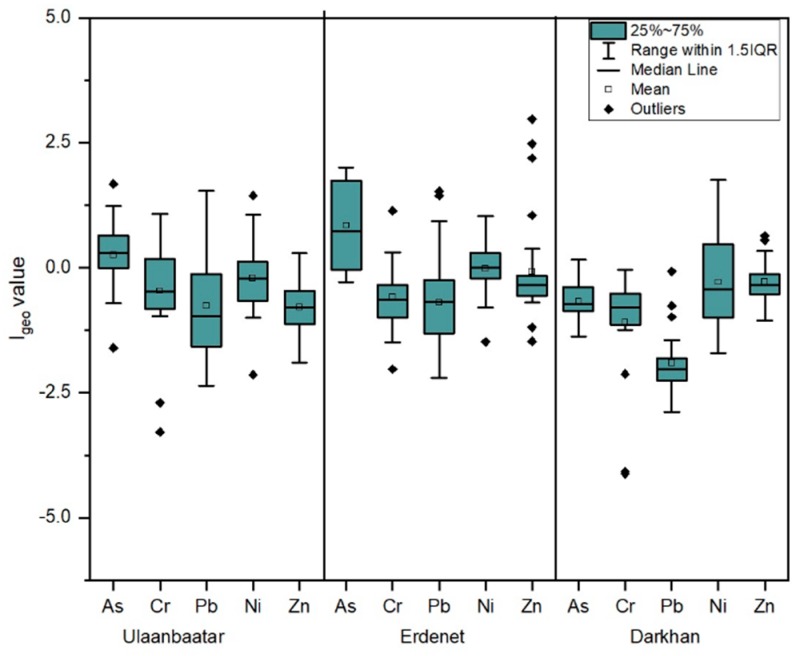
Using the case of Ulaanbaatar, Erdenet, and Darkhan cities from Mongolia, the study aimed to assess the contamination level and health risk assessment of heavy metals (As, Cr, Pb, Ni, and Zn) in urban soil. A total of 78 samples was collected from a variety of functional areas. The geoaccumulation index (I) and integrated pollution index (IPI) were used in pollution assessment, while the health risk was scored using a hazard quotient () and health index (HI) for non-carcinogenic heavy metals, as well as a lifetime average daily dose () for carcinogenic heavy metals. The results show that the concentration of heavy metals in the soil samples taken from Darkhan city, which presented "uncontaminated" values in terms of I for all metals, was relatively lower than other cities within the contamination assessment. Furthermore, the I value signified "uncontimated to heavily contaminated" soil in the Ulaanbaatar and Erdenet cities. Typically, as for the IPI that observed similar trends with I, the mean IPI values in Ulaanbaatar, Erdenet, and Darkhan were 1.33 (moderate level of pollution), 1.83 (moderate level of pollution), and 0.94 (low level of pollution), respectively. In terms of the assessment of potential health risk, there was a particular or different level of ingestion, dermal contact, and inhalation exposure pathway for human health. Among these three different pathways, the ingestion was estimated by the main contributor for health risk. Each value of HQ and HI indicated that soil heavy metals of studied cities were at a safe level (<1) or had the absence of a significant health risk there. In addition, the potential health risk for children was greater than for adults, where heavy metal values of HI for children had a high value compared to adults. We estimated carcinogenic risks through the inhalation exposure, and as a result, there were no significant risks for human health in the studied cities from three elements (As, Cr, and Ni).
利用蒙古乌兰巴托、额尔登特和达尔汗三市的案例,本研究旨在评估城市土壤中重金属(砷、铬、铅、镍和锌)的污染水平和健康风险评估。共采集了来自不同功能区的 78 个样本。采用地积累指数(I)和综合污染指数(IPI)进行污染评估,同时采用非致癌重金属的危害商(HQ)和健康指数(HI)以及致癌重金属的终生平均日剂量(D)对健康风险进行评分。结果表明,在所评估的污染范围内,达尔汗市土壤样本中重金属浓度相对较低,表明该地区所有金属的 I 值均为“无污染”。此外,乌兰巴托和额尔登特市的 I 值表明土壤处于“无污染至重度污染”状态。通常情况下,与 I 具有相似趋势的 IPI 也表明,乌兰巴托、额尔登特和达尔汗的平均 IPI 值分别为 1.33(中度污染水平)、1.83(中度污染水平)和 0.94(低度污染水平)。就潜在健康风险评估而言,人类健康存在特定或不同程度的摄入、皮肤接触和吸入暴露途径。在这三种不同的途径中,摄食被认为是健康风险的主要贡献者。HQ 和 HI 的每个值都表明研究城市的土壤重金属处于安全水平(<1)或不存在显著的健康风险。此外,儿童的潜在健康风险大于成人,儿童的 HI 值重金属值高于成人。我们通过吸入暴露估计了致癌风险,结果表明,在所研究的三个城市中,人类健康没有受到这三种元素(砷、铬和镍)的显著风险。