Department of Dermatology and Venereology, The First Affiliated Hospital of Nanjing Medical University, Nanjing, Jiangsu 210029, P.R. China.
Department of Biochemistry and Molecular Biology, Nanjing Medical University, Nanjing, Jiangsu 210029, P.R. China.
Mol Med Rep. 2019 Sep;20(3):2294-2302. doi: 10.3892/mmr.2019.10450. Epub 2019 Jul 1.
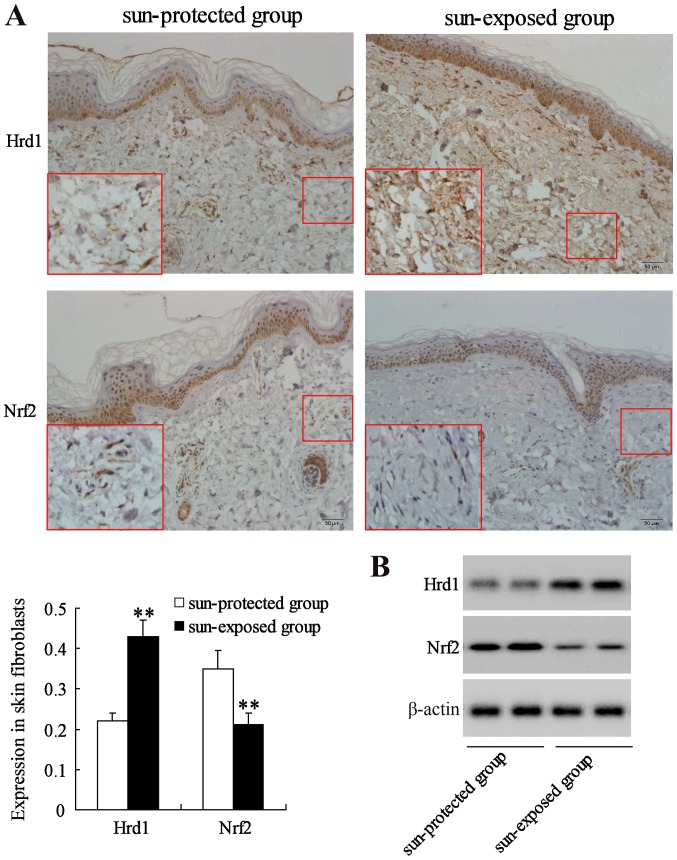
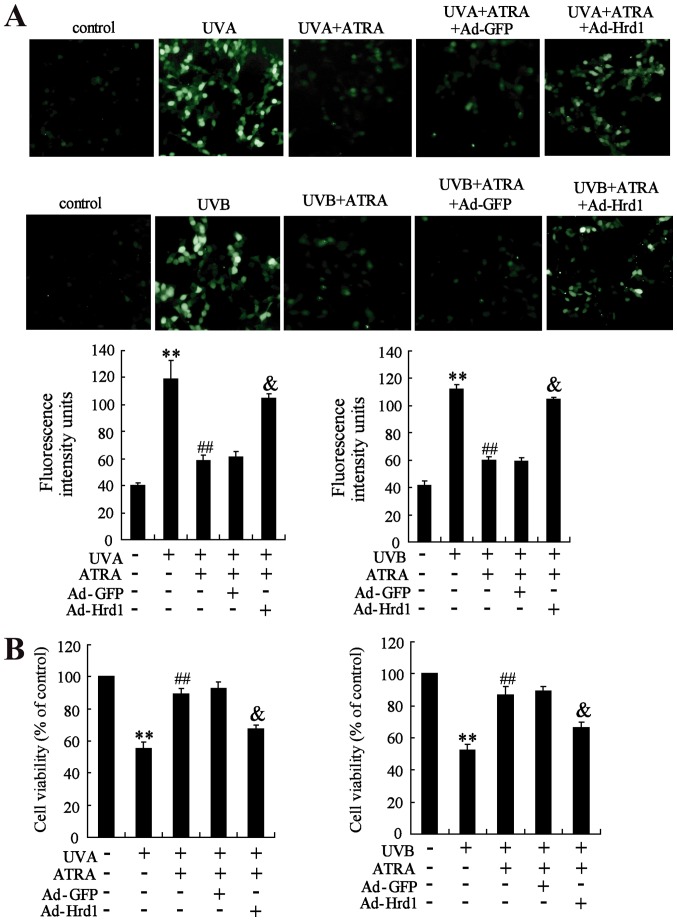
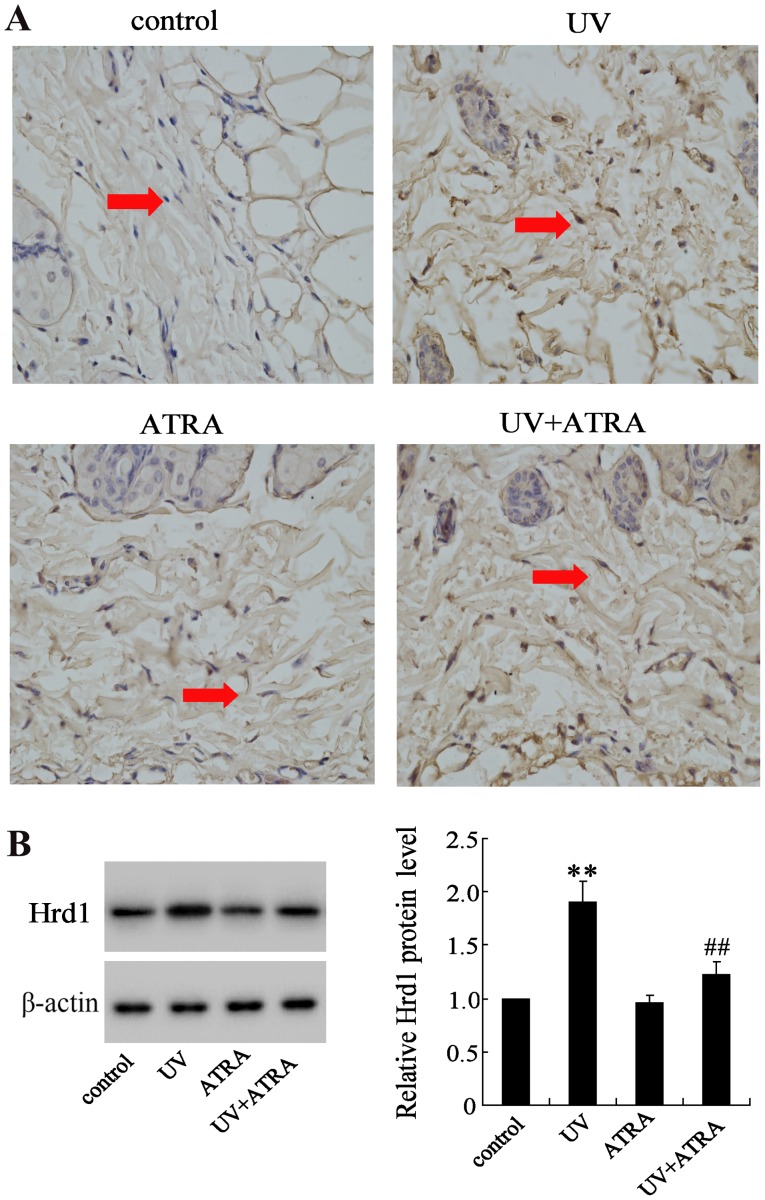
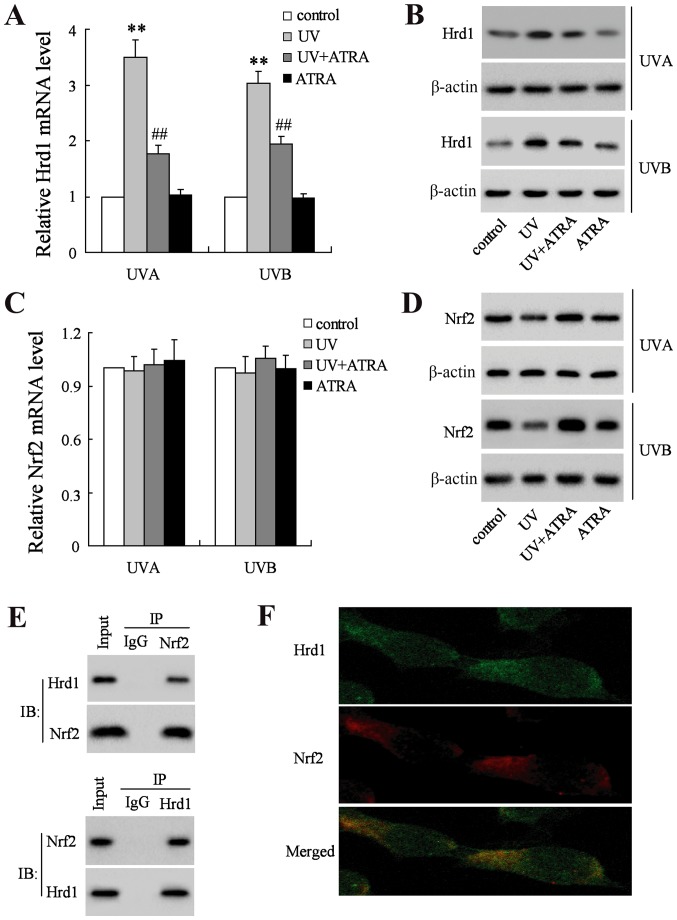
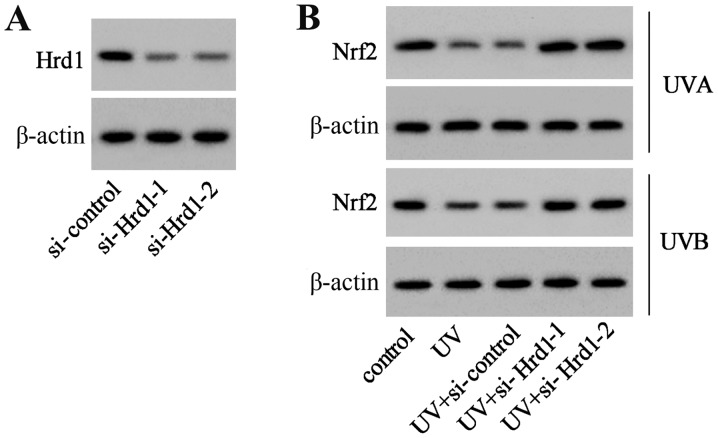
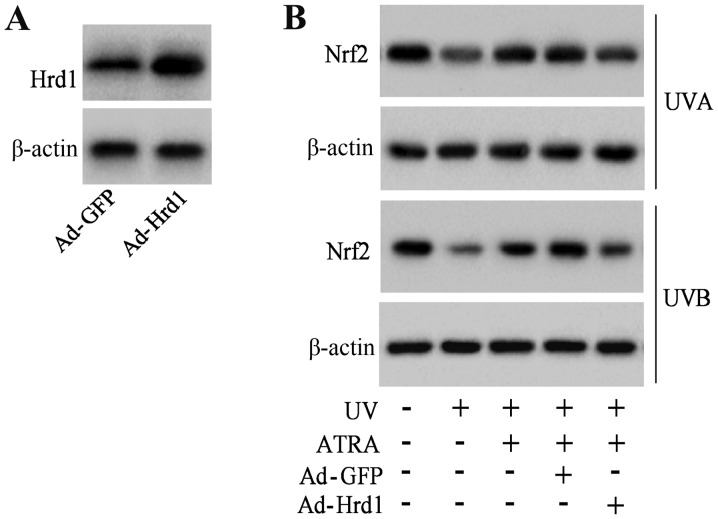
All‑trans retinoic acid (ATRA) can protect fibroblasts against ultraviolet (UV)‑induced oxidative damage, however, its underlying molecular mechanism is still unclear. The present study aimed to investigate the role of 3‑hydroxy‑3‑methylglutaryl reductase degradation (Hrd1) in the protective effect of ATRA on human skin fibroblasts exposed to UV. The expression of Hrd1 in human or mice skin was assessed by immunohistochemistry (IHC) staining and western blot analysis. Hrd1 siRNA (si‑Hrd1) and Hrd1 recombinant adenoviruses (Ad‑Hrd1) were used to downregulate and upregulate Hrd1 expression in fibroblasts, respectively. The interaction between Hrd1 and NF‑E2‑related factor 2 (Nrf2) was assessed by co‑immunoprecipitation (co‑IP) and immunofluorescence analysis. The results revealed that Hrd1 expression was increased but Nrf2 expression was decreased in UV‑exposed human skin fibroblasts. In addition, ATRA could reverse the increase of Hrd1 expression induced by UV radiation in vivo and in vitro. ATRA or knockdown of Hrd1 could increase Nrf2 expression in fibroblasts exposed to UV radiation, and Hrd1 could directly interact with Nrf2 in skin fibroblasts. Notably, overexpression of Hrd1 abolished the protective effect of ATRA on the UV‑induced decrease of Nrf2 expression, the production of reactive oxygen species (ROS) and the decrease of cell viability. In conclusion, the present data demonstrated that ATRA protected skin fibroblasts against UV‑induced oxidative damage through inhibition of E3 ligase Hrd1.
全反式维甲酸(ATRA)可保护成纤维细胞免受紫外线(UV)诱导的氧化损伤,但具体的分子机制尚不清楚。本研究旨在探讨 3-羟基-3-甲基戊二酰基辅酶 A 还原酶降解(Hrd1)在 ATRA 保护 UV 暴露下人皮肤成纤维细胞中的作用。通过免疫组织化学(IHC)染色和 Western blot 分析评估 Hrd1 在人或小鼠皮肤中的表达。使用 Hrd1 siRNA(si-Hrd1)和 Hrd1 重组腺病毒(Ad-Hrd1)分别下调和上调成纤维细胞中的 Hrd1 表达。通过共免疫沉淀(co-IP)和免疫荧光分析评估 Hrd1 与 NF-E2 相关因子 2(Nrf2)之间的相互作用。结果表明,UV 暴露后人皮肤成纤维细胞中 Hrd1 表达增加而 Nrf2 表达减少。此外,ATRA 可逆转 UV 辐射在体内和体外诱导的 Hrd1 表达增加。ATRA 或 Hrd1 敲低可增加 UV 辐射暴露的成纤维细胞中 Nrf2 的表达,Hrd1 可在皮肤成纤维细胞中与 Nrf2 直接相互作用。值得注意的是,Hrd1 的过表达消除了 ATRA 对 UV 诱导的 Nrf2 表达降低、活性氧(ROS)产生和细胞活力降低的保护作用。综上所述,本研究数据表明,ATRA 通过抑制 E3 连接酶 Hrd1 保护皮肤成纤维细胞免受 UV 诱导的氧化损伤。