Council for Agricultural Research and Economics (CREA), Research Center for Animal Production and Aquaculture, viale Piacenza 29, 26900, Lodi, Italy.
Department of Agricultural, Food and Environmental Science, University of Perugia, Borgo XX Giugno 74, 06121, Perugia, Italy.
BMC Genomics. 2019 Jul 22;20(1):603. doi: 10.1186/s12864-019-5920-x.
A thorough verification of the ability of genomic selection (GS) to predict estimated breeding values for pea (Pisum sativum L.) grain yield is pending. Prediction for different environments (inter-environment prediction) has key importance when breeding for target environments featuring high genotype × environment interaction (GEI). The interest of GS would increase if it could display acceptable prediction accuracies in different environments also for germplasm that was not used in model training (inter-population prediction).
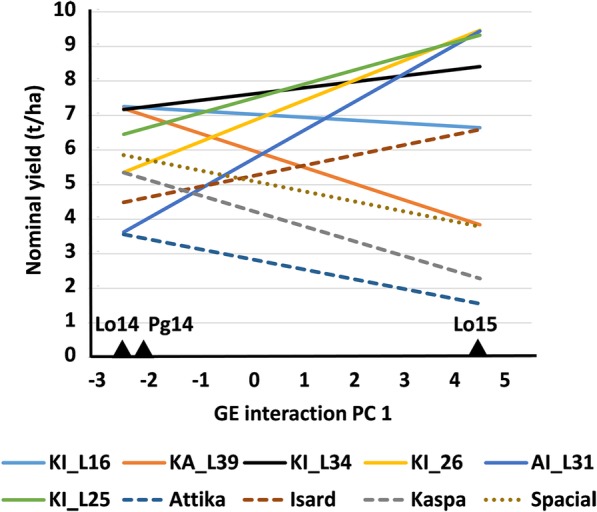
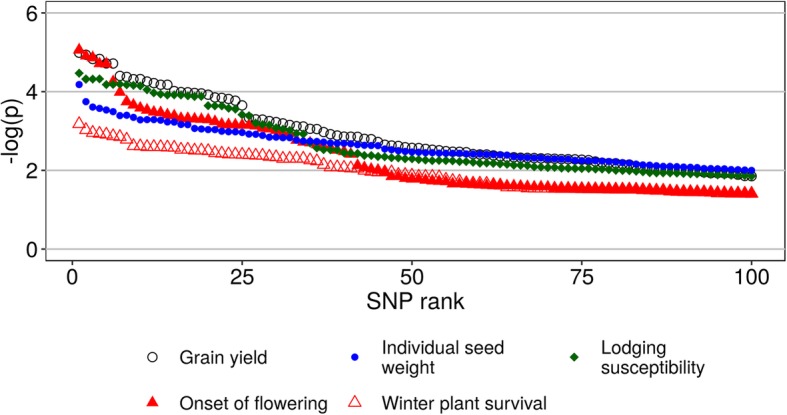
Some 306 genotypes belonging to three connected RIL populations derived from paired crosses between elite cultivars were genotyped through genotyping-by-sequencing and phenotyped for grain yield, onset of flowering, lodging susceptibility, seed weight and winter plant survival in three autumn-sown environments of northern or central Italy. The large GEI for grain yield and its pattern (implying larger variation across years than sites mainly due to year-to-year variability for low winter temperatures) encouraged the breeding for wide adaptation. Wider within-population than between-population variation was observed for nearly all traits, supporting GS application to many lines of relatively few elite RIL populations. Bayesian Lasso without structure imputation and 1% maximum genotype missing rate (including 6058 polymorphic SNP markers) was selected for GS modelling after assessing different GS models and data configurations. On average, inter-environment predictive ability using intra-population predictions reached 0.30 for yield, 0.65 for onset of flowering, 0.64 for seed weight, and 0.28 for lodging susceptibility. Using inter-population instead of intra-population predictions reduced the inter-environment predictive ability to 0.19 for grain yield, 0.40 for onset of flowering, 0.28 for seed weight, and 0.22 for lodging susceptibility. A comparison of GS vs phenotypic selection (PS) based on predicted genetic gains per unit time for same selection costs suggested greater efficiency of GS for all traits under various selection scenarios. For yield, the advantage in predicted efficiency of GS over PS was at least 80% using intra-population predictions and 20% using inter-population predictions. A genome-wide association study confirmed the highly polygenic control of most traits.
Genome-enabled predictions can increase the efficiency of pea line selection for wide adaptation to Italian environments relative to phenotypic selection.
对于豌豆(Pisum sativum L.)籽粒产量的基因组选择(GS)预测能力,需要进行全面验证。在针对具有高基因型×环境互作(GEI)的目标环境进行育种时,不同环境(环境间预测)的预测具有重要意义。如果 GS 能够在未用于模型训练的种质(群体间预测)的不同环境中显示出可接受的预测准确性,那么它的应用价值将会增加。
通过测序进行基因型鉴定并对 306 个基因型进行了籽粒产量、开花起始、倒伏敏感性、种子重量和冬季植株存活率的表型鉴定,这些基因型来自于三个通过配对杂交构建的紧密连锁 RIL 群体,这些 RIL 群体来自于意大利北部或中部三个秋季播种环境中的优良品种。籽粒产量的大 GEI 及其模式(主要由于低温的年际变化,导致年份间的变异性大于地点间的变异性)鼓励了广泛适应性的育种。几乎所有性状的群体内变异都大于群体间变异,支持将 GS 应用于许多相对较少的优良 RIL 群体的许多品系。在评估了不同的 GS 模型和数据配置后,选择了无结构插补的贝叶斯 Lasso 和最大基因型缺失率为 1%(包括 6058 个多态性 SNP 标记)进行 GS 建模。平均而言,使用群体内预测进行环境间预测能力,产量达到 0.30,开花起始达到 0.65,种子重量达到 0.64,倒伏敏感性达到 0.28。使用群体间预测代替群体内预测,将籽粒产量的环境间预测能力降低至 0.19,开花起始降低至 0.40,种子重量降低至 0.28,倒伏敏感性降低至 0.22。比较基于相同选择成本的 GS 与表型选择(PS)的遗传增益预测表明,在各种选择情景下,GS 对所有性状的效率更高。对于产量,使用群体内预测时,GS 对 PS 的预测效率优势至少为 80%,使用群体间预测时为 20%。全基因组关联研究证实了大多数性状的高度多基因控制。
与表型选择相比,基于基因组的预测可以提高豌豆品系对意大利环境的广泛适应性选择效率。