Crop Development Centre, Department of Plant Sciences, 51 Campus Drive, University of Saskatchewan, Saskatoon, SK, Canada.
CHS, Inc, 220 Clement Ave., Grandin, ND, 58038, USA.
BMC Plant Biol. 2018 Aug 16;18(1):172. doi: 10.1186/s12870-018-1368-4.
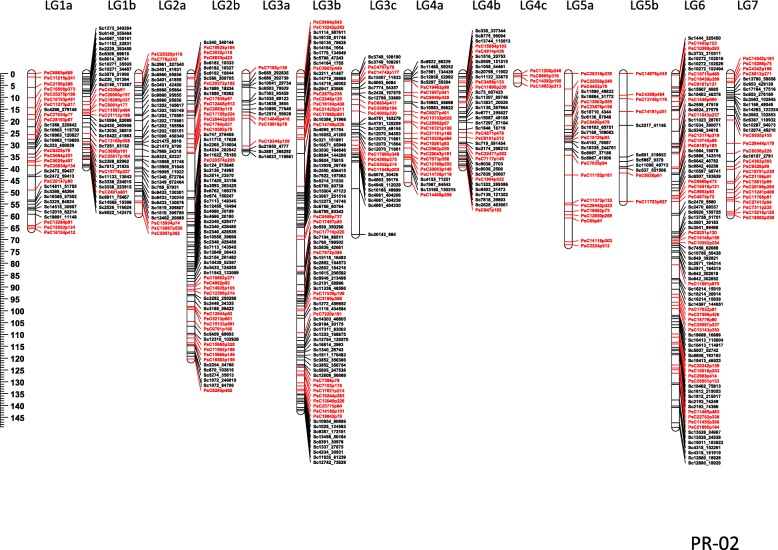
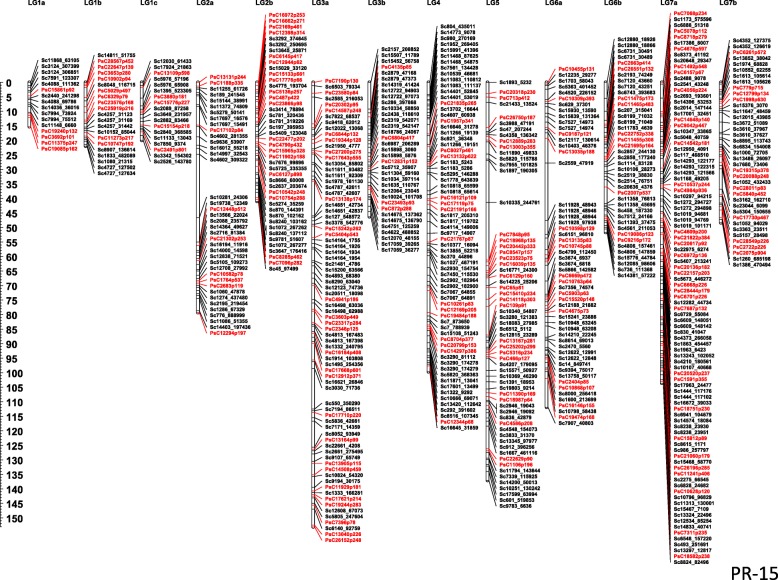
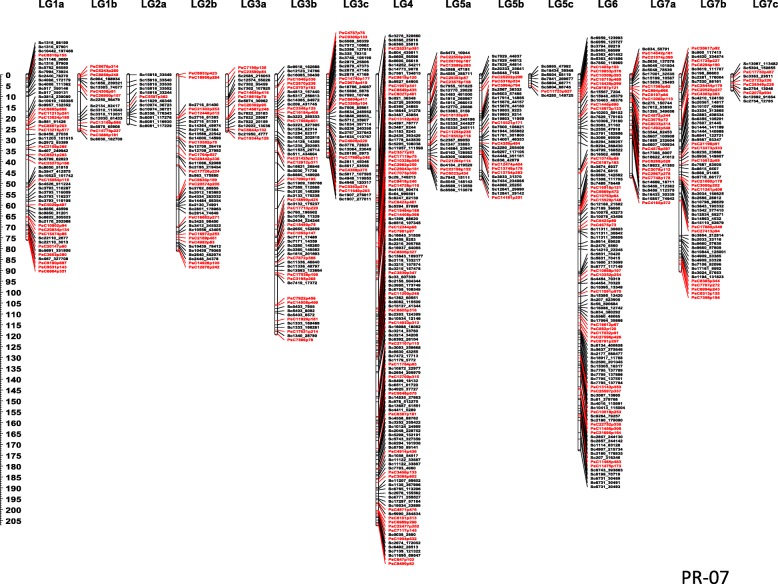
The objective of this research was to map quantitative trait loci (QTLs) of multiple traits of breeding importance in pea (Pisum sativum L.). Three recombinant inbred line (RIL) populations, PR-02 (Orb x CDC Striker), PR-07 (Carerra x CDC Striker) and PR-15 (1-2347-144 x CDC Meadow) were phenotyped for agronomic and seed quality traits under field conditions over multiple environments in Saskatchewan, Canada. The mapping populations were genotyped using genotyping-by-sequencing (GBS) method for simultaneous single nucleotide polymorphism (SNP) discovery and construction of high-density linkage maps.
After filtering for read depth, segregation distortion, and missing values, 2234, 3389 and 3541 single nucleotide polymorphism (SNP) markers identified by GBS in PR-02, PR-07 and PR-15, respectively, were used for construction of genetic linkage maps. Genetic linkage groups were assigned by anchoring to SNP markers previously positioned on these linkage maps. PR-02, PR-07 and PR-15 genetic maps represented 527, 675 and 609 non-redundant loci, and cover map distances of 951.9, 1008.8 and 914.2 cM, respectively. Based on phenotyping of the three mapping populations in multiple environments, 375 QTLs were identified for important traits including days to flowering, days to maturity, lodging resistance, Mycosphaerella blight resistance, seed weight, grain yield, acid and neutral detergent fiber concentration, seed starch concentration, seed shape, seed dimpling, and concentration of seed iron, selenium and zinc. Of all the QTLs identified, the most significant in terms of explained percentage of maximum phenotypic variance (PV) and occurrence in multiple environments were the QTLs for days to flowering (PV = 47.9%), plant height (PV = 65.1%), lodging resistance (PV = 35.3%), grain yield (PV = 54.2%), seed iron concentration (PV = 27.4%), and seed zinc concentration (PV = 43.2%).
We have identified highly significant and reproducible QTLs for several agronomic and seed quality traits of breeding importance in pea. The QTLs identified will be the basis for fine mapping candidate genes, while some of the markers linked to the highly significant QTLs are useful for immediate breeding applications.
本研究旨在绘制豌豆(Pisum sativum L.)多个重要育种性状的数量性状基因座(QTL)图谱。在加拿大萨斯喀彻温省的多个田间环境中,对 PR-02(Orb x CDC Striker)、PR-07(Carerra x CDC Striker)和 PR-15(1-2347-144 x CDC Meadow)三个重组自交系(RIL)群体进行了农艺和种子质量性状的表型分析。利用基因型测序(GBS)方法对这些作图群体进行基因型分析,以同时发现单核苷酸多态性(SNP)并构建高密度连锁图谱。
对读深度、分离偏度和缺失值进行过滤后,分别在 PR-02、PR-07 和 PR-15 中鉴定出 2234、3389 和 3541 个单核苷酸多态性(SNP)标记,用于构建遗传连锁图谱。通过锚定到这些连锁图谱上先前定位的 SNP 标记,将连锁群分配给遗传连锁图谱。PR-02、PR-07 和 PR-15 遗传图谱分别代表 527、675 和 609 个非冗余基因座,覆盖 951.9、1008.8 和 914.2 cM 的图谱距离。基于三个作图群体在多个环境中的表型分析,共鉴定到 375 个与开花时间、成熟时间、倒伏抗性、黑痣病抗性、种子重量、籽粒产量、酸性和中性洗涤剂纤维浓度、种子淀粉浓度、种子形状、种子凹痕、种子铁、硒和锌浓度等重要性状相关的 QTL。在所鉴定的所有 QTL 中,在最大表型方差(PV)解释率和多个环境中出现的方面最显著的是开花时间(PV=47.9%)、株高(PV=65.1%)、倒伏抗性(PV=35.3%)、籽粒产量(PV=54.2%)、种子铁浓度(PV=27.4%)和种子锌浓度(PV=43.2%)的 QTL。
我们已经鉴定到豌豆多个重要农艺和种子质量性状的高度显著和可重复的 QTL。所鉴定的 QTL 将是精细定位候选基因的基础,而与高度显著 QTL 连锁的一些标记可用于直接的育种应用。