Department of Clinical Dietetics, Faculty of Health Sciences, Medical University of Warsaw, E Ciolka Str. 27, 01-445 Warsaw, Poland.
Department of Metabolomics Food and Nutrition Institute, 61/63 Powsińska Str., 02-903 Warsaw, Poland.
Nutrients. 2019 Jul 12;11(7):1585. doi: 10.3390/nu11071585.
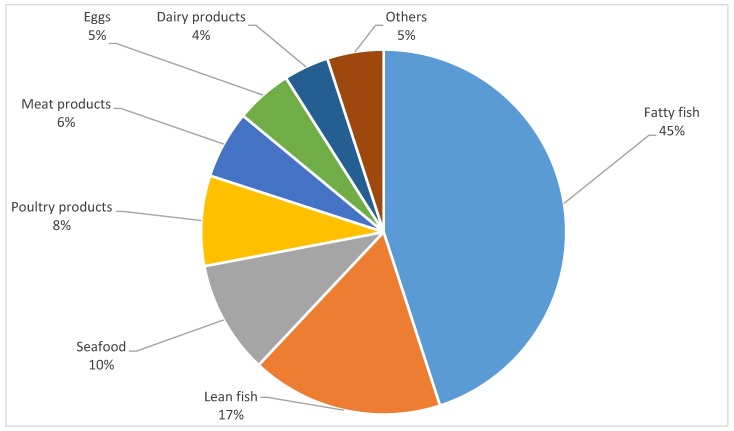
This study determined fatty acid (FA) concentrations in maternal milk and investigated the association between omega-3 fatty acid levels and their maternal current dietary intake (based on three-day dietary records) and habitual dietary intake (based on intake frequency of food products). Tested material comprised 32 samples of human milk, coming from exclusively breastfeeding women during their first month of lactation. Milk fatty acids were analyzed as fatty acid methyl ester (FAME) by gas chromatography using a Hewlett-Packard 6890 gas chromatograph with MS detector 5972A. We did not observe any correlation between current dietary intake of omega-3 FAs and their concentrations in human milk. However, we observed that the habitual intake of fatty fish affected omega-3 FA concentrations in human milk. Kendall's rank correlation coefficients were 0.25 ( = 0.049) for DHA, 0.27 ( = 0.03) for EPA, and 0.28 ( = 0.02) for ALA. Beef consumption was negatively correlated with DHA concentrations in human milk (r = -0.25; = 0.046). These findings suggest that current omega-3 FA intake does not translate directly into their concentration in human milk. On the contrary, their habitual intake seems to markedly influence their milk concentration.
本研究测定了母乳中的脂肪酸(FA)浓度,并探讨了ω-3 脂肪酸水平与其母体当前饮食摄入(基于三天饮食记录)和习惯性饮食摄入(基于食品摄入频率)之间的关系。测试材料包括 32 个人乳样本,来自哺乳期第一个月的纯母乳喂养女性。通过使用带有 MS 检测器 5972A 的 Hewlett-Packard 6890 气相色谱仪,将奶样脂肪酸分析为脂肪酸甲酯(FAME)。我们没有观察到ω-3 FAs 的当前饮食摄入与其在母乳中的浓度之间存在任何相关性。然而,我们观察到食用油性鱼类的习惯性摄入会影响母乳中 ω-3 FA 的浓度。Kendall 等级相关系数分别为 0.25( = 0.049)对于 DHA、0.27( = 0.03)对于 EPA 和 0.28( = 0.02)对于 ALA。牛肉消费与母乳中 DHA 浓度呈负相关(r = -0.25; = 0.046)。这些发现表明,当前的 ω-3 FA 摄入量不会直接转化为其在母乳中的浓度。相反,它们的习惯性摄入似乎会显著影响其奶中的浓度。