Ariza-Garcia Angelica, Lozano-Lozano Mario, Galiano-Castillo Noelia, Postigo-Martin Paula, Arroyo-Morales Manuel, Cantarero-Villanueva Irene
Department of Physical Therapy, University of Granada, Granada, Spain.
"San Cecilio" University Hospital, Granada, Spain.
J Med Internet Res. 2019 Jul 24;21(7):e14418. doi: 10.2196/14418.
Breast cancer patients have to face a high-risk state during chemotherapy, which involves deterioration of their health including extensive physical deterioration. Face-to-face physical exercise programs have presented low adherence rates during medical treatment, and telehealth systems could improve these adherence rates.
This study aimed to evaluate the effectiveness of a Web-based exercise program (e-CuidateChemo) to mitigate the side effects of chemotherapy on the physical being, anthropometric aspects, and body composition.
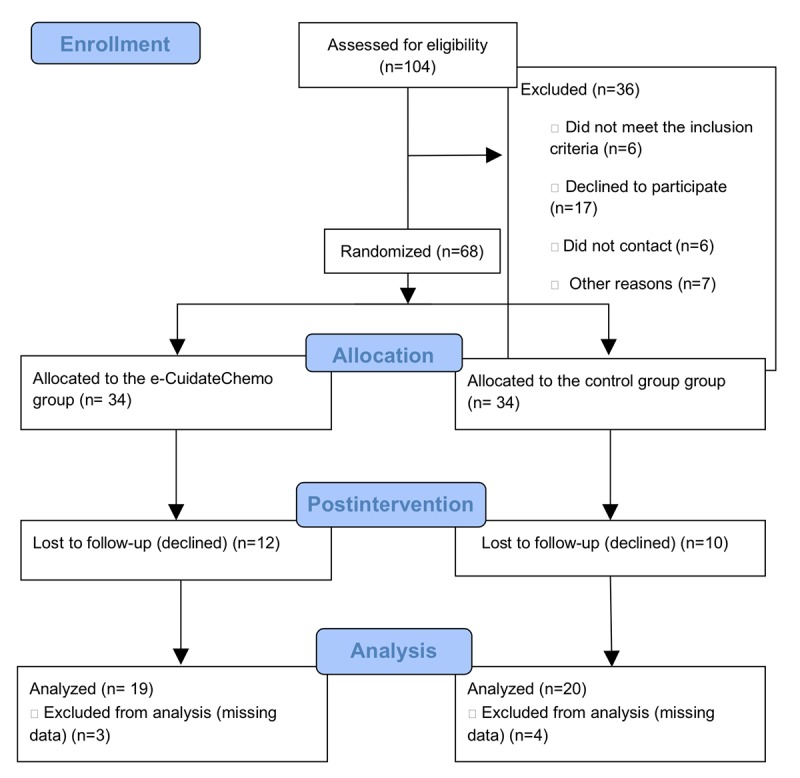
A total of 68 patients diagnosed with breast cancer, who were undergoing chemotherapy, were enrolled. The patients were categorized into two groups: e-CuidateChemo (n=34) and controls (n=34). The e-CuidateChemo group participated in an adapted 8-week tailored exercise program through a Web-based system. A blinded, trained researcher assessed functional capacity, strength, anthropometric parameters, and body composition. The intervention effects were tested using analysis of covariance and Cohen d tests.
Functional capacity improved significantly in the e-CuidateChemo group compared to the control group (6-minute walk test: 62.07 [SD 130.09] m versus -26.34 [SD 82.21] m; 6-minute walk test % distance predicted: 10.81% [SD 22.69%] m versus -4.60% [SD 14.58%]; between-group effect: P=.015 for both). The intervention group also showed significantly improved secondary outcomes such as between-group effects for abdominal (24.93 [SD 26.83] s vs -18.59 [SD 38.69] s), back (12.45 [SD 10.20] kg vs 1.39 [10.72] kg), and lower body (-2.82 [SD 3.75] s vs 1.26 [SD 2.84] s) strength; all P<.001 compared to the control group.
This paper showed that a Web-based exercise program was effective in reversing the detriment in functional capacity and strength due to chemotherapy.
ClinicalTrials.gov NCT02350582; https://clinicaltrials.gov/ct2/show/NCT02350582.
乳腺癌患者在化疗期间不得不面临高风险状态,这包括其健康状况的恶化,其中身体状况广泛恶化。面对面的体育锻炼计划在医疗期间的依从率较低,而远程医疗系统可以提高这些依从率。
本研究旨在评估基于网络的锻炼计划(e-CuidateChemo)对减轻化疗对身体、人体测量学方面和身体成分的副作用的有效性。
共纳入68例正在接受化疗的乳腺癌确诊患者。患者被分为两组:e-CuidateChemo组(n = 34)和对照组(n = 34)。e-CuidateChemo组通过基于网络的系统参与了一项为期8周的适应性定制锻炼计划。一名经过盲法培训的研究人员评估了功能能力、力量、人体测量参数和身体成分。使用协方差分析和科恩d检验来测试干预效果。
与对照组相比,e-CuidateChemo组的功能能力有显著改善(6分钟步行试验:62.07 [标准差130.09]米对-26.34 [标准差82.21]米;6分钟步行试验预测距离百分比:10.81% [标准差22.69%]米对-4.60% [标准差14.58%];组间效应:两者均为P = 0.015)。干预组还显示出次要结局有显著改善,如腹部(24.93 [标准差26.83]秒对-18.59 [标准差38.69]秒)、背部(12.45 [标准差10.20]千克对1.39 [10.72]千克)和下肢(-2.82 [标准差3.75]秒对1.26 [标准差2.84]秒)力量的组间效应;与对照组相比,所有P < 0.001。
本文表明,基于网络的锻炼计划在逆转化疗导致的功能能力和力量损害方面是有效的。
ClinicalTrials.gov NCT02350582;https://clinicaltrials.gov/ct2/show/NCT02350582。