Zein Naimah, Harmouch Ezeddine, Lutz Jean-Christophe, Fernandez De Grado Gabriel, Kuchler-Bopp Sabine, Clauss François, Offner Damien, Hua Guoqiang, Benkirane-Jessel Nadia, Fioretti Florence
French National Institute of Health and Medical Research (INSERM), Regenerative Nanomedicine, UMR 1260, FMTS, 67085 Strasbourg, France.
Faculté de Médecine de Strasbourg, Strasbourg, Université de Strasbourg, 67000 Strasbourg, France.
Materials (Basel). 2019 Jul 24;12(15):2347. doi: 10.3390/ma12152347.
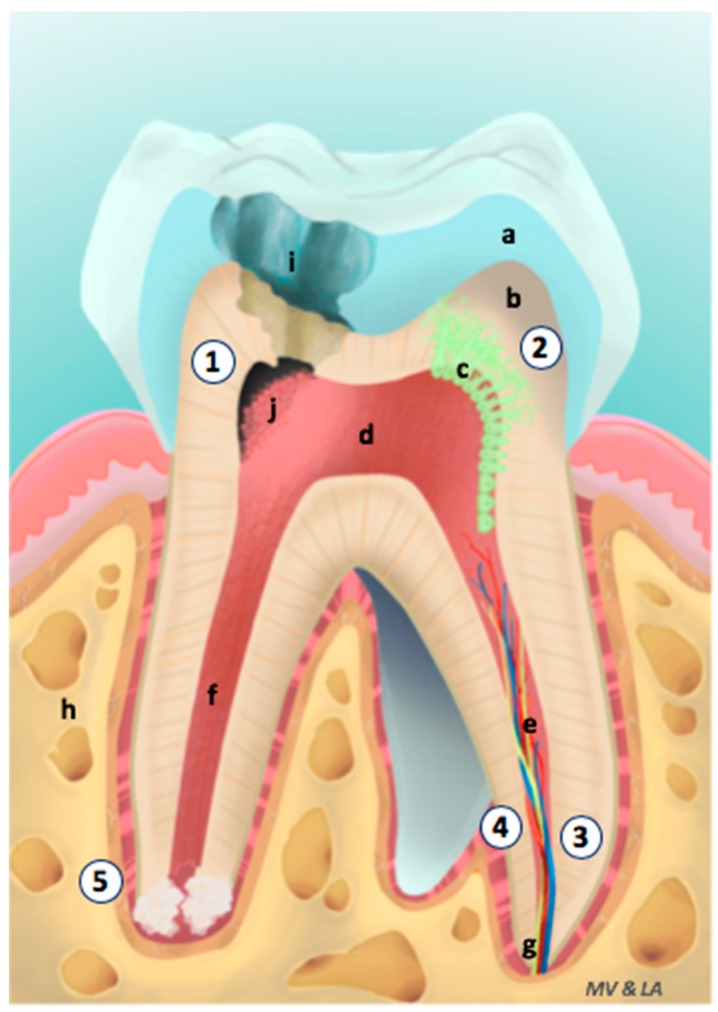
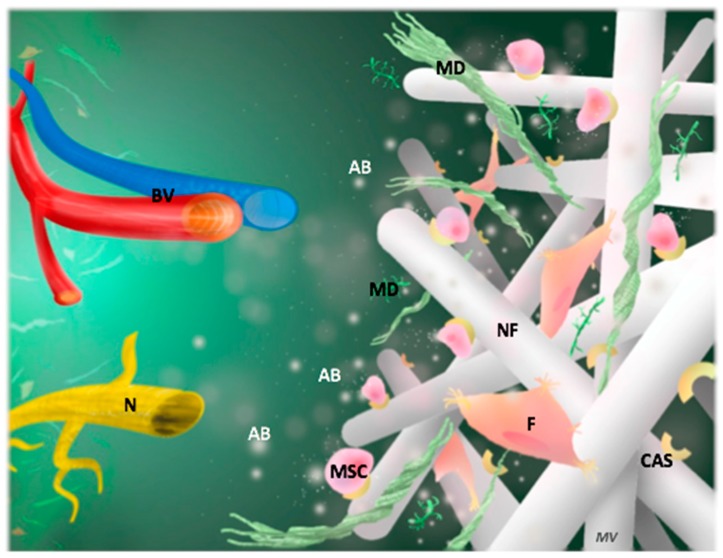
The challenge of endodontic regeneration is modulated by clinical conditions which determine five kinds of tissue requirements: pulp connective-tissue formation, dentin formation, revascularization, reinnervation and radicular edification. Polymer scaffolds constitute keystone of the different endodontic regenerative strategies. Indeed, scaffolds are crucial for carrying active molecules and competent cells which optimize the regeneration. Hydrogels are very beneficial for controlling viscosity and porosity of endodontic scaffolds. The nanofibrous and microporous scaffolds mimicking extracellular matrix are also of great interest for promoting dentin-pulp formation. Two main types of polymer scaffolds are highlighted: collagen and fibrin. Collagen scaffolds which are similar to native pulp tissue, are adequate for pulp connective tissue formation. Functionnalization by active biomolecules as BMP, SDF-1, G-CSF enhances their properties. Fibrin or PRF scaffolds present the advantage of promoting stem cell differentiation and concomitant revascularisation. The choice of the type of polymers (polypeptide, PCL, chitosan) can depend on its ability to deliver the active biomolecule or to build as suitable hydrogel as possible. Since 2010s, proposals to associate different types of polymers in a same scaffold have emerged for adding advantages or for offsetting a disadvantage of a polymer. Further works would study the synergetic effects of different innovative polymers composition.
牙髓再生面临的挑战受到临床条件的调节,这些条件决定了五种组织需求:牙髓结缔组织形成、牙本质形成、血管再生、神经再生和牙根形成。聚合物支架是不同牙髓再生策略的关键。事实上,支架对于携带能优化再生的活性分子和有能力的细胞至关重要。水凝胶对于控制牙髓支架的粘度和孔隙率非常有益。模仿细胞外基质的纳米纤维和微孔支架对于促进牙本质-牙髓形成也非常有意义。重点介绍了两种主要类型的聚合物支架:胶原蛋白和纤维蛋白。与天然牙髓组织相似的胶原蛋白支架适用于牙髓结缔组织形成。通过BMP、SDF-1、G-CSF等活性生物分子进行功能化可增强其性能。纤维蛋白或富血小板纤维蛋白支架具有促进干细胞分化和伴随血管再生的优势。聚合物类型(多肽、聚己内酯、壳聚糖)的选择可能取决于其递送活性生物分子或构建尽可能合适的水凝胶的能力。自2010年代以来,出现了在同一支架中结合不同类型聚合物的提议,以增加优势或弥补聚合物的劣势。进一步的研究将探讨不同创新聚合物组合的协同效应。