Masiero Marianna, Lucchiari Claudio, Maisonneuve Patrick, Pravettoni Gabriella, Veronesi Giulia, Mazzocco Ketti
Department of Biomedical and Clinical Sciences (DIBIC), Luigi Sacco, University of Milan, Milan, Italy.
Applied Research Division for Cognitive and Psychological Science, European Institute of Oncology (IEO), IRCSS, Milan, Italy.
Front Behav Neurosci. 2019 Jul 10;13:154. doi: 10.3389/fnbeh.2019.00154. eCollection 2019.
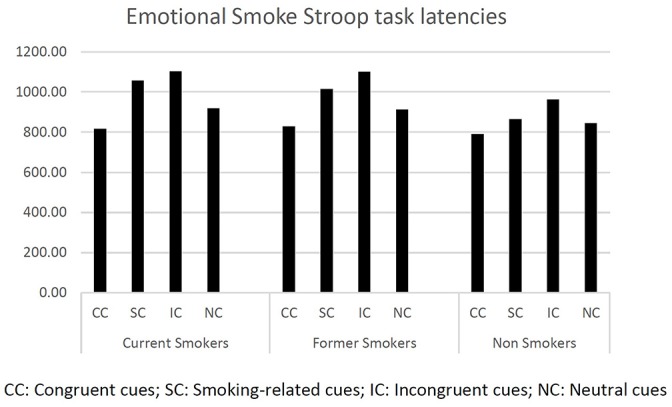
Attentional bias has been defined as the propensity of a person to allocate selective attention automatically to salient cues (Field and Powell, 2007). In the case of smoking, this bias implies that smokers are implicitly attracted by smoking-related stimuli, which produce behavioral, memory, and emotional effects (Volkow et al., 2006; Giardini et al., 2009). In more detail, scientific evidence pointed out that smoking is strongly supported by attentional bias that activates craving and urgency to smoke a cigarette. However, poor and conflicting data are available regarding the role of this cognitive bias on former smokers. The main aim of this study is to explore the occurrence of the attentional bias on of both current and former smokers, also with the aim to identify associations with behavioral, psychological and cognitive characteristic of participants. We collected data on 245 current, volunteers (male 50.6%; female 49.4%) aged 54.81 (SD = 14.352, range = 18-63), divided in current smokers (98), former smokers (102) and non-smokers (45). A combination of neuropsychology tests (Emotional Smoke Stroop Task and Go/no-Go task), and standardized questionnaires [Behavioral Inhibition System-Behavioral Approach System (BIS-BAS), Fagerström Test for Nicotine Dependence (FTND), Barratt Impulsiveness Scale, Motivational questionnaire] were used to assess the attentional bias, psychological variables, and smoking-related characteristics. Responses at the Emotional Smoke Stroop task revealed that current and former smokers are actually slower than non-smokers are when facing smoking cues, while performances at other Stroop conditions and at the Go/no-Go task are not statistically different. These results confirmed the occurrence of the attentional bias in current smokers, and above all points out that the same effect is present in former smokers. We found only small and selective correlations between attentional bias and psychological variables (e.g., impulsiveness and inhibition). In particular, impulsivity is not directly associated with the AB intensity. Also, smoking characteristics (e.g., years of smoking and dependence level) and the length of the period of abstinence do not seem to modulate implicit cognition of smoking cue. Our data support the idea that the attentional bias may be considered relevant in sustaining smoking and favoring relapse.
注意偏向被定义为一个人自动将选择性注意分配到显著线索的倾向(菲尔德和鲍威尔,2007年)。就吸烟而言,这种偏向意味着吸烟者会被与吸烟相关的刺激隐性吸引,这些刺激会产生行为、记忆和情感效应(沃尔科夫等人,2006年;贾尔迪尼等人,2009年)。更详细地说,科学证据指出,注意偏向强烈支持吸烟行为,这种偏向会引发对吸烟的渴望和紧迫感。然而,关于这种认知偏向在前吸烟者中的作用,现有数据匮乏且相互矛盾。本研究的主要目的是探讨当前吸烟者和前吸烟者中注意偏向的发生情况,同时也旨在确定与参与者的行为、心理和认知特征之间的关联。我们收集了245名当前吸烟者的志愿者数据(男性占50.6%;女性占49.4%),年龄为54.81岁(标准差 = 14.352,范围 = 18 - 63岁),分为当前吸烟者(98人)、前吸烟者(102人)和非吸烟者(45人)。综合使用神经心理学测试(情绪性吸烟斯特鲁普任务和Go/No-Go任务)以及标准化问卷[行为抑制系统 - 行为趋近系统(BIS - BAS)、尼古丁依赖的法格斯特伦测试(FTND)、巴拉特冲动性量表、动机问卷]来评估注意偏向、心理变量和与吸烟相关的特征。情绪性吸烟斯特鲁普任务的反应显示,当前吸烟者和前吸烟者在面对吸烟线索时实际上比非吸烟者反应更慢,而在其他斯特鲁普条件下以及Go/No-Go任务中的表现没有统计学差异。这些结果证实了当前吸烟者中存在注意偏向,最重要的是指出前吸烟者中也存在同样的效应。我们发现注意偏向与心理变量(如冲动性和抑制)之间只有微小的选择性关联。特别是,冲动性与注意偏向强度没有直接关联。此外,吸烟特征(如吸烟年限和依赖程度)以及戒烟时间长短似乎并未调节对吸烟线索的隐性认知。我们的数据支持这样一种观点,即注意偏向可能在维持吸烟和促进复吸方面具有相关性。