Liska DeAnn, Kelley Michael, Mah Eunice
Biofortis, Mérieux NutriSciences, Addison, IL, United States.
Michael Kelley Nutrition Consulting, Chicago, IL, United States.
Front Public Health. 2019 Jul 12;7:190. doi: 10.3389/fpubh.2019.00190. eCollection 2019.
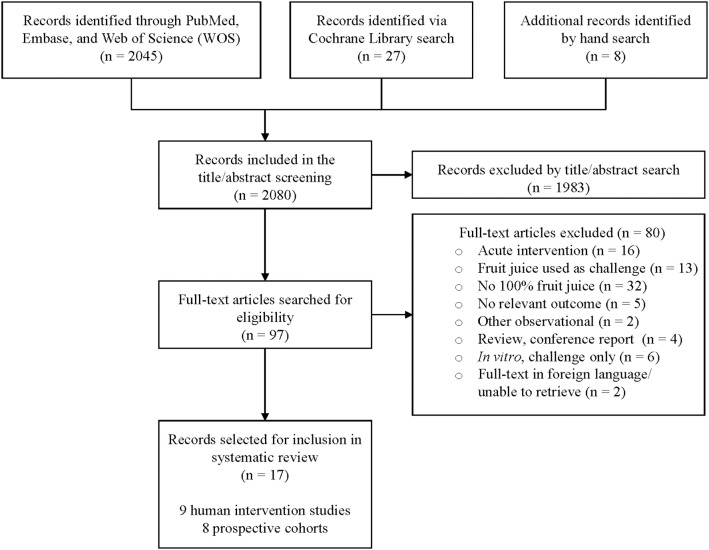
The objective of this systematic review was to assess the scope and breadth of publicly available prospective cohort and randomized controlled trial (RCT) literature on 100% fruit juice and dental caries or tooth erosion in humans. We performed a systematic search in MEDLINE/PubMed, EMBASE, and Web of Science for studies published from inception through May 2018, and the Cochrane Library databases for reports published through January 2018. Prospective cohort studies or RCTs conducted on dental health and 100% fruit juice, and published in English were selected. No restrictions were set for age, sex, geographic location, or socioeconomic status. Eight publications representing five independent prospective cohort studies and nine publications on nine RCTs were included. All prospective cohort studies were in children or adolescents, and all RCTs were in adults. Prospective cohort studies on tooth erosion found no association between juice intake and tooth erosion, while those on dental caries incidence reported either no association or an inverse association between 100% fruit juice intakes and dental caries incidence. RCTs on tooth erosion showed decreased microhardness, increased surface enamel loss, increased erosion depth, greater enamel softening, and/or increased pellicle layer with 100% fruit juice, and those on dental caries showed increased demineralization of enamel slabs with 100% fruit juice. The existing evidence on 100% fruit juice intake and caries and tooth erosion are not conclusive. Overall, prospective cohort studies in children and adolescents found no association between 100% fruit juice intake and tooth erosion or dental caries, but, RCT data in adults suggests that 100% fruit juice could contribute to tooth erosion and dental caries. The RCT data, however, were from small, short-term studies that utilized intra-oral devices generally devoid of normal plaque or saliva action, and generally employed conditions that are not reflective of normal juice consumption.
本系统评价的目的是评估关于100%果汁与人类龋齿或牙齿侵蚀的公开可用前瞻性队列研究和随机对照试验(RCT)文献的范围和广度。我们在MEDLINE/PubMed、EMBASE和Web of Science中进行了系统检索,以查找从创刊至2018年5月发表的研究,并在Cochrane图书馆数据库中查找截至2018年1月发表的报告。选择了以英文发表的、关于牙齿健康和100%果汁的前瞻性队列研究或RCT。对年龄、性别、地理位置或社会经济地位未设限制。纳入了代表五项独立前瞻性队列研究的八篇出版物以及关于九项RCT的九篇出版物。所有前瞻性队列研究均针对儿童或青少年,所有RCT均针对成年人。关于牙齿侵蚀的前瞻性队列研究发现果汁摄入量与牙齿侵蚀之间无关联,而关于龋齿发病率的研究报告100%果汁摄入量与龋齿发病率之间要么无关联,要么呈负相关。关于牙齿侵蚀的RCT显示,100%果汁会导致显微硬度降低、釉质表面损失增加、侵蚀深度增加、釉质软化加剧和/或薄膜层增加,而关于龋齿的RCT显示,100%果汁会导致釉质块脱矿增加。关于100%果汁摄入量与龋齿和牙齿侵蚀的现有证据尚无定论。总体而言,儿童和青少年的前瞻性队列研究发现100%果汁摄入量与牙齿侵蚀或龋齿之间无关联,但成年人的RCT数据表明100%果汁可能会导致牙齿侵蚀和龋齿。然而,RCT数据来自小型短期研究,这些研究使用的口腔内装置通常缺乏正常的菌斑或唾液作用,且通常采用不能反映正常果汁饮用情况的条件。