Department of Orthoptics and Visual Sciences, School of Health Sciences, International University of Health and Welfare, Tochigi, Japan.
Sanno Hospital, Tokyo, Japan.
Biomed Res Int. 2019 Jul 8;2019:3458548. doi: 10.1155/2019/3458548. eCollection 2019.
This study was performed to investigate the relationships among crystalline lens shape, actual intraocular lens (IOL) position, and crystalline lens thickness (LT), as measured by anterior segment optical coherence tomography (AS-OCT), and to determine anterior ocular segment parameters that predict postoperative IOL position.
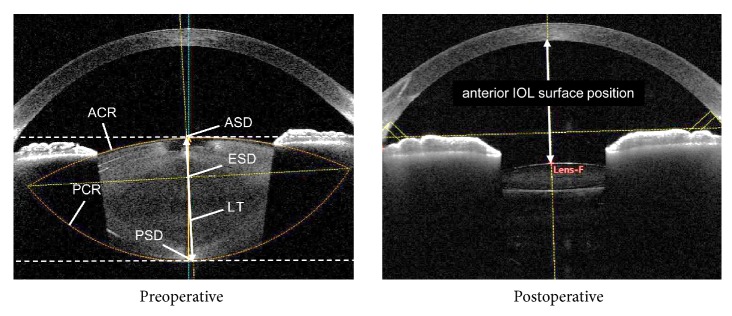
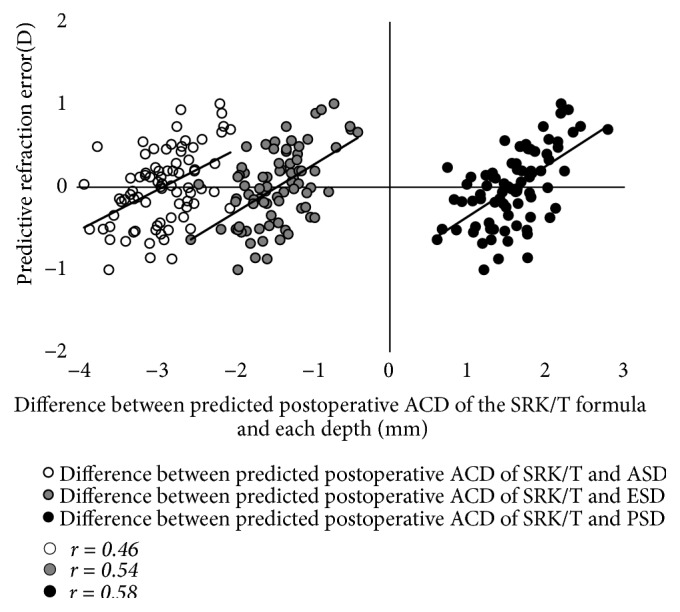
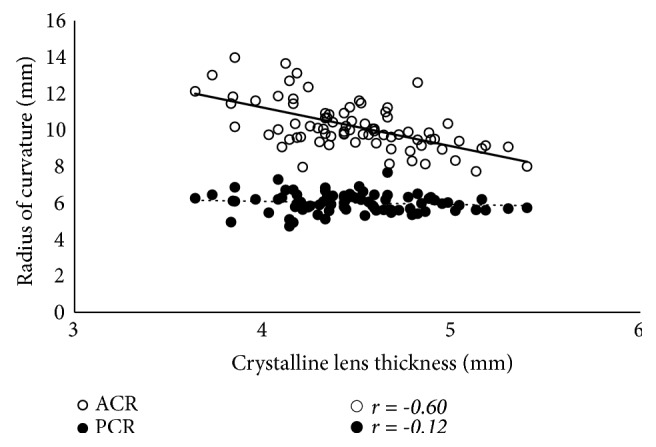
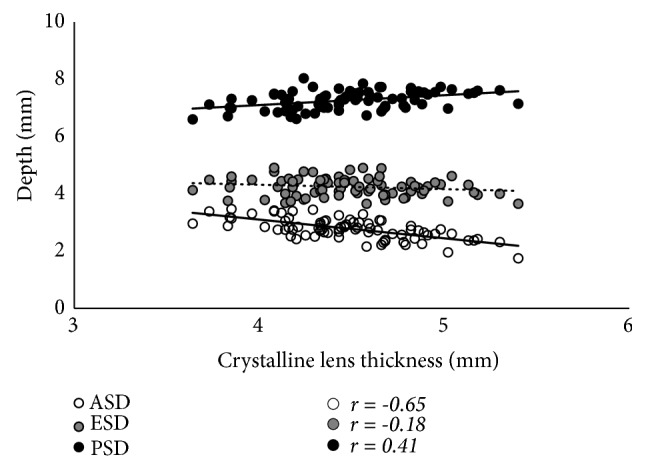
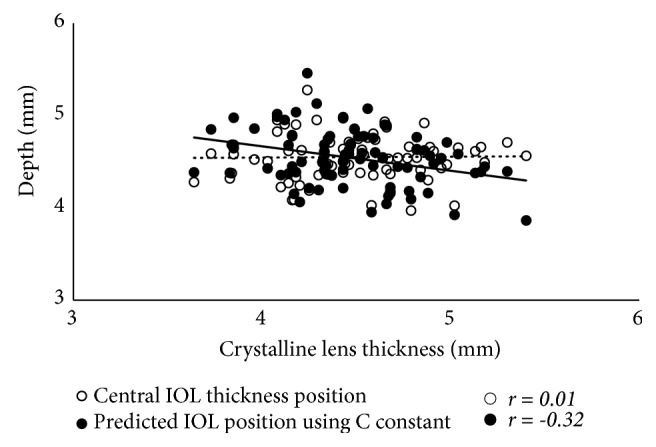
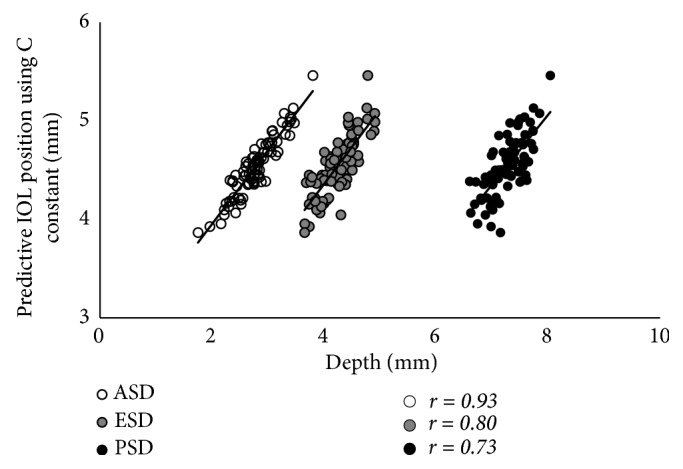
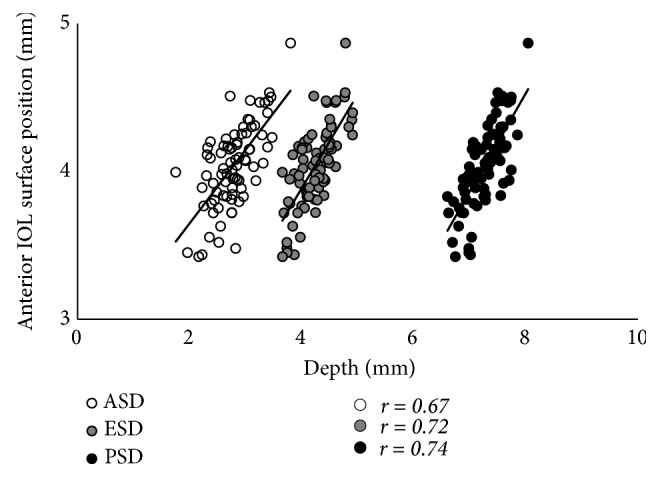
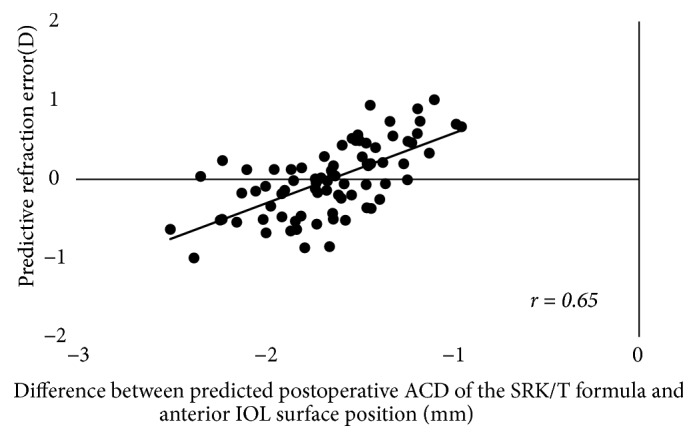
Seventy-nine eyes of 79 patients who underwent uneventful cataract surgery were enrolled. For crystalline lens preoperative anterior segment data, the LT, and anterior, equatorial, and posterior surface depths (ASD, ESD, and PSD, respectively) of crystalline lenses were quantitatively determined. For postoperative anterior segment data, the actual IOL position was quantified. Moreover, the following correlations were analyzed: LT with the ASD, ESD, PSD, and IOL position; IOL position with the ASD, ESD, and PSD; and refractive prediction error with the difference between the predicted postoperative anterior chamber depth (ACD) of the SRK/T formula and the IOL position, ASD, ESD, and PSD (each depth minus the predicted postoperative ACD of the SRK/T formula).
The LT was significantly correlated with the ASD (r = -0.65) and PSD (r = 0.41), whereas it was not correlated with the ESD or IOL position. The IOL position was significantly correlated with the ASD (r = 0.67), ESD (r = 0.72), and PSD (r = 0.74). The refractive prediction error was significantly correlated with the difference between the predicted postoperative ACD of the SRK/T formula and the IOL position (r = 0.65), ASD (r = 0.46), ESD (r = 0.54), and PSD (r = 0.58).
The ESD and PSD obtained using AS-OCT were highly correlated with the IOL position and significantly correlated with the refractive prediction error. These findings suggest that the ESD and PSD may enhance the accuracy of actual IOL position prediction.
本研究旨在探讨眼前节光学相干断层扫描(AS-OCT)测量的晶状体形状、实际人工晶状体(IOL)位置与晶状体厚度(LT)之间的关系,并确定预测术后 IOL 位置的眼前节参数。
纳入 79 例(79 只眼)无并发症白内障手术患者。对于晶状体术前眼前节数据,定量测量晶状体的 LT 以及晶状体的前、赤道和后表面深度(ASD、ESD 和 PSD)。对于术后眼前节数据,量化实际 IOL 位置。此外,分析了以下相关性:LT 与 ASD、ESD、PSD 和 IOL 位置的相关性;IOL 位置与 ASD、ESD 和 PSD 的相关性;以及屈光预测误差与 SRK/T 公式预测术后前房深度(ACD)与 IOL 位置、ASD、ESD 和 PSD(每个深度减去 SRK/T 公式预测的术后 ACD)之间的差值。
LT 与 ASD(r=-0.65)和 PSD(r=0.41)显著相关,而与 ESD 或 IOL 位置不相关。IOL 位置与 ASD(r=0.67)、ESD(r=0.72)和 PSD(r=0.74)显著相关。屈光预测误差与 SRK/T 公式预测的术后 ACD 与 IOL 位置(r=0.65)、ASD(r=0.46)、ESD(r=0.54)和 PSD(r=0.58)之间的差值显著相关。
AS-OCT 获得的 ESD 和 PSD 与 IOL 位置高度相关,与屈光预测误差显著相关。这些发现表明,ESD 和 PSD 可能提高实际 IOL 位置预测的准确性。