Platt Jodyn, Raj Minakshi, Büyüktür Ayşe G, Trinidad M Grace, Olopade Olufunmilayo, Ackerman Mark S, Kardia Sharon
University of Michigan Medical School, Department of Learning Health Sciences, US.
University of Michigan School of Public Health, Department of Health Management and Policy, US.
EGEMS (Wash DC). 2019 Jul 25;7(1):33. doi: 10.5334/egems.288.
Health information generated by health care encounters, research enterprises, and public health is increasingly interoperable and shareable across uses and users. This paper examines the US public's willingness to be a part of multi-user health information networks and identifies factors associated with that willingness.
Using a probability-based sample (n = 890), we examined the univariable and multivariable relationships between willingness to participate in health information networks and demographic factors, trust, altruism, beliefs about the public's ethical obligation to participate in research, privacy, medical deception, and policy and governance using linear regression modeling.
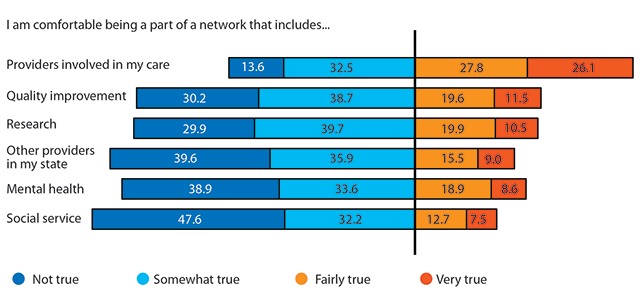
Willingness to be a part of a multi-user network that includes health care providers, mental health, social services, research, or quality improvement is low (26 percent-7.4 percent, depending on the user). Using stepwise regression, we identified a model that explained 42.6 percent of the variability in willingness to participate and included nine statistically significant factors associated with the outcome: Trust in the health system, confidence in policy, the belief that people have an obligation to participate in research, the belief that health researchers are accountable for conducting ethical research, the desire to give permission, education, concerns about insurance, privacy, and preference for notification.
Our results suggest willingness to be a part of multi-user data networks is low, but that attention to governance may increase willingness. Building trust to enable acceptance of multi-use data networks will require a commitment to aligning data access practices with the expectations of the people whose data is being used.
由医疗保健服务、研究机构和公共卫生所产生的健康信息在不同用途和用户之间越来越具有互操作性和可共享性。本文考察了美国公众参与多用户健康信息网络的意愿,并确定了与该意愿相关的因素。
我们采用基于概率的样本(n = 890),使用线性回归模型,考察了参与健康信息网络的意愿与人口统计学因素、信任、利他主义、对公众参与研究的道德义务的信念、隐私、医疗欺骗以及政策和治理之间的单变量和多变量关系。
参与包含医疗保健提供者、心理健康、社会服务、研究或质量改进的多用户网络的意愿较低(26%-7.4%,取决于用户群体)。通过逐步回归,我们确定了一个模型,该模型解释了参与意愿中42.6%的变异性,并包含与结果相关的九个具有统计学意义的因素:对卫生系统的信任、对政策的信心、认为人们有参与研究的义务、认为健康研究人员有责任进行道德研究、给予许可的愿望、教育程度、对保险的担忧、隐私以及对通知的偏好。
我们的结果表明,参与多用户数据网络的意愿较低,但对治理的关注可能会提高意愿。建立信任以促使人们接受多用途数据网络,需要致力于使数据访问实践符合数据使用者的期望。