Perry Amanda E, Waterman Mitch G, House Allan O, Greenhalgh Joanne
Department of Health Sciences, University of York, Fulford, York, YO10 5DD, UK.
Department of Psychology, University of Leeds, Leeds, LS2 9JT, UK.
Health Justice. 2019 Jul 31;7(1):14. doi: 10.1186/s40352-019-0094-9.
Social problem-solving is one technique used to help reduce incidence of self-harm. Our study evaluated the feasibility and acceptability of the adaptation and implementation of a brief Problem-Solving Training (PST) intervention to reduce self-harm in prisons.
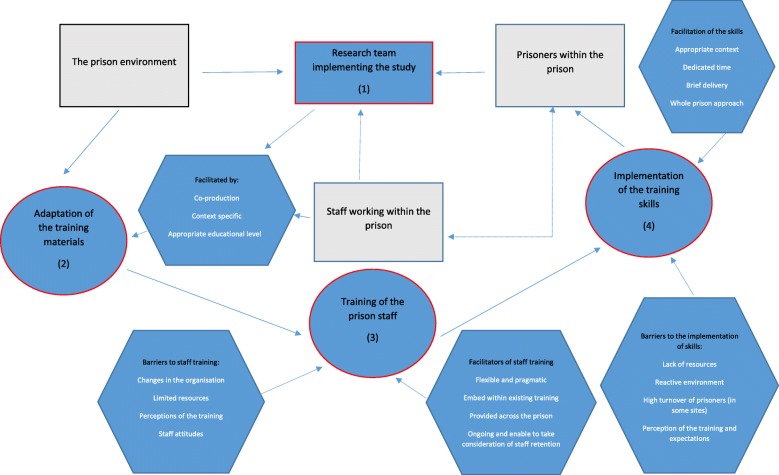
The process involved i) adaptation of the training materials using focus groups with prison staff and prisoners, ii) training frontline prison staff to use the skills, and iii) implementation of the skills with prisoners at risk of self-harm. Qualitative interviews were conducted with prison staff, prisoners and field researchers and were analysed using a thematic framework to produce a model of the barriers and facilitators to the process.
We conducted 43 interviews across three prison sites. The interviews included 19 prison staff, 18 prisoners and six field researcher meetings. The adaptation to the training and intervention materials were well received. The findings identified the need to support training using a collaborative and flexible approach. Prisoner engagement was affected by their own personal circumstances and by a range of contextual issues relating to the prison environment. Implementation of the skills by prison staff were hindered by resource constraints, the prison environment and staff attitudes.
We found that it was feasible to adapt an existing intervention and contextualise it within the prison environment. Although we could train large numbers of staff it was deemed unfeasible for staff to implement the problem-solving skills to prisoners at risk of self-harm. Prisoners who engaged with the intervention reported a range of benefits. Alternative implementation mechanisms to tackle the contextual barriers proposed by staff and prisoners included delivery of the intervention using an educational setting and/or use of a prisoner peer-led scheme.
社会问题解决是一种用于帮助减少自我伤害发生率的技术。我们的研究评估了对一种简短的问题解决训练(PST)干预措施进行调整并在监狱中实施以减少自我伤害的可行性和可接受性。
该过程包括:i)通过与监狱工作人员和囚犯进行焦点小组讨论来改编培训材料;ii)培训一线监狱工作人员使用这些技能;iii)对有自我伤害风险的囚犯实施这些技能。对监狱工作人员、囚犯和实地研究人员进行了定性访谈,并使用主题框架进行分析,以建立该过程中障碍和促进因素的模型。
我们在三个监狱地点进行了43次访谈。访谈包括19名监狱工作人员、18名囚犯和6次实地研究人员会议。对培训和干预材料的改编受到好评。研究结果表明需要采用协作和灵活的方法来支持培训。囚犯的参与受到其个人情况以及与监狱环境相关的一系列背景问题的影响。监狱工作人员实施这些技能受到资源限制、监狱环境和工作人员态度的阻碍。
我们发现改编现有干预措施并将其在监狱环境中进行情境化是可行的。虽然我们可以培训大量工作人员,但让工作人员对有自我伤害风险的囚犯实施问题解决技能被认为是不可行的。参与该干预措施的囚犯报告了一系列益处。解决工作人员和囚犯提出的背景障碍的替代实施机制包括在教育环境中提供干预措施和/或使用囚犯同伴主导的计划。