Ekpenyong Moses E, Etebong Philip I, Jackson Tenderwealth C
Department of Computer Science, University of Uyo, Nigeria.
Department of Pharmaceutics and Pharmaceutical Technology, University of Uyo, Nigeria.
Heliyon. 2019 Jul 20;5(7):e02080. doi: 10.1016/j.heliyon.2019.e02080. eCollection 2019 Jul.
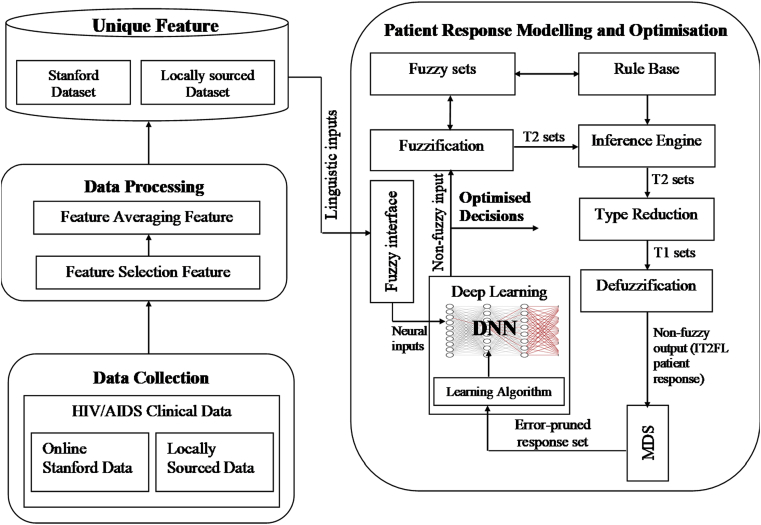
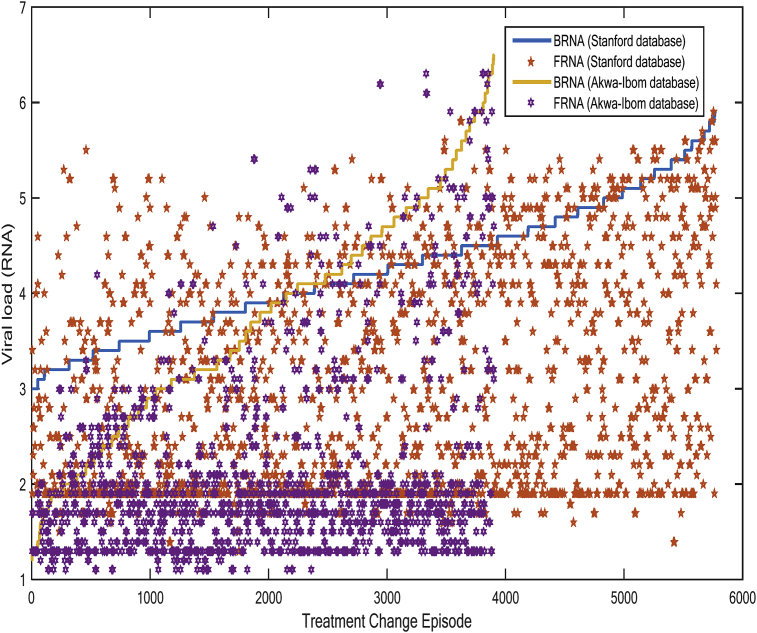
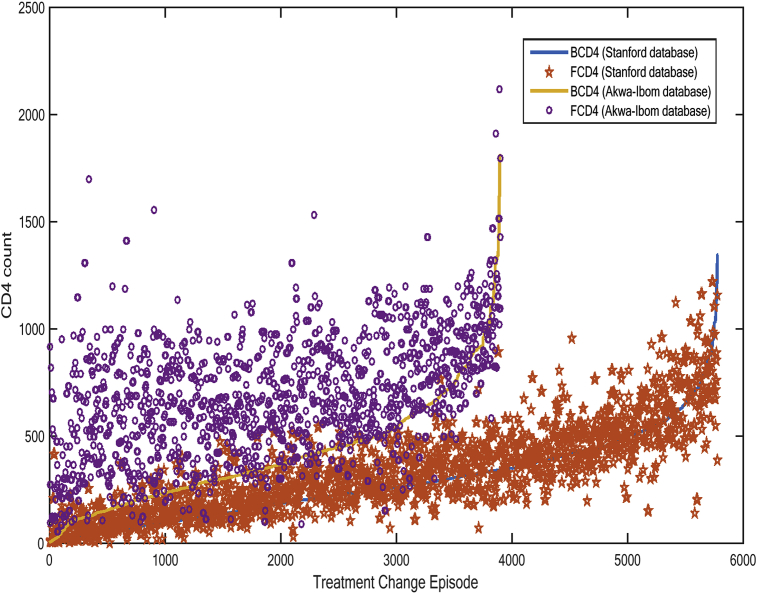
Drug component interactions are most likely to trigger unexpected pharmacological effects with unknown causal mechanisms, hence, demanding the discovery of patterns to establish suitable and effective regimens. This paper proposes a novel framework that embeds machine learning (ML) and multidimensional scaling (MDS) techniques, for efficient prediction of patient response to antiretroviral therapy (ART). To achieve this, experiment databases were created from two independent sources: a publicly available HIV domain datasets of patients with failed treatment - hosted by the Stanford University, hereinafter referred to as the Stanford HIV database, and locally sourced datasets gathered from 13 prominent healthcare facilities treating HIV patients in Akwa Ibom State of Nigeria, hereinafter referred to as the Akwa-Ibom HIV database: with 5,780 and 3,168 individual treatment change episodes (TCEs) of HIV treatment indicators (baseline CD4 count (BCD4), followup CD4 count (FCD4), baseline viral load (BRNA), followup viral load (FRNA), and drug type combination (DType)), observed from 1,521 and 1,301 unique patient records, respectively. A hybridised (two-stage) classification system consuming the Interval Type-2 Fuzzy Logic (IT2FL) and Deep Neural Network (DNN) was employed to model and optimise patients' response to ART with appreciable error pruning achieved through MDS. Visualisation of the experiment databases showed remarkable immunological changes in the Akwa-Ibom HIV database, as the FCD4 of TCEs clustered far above the BCD4, compared to the Stanford HIV database, where over 40% of FCD4 clustered below the BCD4. Similar changes were noticed for the RNA, as more FRNA copies clustered below the BRNA for the Akwa-Ibom datasets, compared to the Stamford datasets. DNN classification results for both databases showed best performance metrics for the Levenberg-Marquardt algorithm when compared with the resilient backpropagation algorithm, with improved drug pattern predictions for experiment with MDS. This paper is most likely to evolve an avenue that triggers interesting combination(s) for optimum patient response, while ensuring minimal side effects, as further findings revealed the superiority of the proposed approach over existing approaches.
药物成分相互作用最有可能引发因果机制不明的意外药理作用,因此,需要发现规律以建立合适且有效的治疗方案。本文提出了一种嵌入机器学习(ML)和多维缩放(MDS)技术的新颖框架,用于有效预测患者对抗逆转录病毒疗法(ART)的反应。为此,实验数据库来自两个独立来源:由斯坦福大学托管的公开可用的治疗失败患者的HIV领域数据集,以下简称斯坦福HIV数据库,以及从尼日利亚阿夸伊博姆州13家治疗HIV患者的著名医疗机构收集的本地数据集,以下简称阿夸伊博姆HIV数据库:分别从1,521和1,301条独特的患者记录中观察到5,780和3,168个HIV治疗指标(基线CD4计数(BCD4)、随访CD4计数(FCD4)、基线病毒载量(BRNA)、随访病毒载量(FRNA)和药物类型组合(DType))的个体治疗变化事件(TCE)。采用了一种结合区间二型模糊逻辑(IT2FL)和深度神经网络(DNN)的混合(两阶段)分类系统来对患者对ART的反应进行建模和优化,并通过MDS实现了可观的误差修剪。实验数据库的可视化显示,阿夸伊博姆HIV数据库中出现了显著的免疫变化——与斯坦福HIV数据库相比,TCE的FCD4聚类远高于BCD4,在斯坦福HIV数据库中,超过40%的FCD4聚类低于BCD4。RNA也有类似变化,与斯坦福数据集相比,阿夸伊博姆数据集的更多FRNA拷贝聚类低于BRNA。与弹性反向传播算法相比,两个数据库的DNN分类结果在Levenberg-Marquardt算法下表现出最佳性能指标,MDS实验的药物模式预测得到了改进。本文很可能会开辟一条引发有趣组合以实现最佳患者反应的途径,同时确保副作用最小,因为进一步的研究结果表明所提出的方法优于现有方法。