Stanford University, California.
Autism Speaks, New York.
J Am Acad Child Adolesc Psychiatry. 2020 Nov;59(11):1252-1263.e3. doi: 10.1016/j.jaac.2019.07.938. Epub 2019 Aug 1.
Research Domain Criteria (RDoC) operationalizes a set of basic social dimensions that can be used to deconstruct sources of variation in social impairments across affected individuals, regardless of their diagnostic status. This is a necessary step toward the development of etiologically based and individualized treatments. The main objective of this investigation was to derive estimations of the RDoC social constructs from the Social Responsiveness Scale (SRS-2).
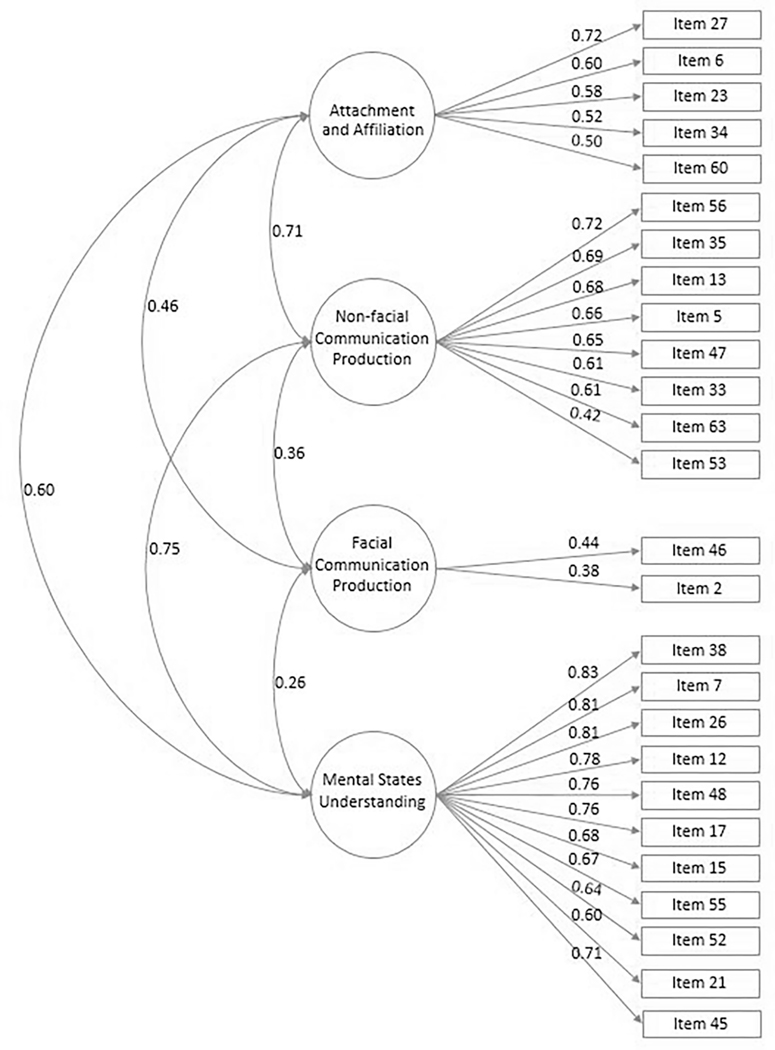
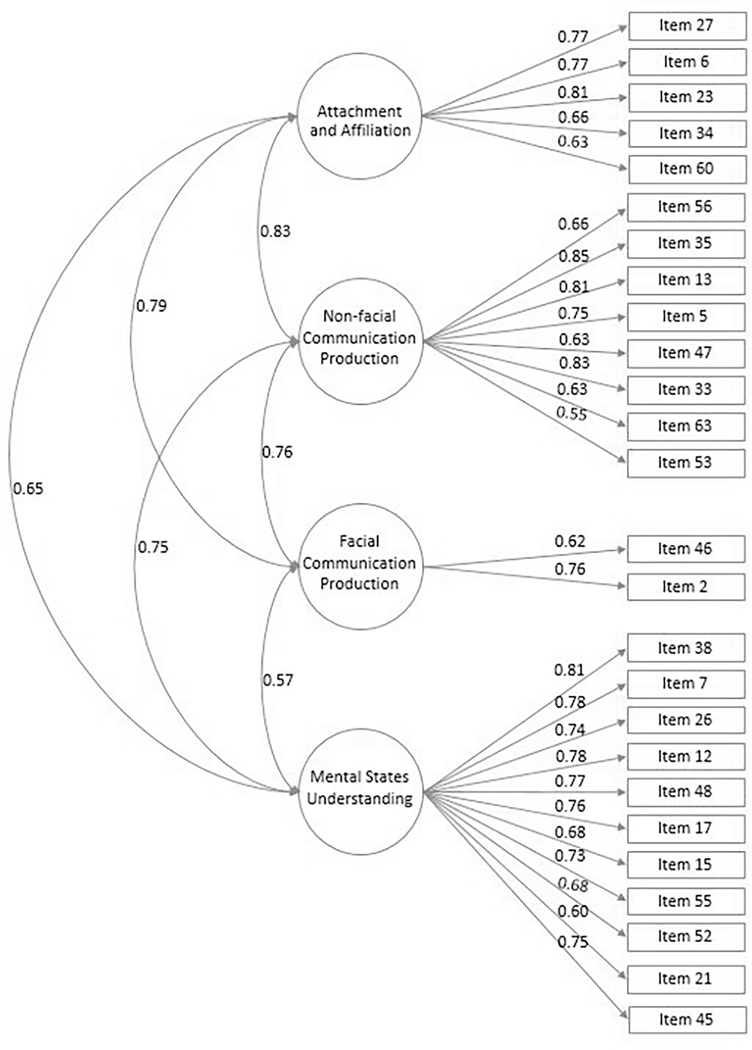
Exploratory structural equation modeling and confirmatory factor analysis were conducted using individual SRS-2 items from six distinct databases ( N = 27,953; mean age = 9.55 years, SD = 3.79; 71.7% male participants) spanning normative (33.8%) and atypical (66.2%) development. The following models were estimated: a one-factor model; a three-factor model with separate attachment and affiliation, social communication, and understanding of mental states factors; and a four-factor model where social communication was further split into production of facial and non-facial communication.
The one-factor solution showed poor fit. The three-factor solution had adequate fit (comparative fit index = 0.952, Tucker Lewis Index = 0.937, root mean square error of approximation = 0.054). However, the four-factor solution had superior fit (comparative fit index = 0.973, Tucker Lewis Index = 0.961, root mean square error of approximation = 0.042) and was robust across age, sex, and clinical status.
To our knowledge, this is the first study examining estimations of the RDoC social constructs from an existing measure. Reported findings show promise for capturing important RDoC social constructs using the SRS-2 and highlight crucial areas for the development of novel dimensional social processing measures.
研究领域标准(RDoC)将一套基本的社会维度进行操作化,这些维度可以用来解构受影响个体的社会障碍的变异来源,而不论其诊断状况如何。这是朝着开发基于病因和个体化治疗的方向迈出的必要一步。本研究的主要目的是从社会反应量表(SRS-2)中得出 RDoC 社会结构的估计值。
使用来自六个不同数据库的个体 SRS-2 项目(N=27953;平均年龄 9.55 岁,标准差 3.79;71.7%为男性参与者)进行探索性结构方程建模和验证性因子分析,涵盖了正常(33.8%)和异常(66.2%)发育。估计了以下模型:一个单因素模型;一个包含独立的依恋和亲和、社会沟通和心理状态理解的三因素模型;以及一个将社会沟通进一步分为面部和非面部沟通的四因素模型。
单因素模型拟合效果较差。三因素模型具有适当的拟合度(比较拟合指数=0.952,Tucker Lewis 指数=0.937,均方根误差近似值=0.054)。然而,四因素模型具有更好的拟合度(比较拟合指数=0.973,Tucker Lewis 指数=0.961,均方根误差近似值=0.042),并且在年龄、性别和临床状况方面具有稳健性。
据我们所知,这是第一项使用现有量表来检验 RDoC 社会结构估计值的研究。报告的发现表明,使用 SRS-2 可以很好地捕捉重要的 RDoC 社会结构,并突出了开发新型维度社会处理测量的关键领域。