Wang Jiahui, Wang Hao, He Tianyiyi, He Borong, Thakor Nitish V, Lee Chengkuo
Department of Electrical and Computer Engineering National University of Singapore 4 Engineering Drive 3 117576 Singapore.
Singapore Institute for Neurotechnology (SINAPSE) National University of Singapore 28 Medical Drive, #05-COR 117456 Singapore.
Adv Sci (Weinh). 2019 Jun 12;6(14):1900149. doi: 10.1002/advs.201900149. eCollection 2019 Jul 17.
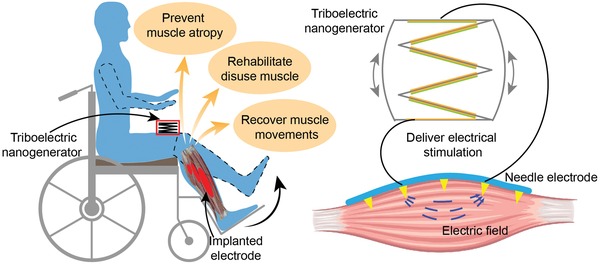
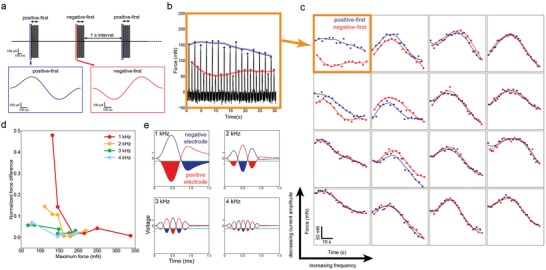
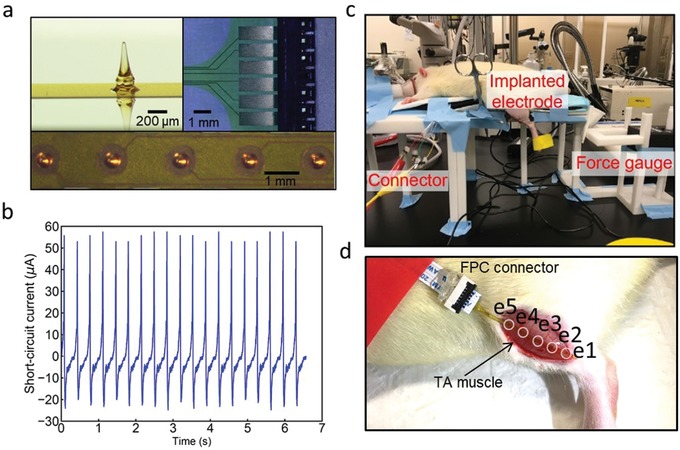
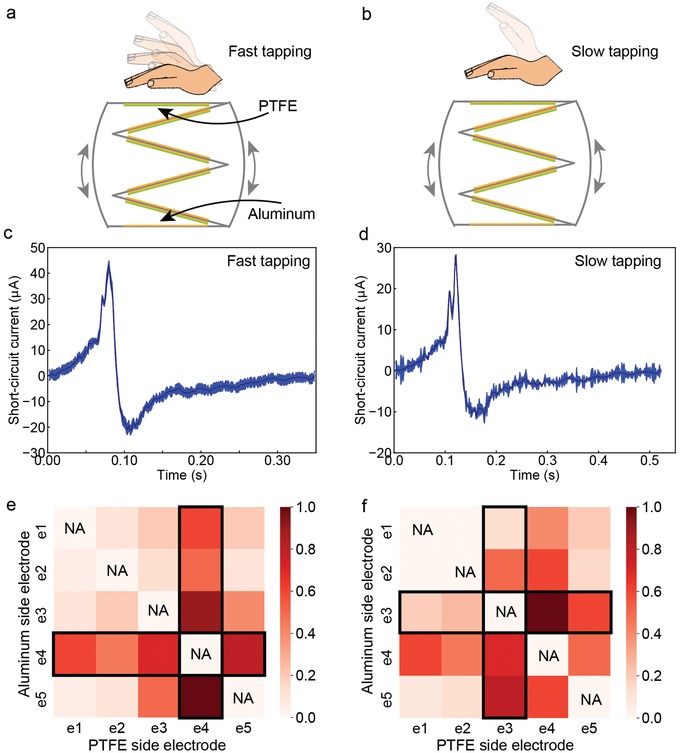
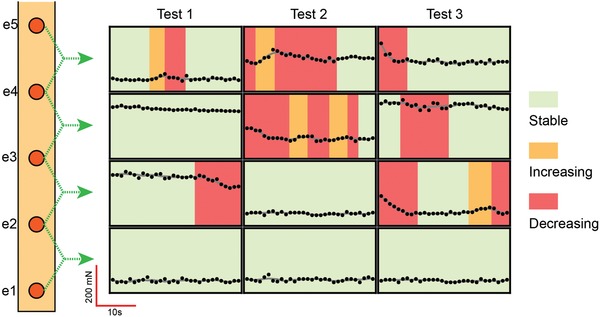
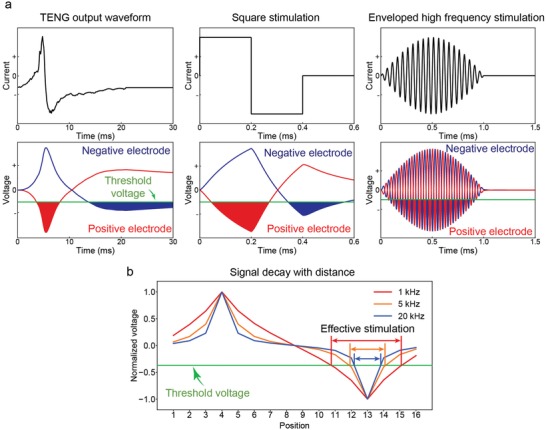
Muscle function loss is characterized as abnormal or completely lost muscle capabilities, and it can result from neurological disorders or nerve injuries. The currently available clinical treatment is to electrically stimulate the diseased muscles. Here, a self-powered system of a stacked-layer triboelectric nanogenerator (TENG) and a multiple-channel epimysial electrode to directly stimulate muscles is demonstrated. Then, the two challenges regarding direct TENG muscle stimulation are further investigated. For the first challenge of improving low-current TENG stimulation efficiency, it is found that the optimum stimulation efficiency can be achieved by conducting a systematic mapping with a multiple-channel epimysial electrode. The second challenge is TENG stimulation stability. It is found that the force output generated by TENGs is more stable than using the conventional square wave stimulation and enveloped high frequency stimulation. With modelling and in vivo measurements, it is confirmed that the two factors that account for the stable stimulation using TENGs are the long pulse duration and low current amplitude. The current waveform of TENGs can effectively avoid synchronous motoneuron recruitment at the two stimulation electrodes to reduce force fluctuation. Here, after investigating these two challenges, it is believed that TENG direct muscle stimulation could be used for rehabilitative and therapeutic purpose of muscle function loss treatment.
肌肉功能丧失的特征是肌肉能力异常或完全丧失,它可能由神经疾病或神经损伤引起。目前可用的临床治疗方法是对患病肌肉进行电刺激。在此,展示了一种由叠层摩擦电纳米发电机(TENG)和多通道肌外膜电极组成的自供电系统,用于直接刺激肌肉。然后,进一步研究了关于TENG直接刺激肌肉的两个挑战。对于提高低电流TENG刺激效率的第一个挑战,发现通过使用多通道肌外膜电极进行系统映射可以实现最佳刺激效率。第二个挑战是TENG刺激的稳定性。发现TENG产生的力输出比使用传统方波刺激和包络高频刺激更稳定。通过建模和体内测量,证实了使用TENG进行稳定刺激的两个因素是长脉冲持续时间和低电流幅度。TENG的电流波形可以有效避免在两个刺激电极处同步运动神经元募集,以减少力波动。在此,在研究了这两个挑战之后,认为TENG直接肌肉刺激可用于肌肉功能丧失治疗的康复和治疗目的。