Faculty of Biology, Hanoi National University of Education, Hanoi 100000, Vietnam.
School of Odonto Stomatology, Hanoi Medical University, Hanoi 100000, Vietnam.
Cells. 2019 Aug 8;8(8):857. doi: 10.3390/cells8080857.
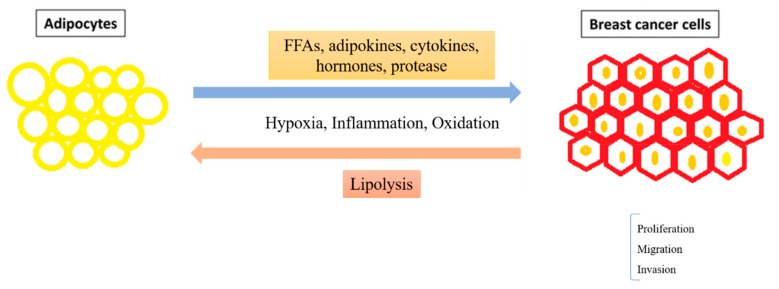
Obesity is a global pandemic and it is well evident that obesity is associated with the development of many disorders including many cancer types. Breast cancer is one of that associated with a high mortality rate. Adipocytes, a major cellular component in adipose tissue, are dysfunctional during obesity and also known to promote breast cancer development both in vitro and in vivo. Dysfunctional adipocytes can release metabolic substrates, adipokines, and cytokines, which promote proliferation, progression, invasion, and migration of breast cancer cells. The secretion of adipocytes can alter gene expression profile, induce inflammation and hypoxia, as well as inhibit apoptosis. It is known that excessive free fatty acids, cholesterol, triglycerides, hormones, leptin, interleukins, and chemokines upregulate breast cancer development. Interestingly, adiponectin is the only adipokine that has anti-tumor properties. Moreover, adipocytes are also related to chemotherapeutic resistance, resulting in the poorer outcome of treatment and advanced stages in breast cancer. Evaluation of the adipocyte secretion levels in the circulation can be useful for prognosis and evaluation of the effectiveness of cancer therapy in the patients. Therefore, understanding about functions of adipocytes as well as obesity in breast cancer may reveal novel targets that support the development of new anti-tumor therapy. In this systemic review, we summarize and update the effects of secreted factors by adipocytes on the regulation of breast cancer in the tumor microenvironment.
肥胖是一种全球性的流行疾病,很明显肥胖与许多疾病的发展有关,包括许多癌症类型。乳腺癌就是其中一种与高死亡率相关的癌症。脂肪细胞是脂肪组织中的主要细胞成分,在肥胖时功能失调,并且已知在体外和体内都能促进乳腺癌的发展。功能失调的脂肪细胞可以释放代谢底物、脂肪因子和细胞因子,促进乳腺癌细胞的增殖、进展、侵袭和迁移。脂肪细胞的分泌可以改变基因表达谱,诱导炎症和缺氧,并抑制细胞凋亡。已知过多的游离脂肪酸、胆固醇、甘油三酯、激素、瘦素、白细胞介素和趋化因子会上调乳腺癌的发展。有趣的是,脂联素是唯一具有抗肿瘤特性的脂肪因子。此外,脂肪细胞还与化疗耐药性有关,导致乳腺癌患者的治疗效果较差和病情进展到晚期。评估循环中脂肪细胞分泌水平可用于预后和评估癌症治疗的效果。因此,了解脂肪细胞以及肥胖在乳腺癌中的作用可能揭示新的靶点,支持新的抗肿瘤治疗方法的发展。在这篇系统综述中,我们总结和更新了脂肪细胞分泌的因子对肿瘤微环境中乳腺癌调节的影响。