Hopkins Marine Station, Stanford University, Pacific Grove, CA 93950, USA.
Woods Institute for the Environment, Stanford University, Stanford, CA 94305, USA.
Philos Trans R Soc Lond B Biol Sci. 2019 Sep 30;374(1782):20180342. doi: 10.1098/rstb.2018.0342. Epub 2019 Aug 12.
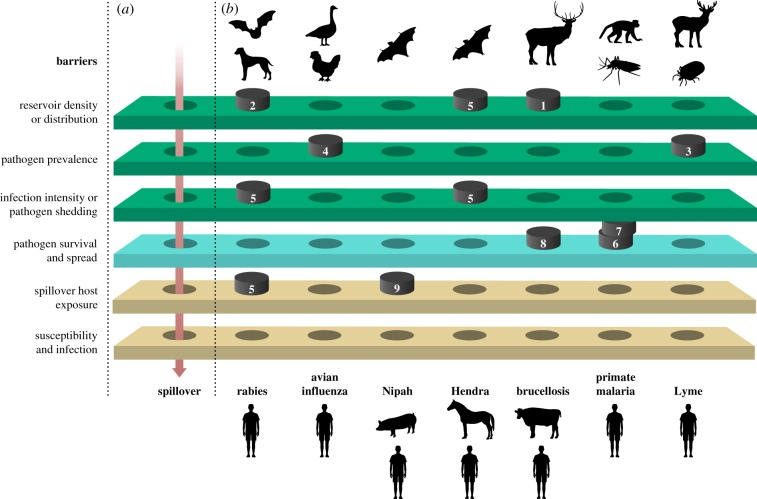
Spillover of a pathogen from a wildlife reservoir into a human or livestock host requires the pathogen to overcome a hierarchical series of barriers. Interventions aimed at one or more of these barriers may be able to prevent the occurrence of spillover. Here, we demonstrate how interventions that target the ecological context in which spillover occurs (i.e. ecological interventions) can complement conventional approaches like vaccination, treatment, disinfection and chemical control. Accelerating spillover owing to environmental change requires effective, affordable, durable and scalable solutions that fully harness the complex processes involved in cross-species pathogen spillover. This article is part of the theme issue 'Dynamic and integrative approaches to understanding pathogen spillover'.
从野生动物宿主到人类或牲畜的病原体溢出,需要病原体克服一系列层次的障碍。旨在阻止一个或多个这些障碍的干预措施可能能够防止溢出的发生。在这里,我们展示了针对溢出发生的生态背景(即生态干预)的干预措施如何能够补充传统方法,如疫苗接种、治疗、消毒和化学控制。由于环境变化而加速溢出,需要有效的、负担得起的、持久的和可扩展的解决方案,这些解决方案要充分利用涉及跨物种病原体溢出的复杂过程。本文是主题为“理解病原体溢出的动态和综合方法”的一部分。