Program in Health Services and Systems Research, Duke-NUS Medical School, Singapore, Singapore.
Syst Rev. 2019 Aug 13;8(1):202. doi: 10.1186/s13643-019-1105-6.
Healthcare needs-based population segmentation is a promising approach for enabling the development and evaluation of integrated healthcare service models that meet healthcare needs. However, healthcare policymakers interested in understanding adult population healthcare needs may not be aware of suitable population segmentation tools available for use in the literature and barring better-known alternatives, may reinvent the wheel by creating and validating their own tools rather than adapting available tools in the literature. Therefore, we undertook a systematic review to identify all available tools which operationalize healthcare need-based population segmentation, to help inform policymakers developing population-level health service programmes.
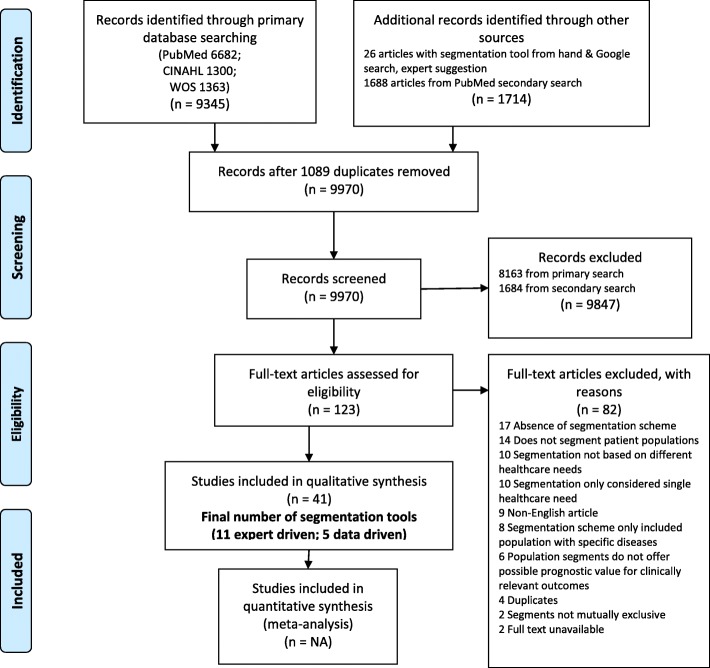
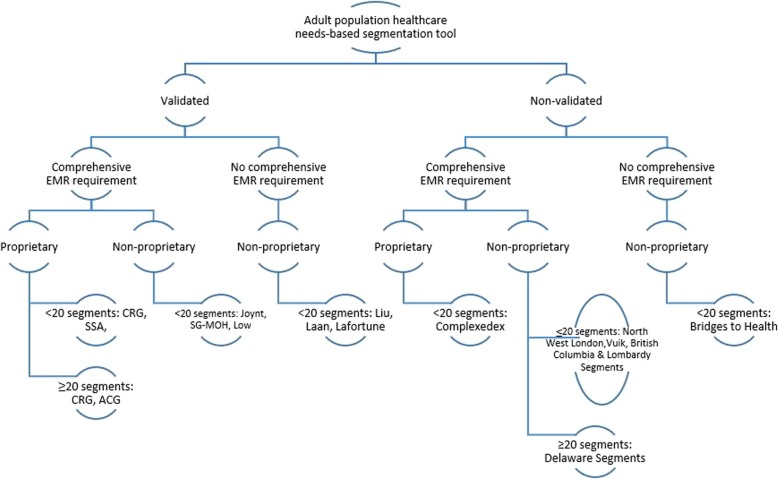
Using search terms reflecting concepts of population, healthcare need and segmentation, we systematically reviewed and included articles containing healthcare need-based adult population segmentation tools in PubMed, CINAHL and Web of Science databases. We included tools comprising mutually exclusive segments with prognostic value for clinically relevant outcomes. An updated secondary search on the PubMed database was also conducted as the last search was conducted 2 years ago. All identified tools were characterized in terms of segment formulation, segmentation base, whether they received peer-reviewed validation, requirement for comprehensive electronic medical records, proprietary status and number of segments.
A total of 16 unique tools were identified from systematically reviewing 9970 articles. Peer-reviewed validation studies were found for 9 of these tools.
The underlying segmentation basis of most identified tools was found to be conceptually comparable to each other which suggests a broad recognition of archetypical patient overall healthcare need profiles. While many tools operate based on administrative record data, it is noted that healthcare systems without comprehensive electronic medical records would benefit from tools which segment populations through primary data collection. Future work could therefore include development and validation of such primary data collection-based tools. While this study is limited by exclusion of non-English literature, the identified and characterized tools will nonetheless facilitate efforts by policymakers to improve patient-centred care through development and evaluation of services tailored for specific populations segmented by these tools.
基于医疗需求的人口细分是一种很有前途的方法,可以帮助开发和评估满足医疗需求的综合医疗服务模式。然而,有兴趣了解成年人口医疗需求的医疗保健政策制定者可能不知道可用的文献中适合使用的人口细分工具,除了更知名的替代工具外,他们可能会通过创建和验证自己的工具而不是采用文献中的可用工具来重新发明轮子。因此,我们进行了系统评价,以确定所有可用于基于医疗需求的人口细分的现有工具,以帮助制定人口层面卫生服务计划的政策制定者。
使用反映人口、医疗需求和细分概念的搜索词,我们系统地审查并纳入了包含在 PubMed、CINAHL 和 Web of Science 数据库中的基于医疗需求的成年人口细分工具的文章。我们纳入了具有临床相关结果预测价值的相互排斥的细分工具。还对 PubMed 数据库进行了一次更新的二次搜索,因为最后一次搜索是在 2 年前进行的。根据细分方法、细分基础、是否经过同行评审验证、是否需要综合电子病历、专有权状况以及细分段数对所有确定的工具进行了特征描述。
从系统审查的 9970 篇文章中总共确定了 16 种独特的工具。其中 9 种工具的同行评审验证研究。
大多数确定的工具的基本细分基础被发现彼此概念上相似,这表明对典型患者整体医疗需求概况有广泛的认识。虽然许多工具基于管理记录数据运作,但值得注意的是,没有全面电子病历的医疗系统将受益于通过原始数据收集细分人群的工具。因此,未来的工作可以包括开发和验证这种基于原始数据收集的工具。尽管这项研究受到排除非英语文献的限制,但所确定和描述的工具将有助于政策制定者通过开发和评估针对这些工具细分的特定人群量身定制的服务来改善以患者为中心的护理。