Zhang Lun, Zhao Guo-Xu, Zhao Yu-Qin, Qiu Yi-Ting, Chi Chang-Feng, Wang Bin
Zhejiang Provincial Engineering Technology Research Center of Marine Biomedical Products, School of Food and Pharmacy, Zhejiang Ocean University, Zhoushan 316022, China.
National and Provincial Joint Laboratory of Exploration and Utilization of Marine Aquatic Genetic Resources, National Engineering Research Center of Marine Facilities Aquaculture, School of Marine Science and Technology, Zhejiang Ocean University, Zhoushan 316022, China.
Antioxidants (Basel). 2019 Aug 19;8(8):318. doi: 10.3390/antiox8080318.
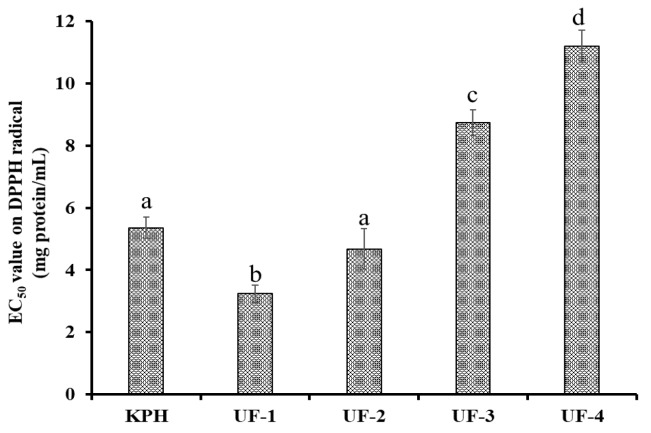
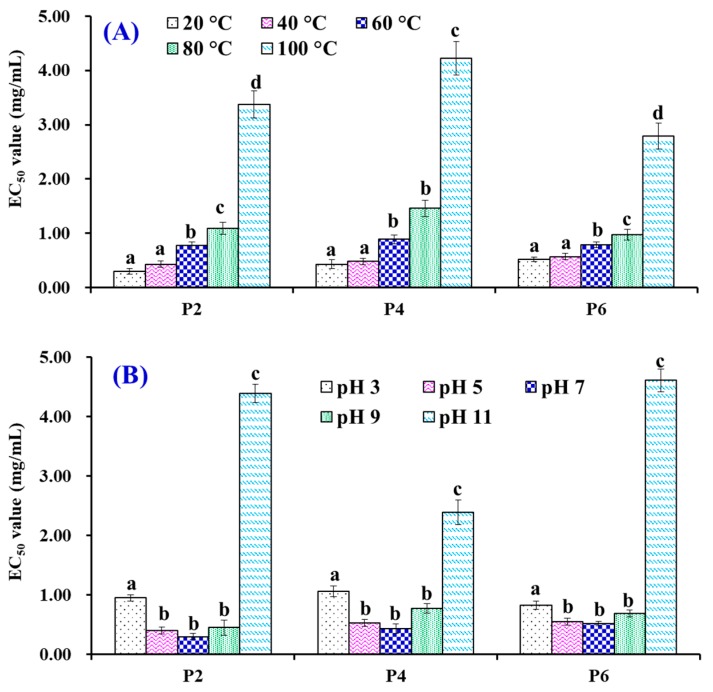
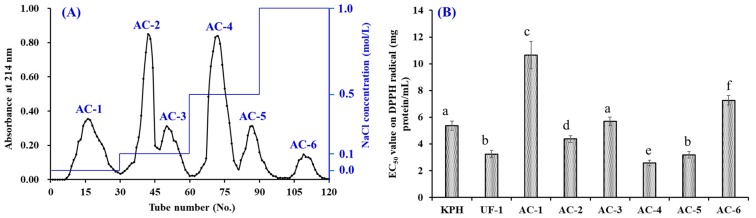
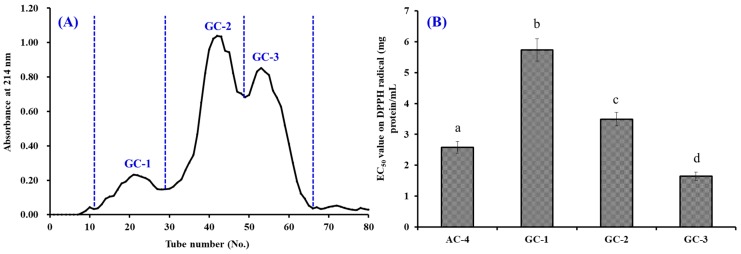
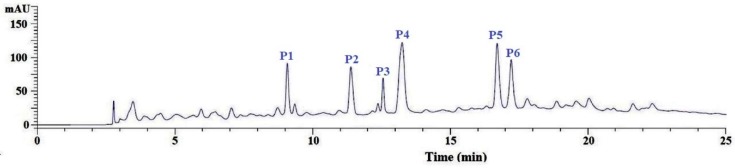
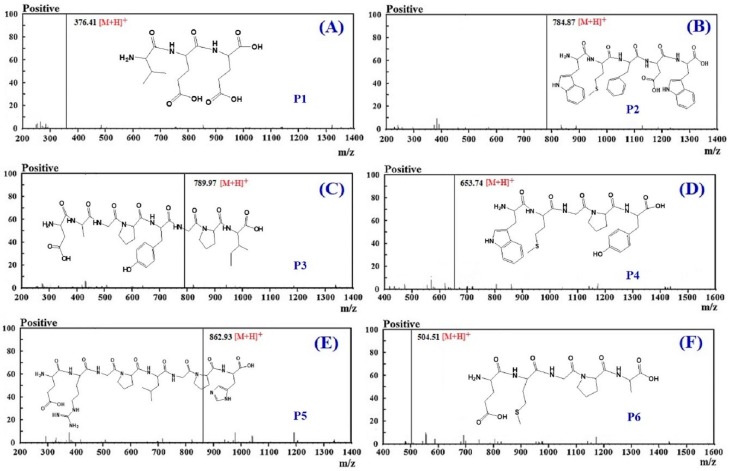
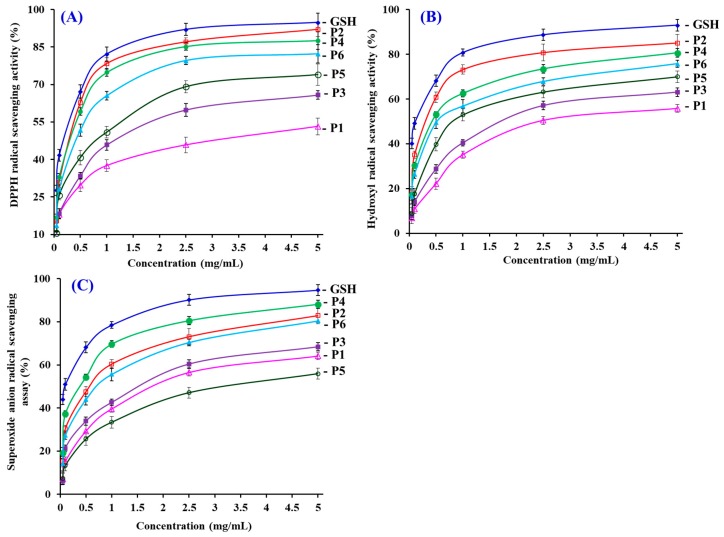
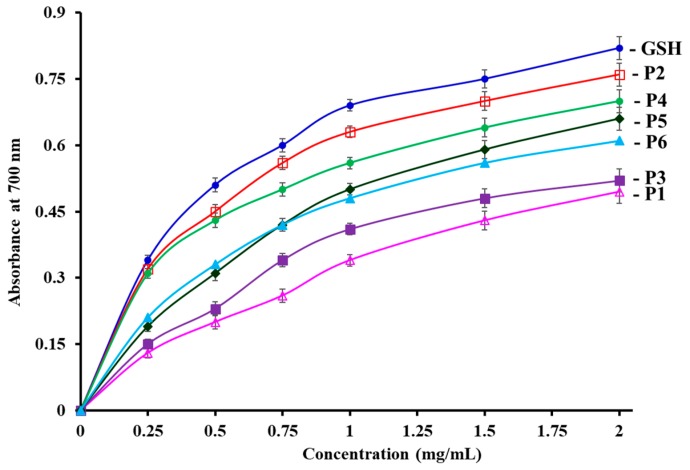
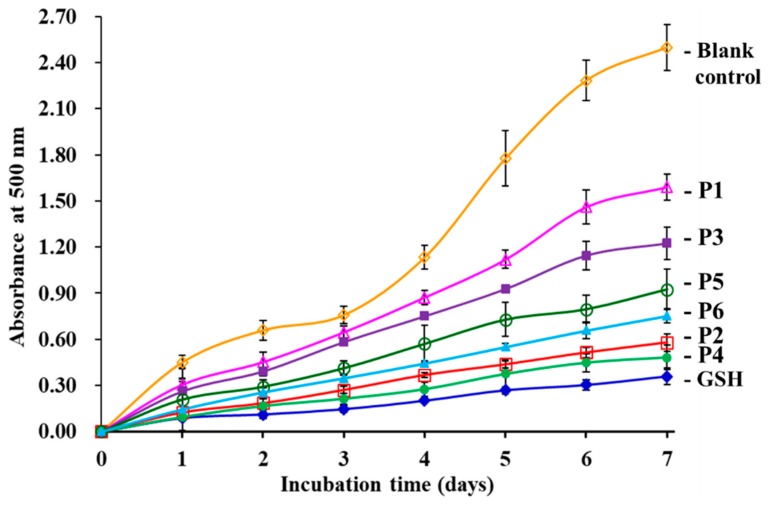
For the full use of fish by-products to produce antioxidant peptides, skipjack tuna () heads generated during can processing were defatted and hydrolyzed using the in vitro gastrointestinal (GI) digestion (pepsin-trypsin system) method and six antioxidant peptides (P1 to P6) were purified from the head hydrolysate (KPH) using ultrafiltration and serial chromatography methods. Six isolated peptides (P1 to P6) were identified as Val-Glu-Glu (VEE, P1), Trp-Met-Phe-Asp-Trp (WMFDW, P2), Asp-Ala-Gly-Pro-Tyr-Gly-Pro-Ile (DAGPYGPI, P3), Trp-Met-Gly-Pro-Tyr (WMGPY, P4), Glu-Arg-Gly-Pro-Leu-Gly-Pro-His (ERGPLGPH, P5), and Glu-Met- Gly-Pro-Ala (EMGPA, P6), respectively, using a protein sequencer and electrospray ionization-mass spectrometer. Among skipjack tuna head hydrolysates, fractions, and six isolated peptides (P1 to P6), WMFDW (P2), WMGPY (P4), and EMGPA (P6) showed the highest radical scavenging activities on 2,2-diphenyl-1-picrylhydrazyl (DPPH) (EC values of 0.31, 0.33, and 0.46 mg/mL for WMFDW, WMGPY, and EMGPA, respectively), hydroxyl (EC values of 0.30, 0.43, and 0.52 mg/mL for WMFDW, WMGPY, and EMGPA, respectively), and superoxide anion (EC values of 0.56, 0.38, and 0.71 mg/mL for WMFDW, WMGPY, and EMGPA, respectively). Moreover, WMFDW, WMGPY, and EMGPA showed strong capability in reducing power and lipd peroxidation inhibition in the linoleic acid system. In addition, WMFDW, WMGPY, and EMGPA can retain strong antioxidant activity at temperatures lower than 60 °C and pH values ranged from 5 to 9. The results showed that six isolated peptides (P1 to P6) from skipjack tuna heads, especially WMFDW, WMGPY, and EMGPA, might be applied in health care products acting as powerful antioxidant agents.
为了充分利用鱼类副产品来生产抗氧化肽,对罐头加工过程中产生的鲣鱼()鱼头进行脱脂处理,并采用体外胃肠道(GI)消化(胃蛋白酶 - 胰蛋白酶系统)方法进行水解,然后使用超滤和串联色谱法从鱼头水解物(KPH)中纯化出六种抗氧化肽(P1至P6)。使用蛋白质测序仪和电喷雾电离 - 质谱仪分别将六种分离出的肽(P1至P6)鉴定为Val - Glu - Glu(VEE,P1)、Trp - Met - Phe - Asp - Trp(WMFDW,P2)、Asp - Ala - Gly - Pro - Tyr - Gly - Pro - Ile(DAGPYGPI,P3)、Trp - Met - Gly - Pro - Tyr(WMGPY,P4)、Glu - Arg - Gly - Pro - Leu - Gly - Pro - His(ERGPLGPH,P5)和Glu - Met - Gly - Pro - Ala(EMGPA,P6)。在鲣鱼鱼头水解物、馏分和六种分离出的肽(P1至P6)中,WMFDW(P2)、WMGPY(P4)和EMGPA(P6)对2,2 - 二苯基 - 1 - 苦基肼(DPPH)表现出最高的自由基清除活性(WMFDW、WMGPY和EMGPA的EC值分别为0.31、0.33和0.46 mg/mL)、羟基(WMFDW、WMGPY和EMGPA的EC值分别为0.30、0.43和0.52 mg/mL)以及超氧阴离子(WMFDW、WMGPY和EMGPA的EC值分别为0.56、0.38和0.71 mg/mL)。此外,WMFDW、WMGPY和EMGPA在亚油酸体系中表现出很强的还原能力和抑制脂质过氧化的能力。此外,WMFDW、WMGPY和EMGPA在低于60°C的温度和pH值范围为5至9时能保持较强的抗氧化活性。结果表明,从鲣鱼鱼头中分离出的六种肽(P1至P6),尤其是WMFDW、WMGPY和EMGPA,可能作为强大的抗氧化剂应用于保健品中。