Department of Microbiology and Immunology, Albert Einstein College of Medicine, Bronx, NY, United States.
Department of Microbiology and Immunology, Albert Einstein College of Medicine, Bronx, NY, United States.
Adv Virus Res. 2019;104:185-224. doi: 10.1016/bs.aivir.2019.07.002. Epub 2019 Aug 7.
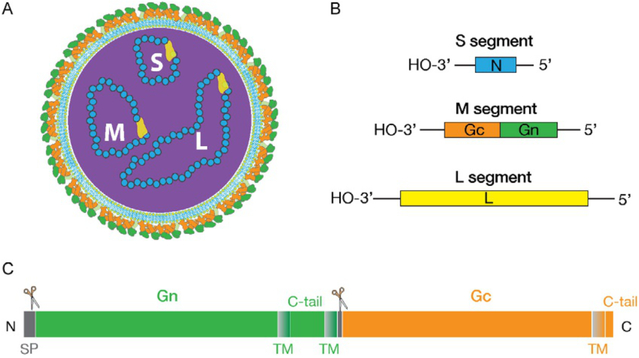
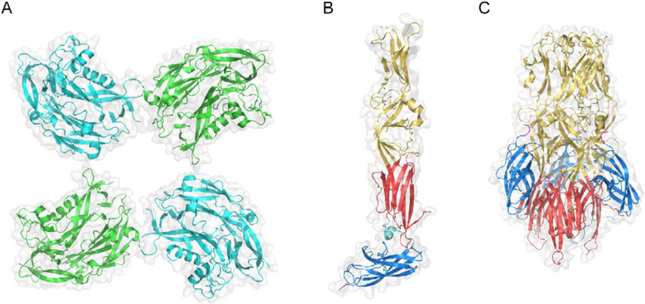
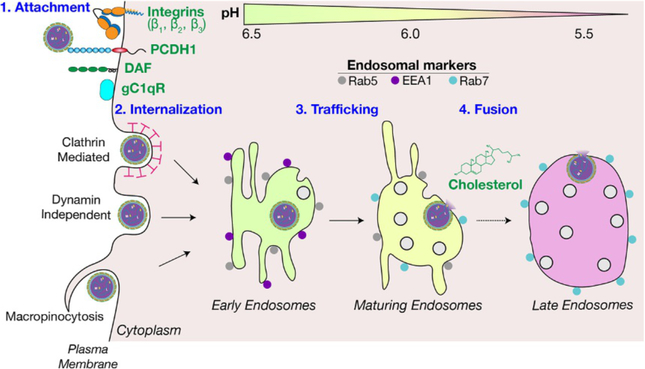
Hantaviruses are important zoonotic pathogens of public health importance that are found on all continents except Antarctica and are associated with hemorrhagic fever with renal syndrome (HFRS) in the Old World and hantavirus pulmonary syndrome (HPS) in the New World. Despite the significant disease burden they cause, no FDA-approved specific therapeutics or vaccines exist against these lethal viruses. The lack of available interventions is largely due to an incomplete understanding of hantavirus pathogenesis and molecular mechanisms of virus replication, including cellular entry. Hantavirus Gn/Gc glycoproteins are the only viral proteins exposed on the surface of virions and are necessary and sufficient to orchestrate virus attachment and entry. In vitro studies have implicated integrins (β), DAF/CD55, and gC1qR as candidate receptors that mediate viral attachment for both Old World and New World hantaviruses. Recently, protocadherin-1 (PCDH1) was demonstrated as a requirement for cellular attachment and entry of New World hantaviruses in vitro and lethal HPS in vivo, making it the first clade-specific host factor to be identified. Attachment of hantavirus particles to cellular receptors induces their internalization by clathrin-mediated, dynamin-independent, or macropinocytosis-like mechanisms, followed by particle trafficking to an endosomal compartment where the fusion of viral and endosomal membranes can occur. Following membrane fusion, which requires cholesterol and acid pH, viral nucleocapsids escape into the cytoplasm and launch genome replication. In this review, we discuss the current mechanistic understanding of hantavirus entry, highlight gaps in our existing knowledge, and suggest areas for future inquiry.
汉坦病毒是重要的人畜共患病病原体,存在于除南极洲以外的所有大陆,与旧世界的肾综合征出血热(HFRS)和新世界的汉坦病毒肺综合征(HPS)有关。尽管它们造成了巨大的疾病负担,但目前还没有获得 FDA 批准的针对这些致命病毒的特定治疗方法或疫苗。缺乏可用的干预措施在很大程度上是由于对汉坦病毒发病机制和病毒复制的分子机制(包括细胞进入)的不完全了解。汉坦病毒 Gn/Gc 糖蛋白是唯一暴露在病毒粒子表面的病毒蛋白,是协调病毒附着和进入所必需的和充分的。体外研究表明整合素(β)、DAF/CD55 和 gC1qR 是介导旧世界和新世界汉坦病毒病毒附着的候选受体。最近,原钙黏蛋白 1(PCDH1)被证明是新世界汉坦病毒体外细胞附着和进入以及体内致命 HPS 的必需条件,使其成为第一个被鉴定的属特异性宿主因子。汉坦病毒颗粒与细胞受体的附着诱导它们通过网格蛋白介导的、与动力蛋白无关的或类似胞饮的机制内化,随后颗粒被转运到内体区室,在那里病毒和内体膜可以融合。在膜融合之后,需要胆固醇和酸性 pH 值,病毒核衣壳逃逸到细胞质中并启动基因组复制。在这篇综述中,我们讨论了汉坦病毒进入的当前机制理解,强调了我们现有知识中的差距,并提出了未来研究的方向。