Department of Electronics, Telecommunications and Informatics, University of Aveiro, Aveiro, Portugal.
Institute of Electronics and Informatics Engineering of Aveiro, University of Aveiro, Aveiro, Portugal.
JMIR Mhealth Uhealth. 2019 Aug 23;7(8):e12649. doi: 10.2196/12649.
Technological advancements, together with the decrease in both price and size of a large variety of sensors, has expanded the role and capabilities of regular mobile phones, turning them into powerful yet ubiquitous monitoring systems. At present, smartphones have the potential to continuously collect information about the users, monitor their activities and behaviors in real time, and provide them with feedback and recommendations.
This systematic review aimed to identify recent scientific studies that explored the passive use of smartphones for generating health- and well-being-related outcomes. In addition, it explores users' engagement and possible challenges in using such self-monitoring systems.
A systematic review was conducted, following Preferred Reporting Items for Systematic Reviews and Meta-Analyses guidelines, to identify recent publications that explore the use of smartphones as ubiquitous health monitoring systems. We ran reproducible search queries on PubMed, IEEE Xplore, ACM Digital Library, and Scopus online databases and aimed to find answers to the following questions: (1) What is the study focus of the selected papers? (2) What smartphone sensing technologies and data are used to gather health-related input? (3) How are the developed systems validated? and (4) What are the limitations and challenges when using such sensing systems?
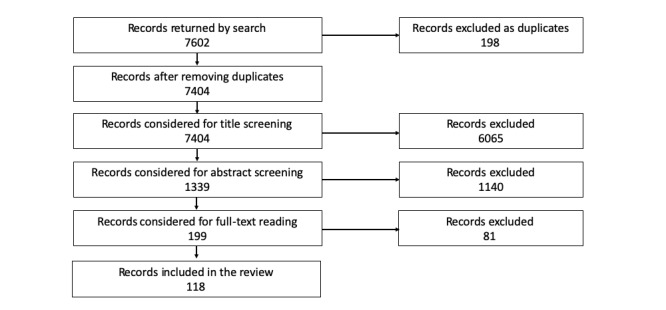
Our bibliographic research returned 7404 unique publications. Of these, 118 met the predefined inclusion criteria, which considered publication dates from 2014 onward, English language, and relevance for the topic of this review. The selected papers highlight that smartphones are already being used in multiple health-related scenarios. Of those, physical activity (29.6%; 35/118) and mental health (27.9; 33/118) are 2 of the most studied applications. Accelerometers (57.7%; 67/118) and global positioning systems (GPS; 40.6%; 48/118) are 2 of the most used sensors in smartphones for collecting data from which the health status or well-being of its users can be inferred.
One relevant outcome of this systematic review is that although smartphones present many advantages for the passive monitoring of users' health and well-being, there is a lack of correlation between smartphone-generated outcomes and clinical knowledge. Moreover, user engagement and motivation are not always modeled as prerequisites, which directly affects user adherence and full validation of such systems.
随着各种传感器的价格和尺寸不断缩小,技术也在不断进步,这使得普通手机的功能和作用得到了扩展,将其转变为强大而无处不在的监测系统。目前,智能手机有潜力持续收集有关用户的信息,实时监测他们的活动和行为,并为他们提供反馈和建议。
本系统评价旨在确定最近探索使用智能手机生成与健康和幸福感相关结果的科学研究。此外,它还探讨了用户在使用此类自我监测系统时的参与度和可能面临的挑战。
我们遵循系统评价和荟萃分析的首选报告项目指南进行了系统评价,以确定最近探索使用智能手机作为普遍健康监测系统的研究。我们在 PubMed、IEEE Xplore、ACM 数字图书馆和 Scopus 在线数据库中进行了可重复的搜索查询,并旨在回答以下问题:(1)所选论文的研究重点是什么?(2)用于收集健康相关输入的智能手机感应技术和数据有哪些?(3)开发的系统如何进行验证?(4)使用这种感应系统时的局限性和挑战有哪些?
我们的文献研究返回了 7404 个独特的出版物。其中,有 118 篇符合预定义的纳入标准,这些标准考虑了从 2014 年开始的出版日期、英语语言以及与本评论主题的相关性。所选论文强调,智能手机已经在多个与健康相关的场景中得到应用。在这些场景中,身体活动(29.6%;35/118)和心理健康(27.9%;33/118)是研究最多的两个应用领域。智能手机中用于收集数据的最常用传感器是加速度计(57.7%;67/118)和全球定位系统(GPS;40.6%;48/118),可以从中推断用户的健康状况或幸福感。
本系统评价的一个重要结果是,尽管智能手机在被动监测用户健康和幸福感方面具有许多优势,但智能手机生成的结果与临床知识之间缺乏相关性。此外,用户参与度和动机并非总是作为前提条件进行建模,这直接影响到用户的依从性和此类系统的全面验证。