Research Center for Primary Health Development and General Practice Education, Jiangsu Vocational College of Medicine, Yancheng, Jiangsu, China (mainland).
VIP Internal Medicine, The First Hospital of Lanzhou University, Lanzhou, Gansu, China (mainland).
Med Sci Monit. 2019 Aug 28;25:6446-6453. doi: 10.12659/MSM.915917.
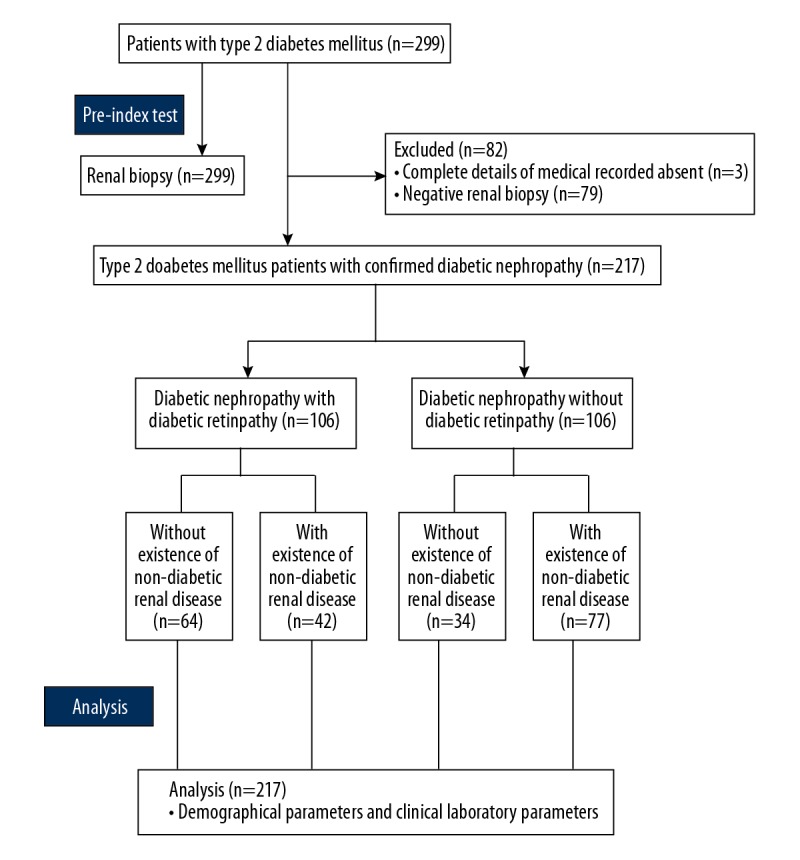
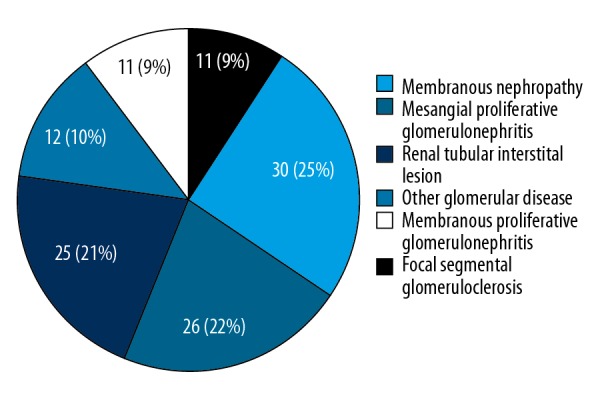
BACKGROUND It has been reported that diabetic nephropathy and diabetic retinopathy are associated with each other through a shared pathophysiological mechanism. However, it is quite difficult to differentiate diabetic nephropathy from other glomerular diseases if diabetic retinopathy is absent in patients, and the only way to do this is to perform renal biopsies. The objective of this study was to test the hypothesis that diabetic nephropathy patients with and without diabetic retinopathy have different clinical and laboratory profiles. MATERIAL AND METHODS Medical records of type 2 diabetes mellitus patients with confirmed diabetic nephropathy were reviewed and analyzed with appropriate statistical modalities. Presence of arteriolar sclerosis of the carotid artery, abdominal aorta, upper extremities, and first-order aortic branches was regarded as a peripheral vascular disease. RESULTS Out of 217 type 2 diabetes mellitus patients with confirmed diabetic nephropathy, retinopathy was present in 106 (48.8%), while 111 (51.2%) had no evidence of retinopathy. About 45% of patients had pure diabetic nephropathy without any diagnosis of non-diabetic renal diseases, of which membranous nephropathy was most common. Diabetic nephropathy patients with retinopathy and those without retinopathy differed in duration of hypertension (p=0.041), serum creatinine (p=0.031), albumin (p=0.001), and erythrocyte sedimentation rate (p=0.001). Moreover, male preponderance (p<0.001), older age (p=0.033), and increased levels of albumin (p=0.033) were significantly associated with pure diabetic nephropathy without retinopathy. CONCLUSIONS Diabetic nephropathy patients with and without diabetic retinopathy have different clinical and laboratory profiles.
据报道,糖尿病肾病和糖尿病视网膜病变通过共同的病理生理机制相互关联。然而,如果患者没有糖尿病视网膜病变,则很难将糖尿病肾病与其他肾小球疾病区分开来,而唯一的方法就是进行肾活检。本研究旨在验证这样一个假设,即患有和不患有糖尿病视网膜病变的糖尿病肾病患者具有不同的临床和实验室特征。
回顾并分析了 217 例经证实患有糖尿病肾病的 2 型糖尿病患者的病历,并采用适当的统计方法进行分析。颈动脉、腹主动脉、上肢和一级主动脉分支的小动脉硬化被视为外周血管疾病。
在 217 例经证实患有糖尿病肾病的 2 型糖尿病患者中,106 例(48.8%)存在视网膜病变,而 111 例(51.2%)则没有视网膜病变的证据。约 45%的患者患有单纯性糖尿病肾病,没有任何非糖尿病性肾脏疾病的诊断,其中膜性肾病最为常见。有视网膜病变的糖尿病肾病患者和无视网膜病变的糖尿病肾病患者在高血压病程(p=0.041)、血清肌酐(p=0.031)、白蛋白(p=0.001)和红细胞沉降率(p=0.001)方面存在差异。此外,男性患病率较高(p<0.001)、年龄较大(p=0.033)和白蛋白水平升高(p=0.033)与无视网膜病变的单纯性糖尿病肾病显著相关。
患有和不患有糖尿病视网膜病变的糖尿病肾病患者具有不同的临床和实验室特征。