School of Public Health, Health Services, Policy and Practice, Brown University School of Public Health, Providence, Rhode Island.
Rehabilitation Medicine, University of Washington, Seattle.
JAMA Netw Open. 2019 Sep 4;2(9):e1910622. doi: 10.1001/jamanetworkopen.2019.10622.
Medicare Advantage (MA) enrollment is increasing, with one-third of Medicare beneficiaries currently selecting MA. Despite this growth, it is difficult to assess the quality of the health care professionals and organizations that serve MA beneficiaries or to compare them with health care professionals and organizations serving traditional Medicare (TM) beneficiaries. Elderly individuals served by home health agencies (HHAs) may be particularly susceptible to the negative outcomes associated with low-quality care.
To compare the quality of HHAs that serve TM and MA beneficiaries.
DESIGN, SETTING, AND PARTICIPANTS: This cross-sectional, admission-level analysis used data from 4 391 980 home health admissions identified using the Outcome and Assessment Information Set (most commonly known as OASIS) admission assessments of Medicare beneficiaries in 2015 from Medicare-certified HHAs. A multinomial logistic regression model was used to assess whether an association existed between the Medicare plan type and HHA quality. The model was adjusted for patient demographics, acuity, and characteristics of the zip codes. Sensitivity analyses controlled for zip code fixed effects. The present analysis was conducted between October 2018 and March 2019.
Home health users were classified as TM or MA beneficiaries using the Master Beneficiary Summary File. The MA beneficiaries were further classified as enrolled in a high- or low-quality MA plan on the basis of publicly reported MA star ratings.
Quality of HHA derived from the publicly reported patient care star ratings: low quality (1.0-2.5 stars), average quality (3.0-3.5 stars), or high quality (≥4.0 stars).
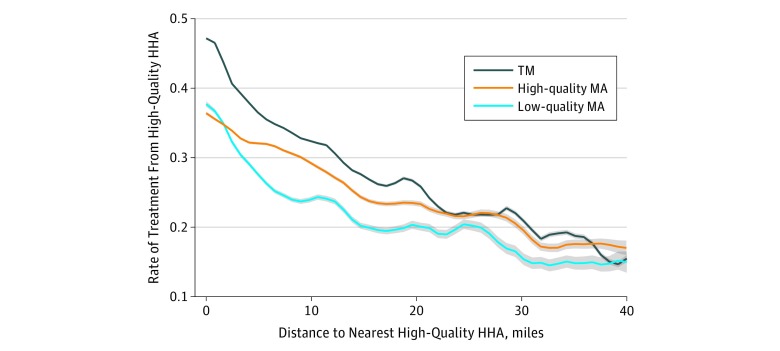
Of 4 391 980 admissions, most (75.5%) were for TM beneficiaries (mean [SD] age, 76.1 [12.2] years), with 16.6% of beneficiaries enrolled in high-quality MA plans (mean [SD] age, 77.8 [10.0] years) and 7.9% in low-quality MA plans (mean [SD] age, 74.4 [11.4] years). Individuals enrolled in low-rated MA plans were most likely to be nonwhite (percentages of nonwhite individuals in TM, 14.3%; in high-quality MA, 19.8%; and in low-quality MA, 36.5%) and dual Medicare-Medicaid eligible (percentages for dual eligible in TM, 30.5%; in high-quality MA, 19.5%; and in low-quality MA, 43.3%). Among TM beneficiaries, 30.4% received care from high-quality HHAs, whereas 17.0% received care from low-quality HHAs. Compared with TM beneficiaries, those in a low-quality MA plan were 3.0 percentage points (95% CI, 2.6%-3.4%) more likely to be treated by a low-quality HHA and 4.9 percentage points (95% CI, -5.4% to -4.3%) less likely to be treated by a high-quality HHA. The MA beneficiaries in high-quality plans were also less likely to receive care from high-quality vs low-quality HHAs (-2.8% [95% CI, -3.1% to -2.2%] vs 1.0% [95% CI, 0.7%-1.3%]).
Compared with TM beneficiaries, MA beneficiaries residing in the same zip code enrolled in either high- or low-quality MA plans may receive treatment from lower-quality HHAs. Policy makers may consider incentivizing MA plans to include higher-quality HHAs in their networks and improving patient education regarding HHA quality.
医疗保险优势计划(MA)的参保人数不断增加,目前有三分之一的 Medicare 受益人选择了 MA。尽管这种增长趋势明显,但评估为 MA 受益人服务的医疗保健专业人员和组织的质量,以及将其与为传统 Medicare(TM)受益人服务的医疗保健专业人员和组织进行比较,仍然具有挑战性。由家庭健康机构(HHA)服务的老年人可能特别容易受到低质量护理相关负面结果的影响。
比较为 TM 和 MA 受益人服务的 HHA 的质量。
设计、设置和参与者:这是一项横断面、入院水平分析,使用了 2015 年 Medicare 认证 HHA 的 OASIS 入院评估中 4391980 名 Medicare 受益人的数据。使用多项逻辑回归模型评估 Medicare 计划类型与 HHA 质量之间是否存在关联。该模型调整了患者的人口统计学、严重程度和邮政编码特征。敏感性分析控制了邮政编码固定效应。本分析于 2018 年 10 月至 2019 年 3 月之间进行。
使用主受益摘要文件将家庭健康使用者分为 TM 或 MA 受益人。MA 受益人进一步根据公开报告的 MA 星级评级分为高或低质量 MA 计划的参保人。
HHA 的质量来源于公开报告的患者护理星级评级:低质量(1.0-2.5 星)、平均质量(3.0-3.5 星)或高质量(≥4.0 星)。
在 4391980 次入院中,大多数(75.5%)是 TM 受益人的(平均[SD]年龄,76.1[12.2]岁),16.6%的受益人参加了高质量的 MA 计划(平均[SD]年龄,77.8[10.0]岁),7.9%参加了低质量的 MA 计划(平均[SD]年龄,74.4[11.4]岁)。参加低评级 MA 计划的人最有可能是非白人(TM 中,非白人的比例为 14.3%;在高质量 MA 中,非白人的比例为 19.8%;在低质量 MA 中,非白人的比例为 36.5%)和双重 Medicare-Medicaid 合格(TM 中,双重合格的比例为 30.5%;在高质量 MA 中,双重合格的比例为 19.5%;在低质量 MA 中,双重合格的比例为 43.3%)。在 TM 受益人中,30.4%的人接受了高质量 HHA 的治疗,而 17.0%的人接受了低质量 HHA 的治疗。与 TM 受益人相比,低质量 MA 计划中的参保人更有可能接受低质量 HHA 的治疗,其可能性高出 3.0 个百分点(95%CI,2.6%-3.4%),而更不可能接受高质量 HHA 的治疗,其可能性低 4.9 个百分点(95%CI,-5.4%至-4.3%)。高质量 MA 计划的 MA 受益人也不太可能接受高质量与低质量 HHA 的治疗(-2.8%[95%CI,-3.1%至-2.2%]与 1.0%[95%CI,0.7%-1.3%])。
与 TM 受益人相比,居住在同一邮政编码的 MA 受益人,无论参加高质量还是低质量的 MA 计划,都可能接受低质量 HHA 的治疗。政策制定者可能会考虑激励 MA 计划将高质量的 HHA 纳入其网络,并提高患者对 HHA 质量的教育。
