Wei Siying, Zhao Jingyu, Bai Meijuan, Li Chenchen, Zhang Lingling, Chen Yan
1CAS Key Laboratory of Nutrition, Metabolism and Food Safety, Shanghai Institute of Nutrition and Health, Shanghai Institutes for Biological Sciences, University of Chinese Academy of Sciences, Chinese Academy of Sciences, 320 Yueyang Rd, Shanghai, 200031 China.
2School of Life Sciences and Technology, Shanghai Tech University, Shanghai, 200031 China.
Nutr Metab (Lond). 2019 Aug 28;16:60. doi: 10.1186/s12986-019-0388-x. eCollection 2019.
Calorie restriction (CR) has been well proved to be a powerful tool to improve metabolic health associated with aging; and many types of CR have been proposed. Intermittent CR has become a trend in recent years due to its better compliance than continuous CR every day. However, there are few studies that directly compare the interventional activity of intermittent CR vs continuous CR in metabolic disorders such as diabetes.
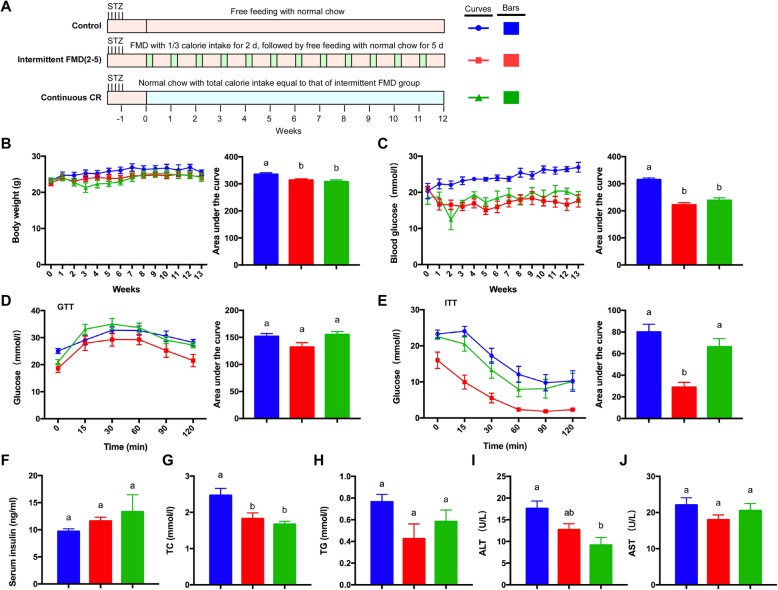
In this study, we analyzed two protocols of intermittent CR with the calorie-matched continuous CR in two diabetic mouse models including and streptozotocin-treated mice. Intermittent CR was carried out by a fasting-mimicking diet (FMD, with 30% calorie intake of the control per day) for 2 days or 5 days (i.e., 2-5 or 5-9 regimes followed by free eating for 5 or 9 days respectively).
In the two diabetic mouse models, both intermittent CR and continuous CR significantly reduced fasting blood glucose level and improved insulin sensitivity. However, intermittent CR performed significantly better than continuous CR in improving glycemic control and insulin sensitivity in mice. In addition, intermittent CR improved the glucose homeostasis of the mice without causing loss of body weight. Analyses with the pancreatic islets reveal that intermittent CR profoundly elevated the number of insulin-positive cells in both diabetic mouse models.
Our study indicated that both intermittent CR and continuous CR can lower fasting blood glucose level in the diabetic mice, while intermittent CR is better than the latter in improving glucose homeostasis in mice.
热量限制(CR)已被充分证明是改善与衰老相关的代谢健康的有力工具;并且已经提出了多种类型的热量限制。间歇性热量限制近年来已成为一种趋势,因为它比每天持续进行热量限制具有更好的依从性。然而,很少有研究直接比较间歇性热量限制与持续热量限制在糖尿病等代谢紊乱中的干预活性。
在本研究中,我们在两种糖尿病小鼠模型(包括 和链脲佐菌素处理的小鼠)中分析了两种间歇性热量限制方案与热量匹配的持续热量限制方案。间歇性热量限制通过模拟禁食饮食(FMD,每天热量摄入量为对照组的30%)进行2天或5天(即分别为2-5或5-9个周期,随后分别自由进食5天或9天)。
在两种糖尿病小鼠模型中,间歇性热量限制和持续热量限制均显著降低空腹血糖水平并改善胰岛素敏感性。然而,在改善 小鼠的血糖控制和胰岛素敏感性方面,间歇性热量限制的表现明显优于持续热量限制。此外,间歇性热量限制改善了 小鼠的葡萄糖稳态,而不会导致体重减轻。对胰岛的分析表明,间歇性热量限制在两种糖尿病小鼠模型中均显著增加了胰岛素阳性细胞的数量。
我们的研究表明,间歇性热量限制和持续热量限制均可降低糖尿病小鼠的空腹血糖水平,而在改善 小鼠的葡萄糖稳态方面,间歇性热量限制优于后者。