Ortiz Stephanie, Herrman Elisa, Lyashenko Claudia, Purcell Anne, Raslan Kareem, Khor Brandon, Snow Michael, Forsyth Anna, Choi Dongseok, Maier Tom, Machida Curtis A
Academic DMD Program, Oregon Health & Science University School of Dentistry, Portland, OR, US.
Department of Integrative Biomedical and Diagnostic Sciences, Oregon Health & Science University School of Dentistry, Portland, OR, US.
J Oral Microbiol. 2019 Aug 28;11(1):1653124. doi: 10.1080/20002297.2019.1653124. eCollection 2019.
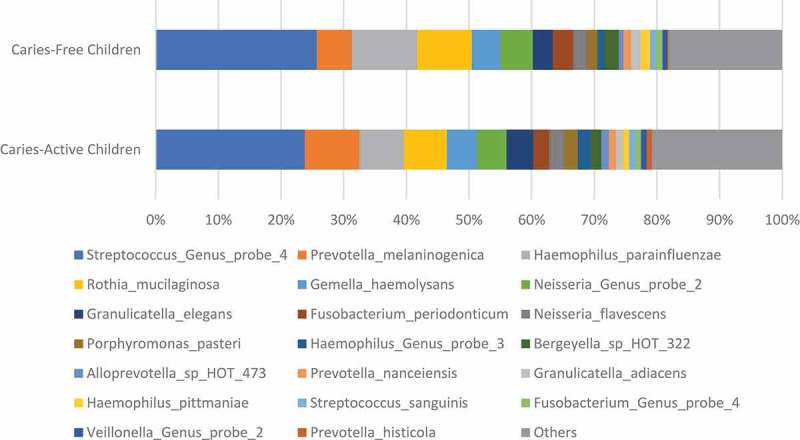
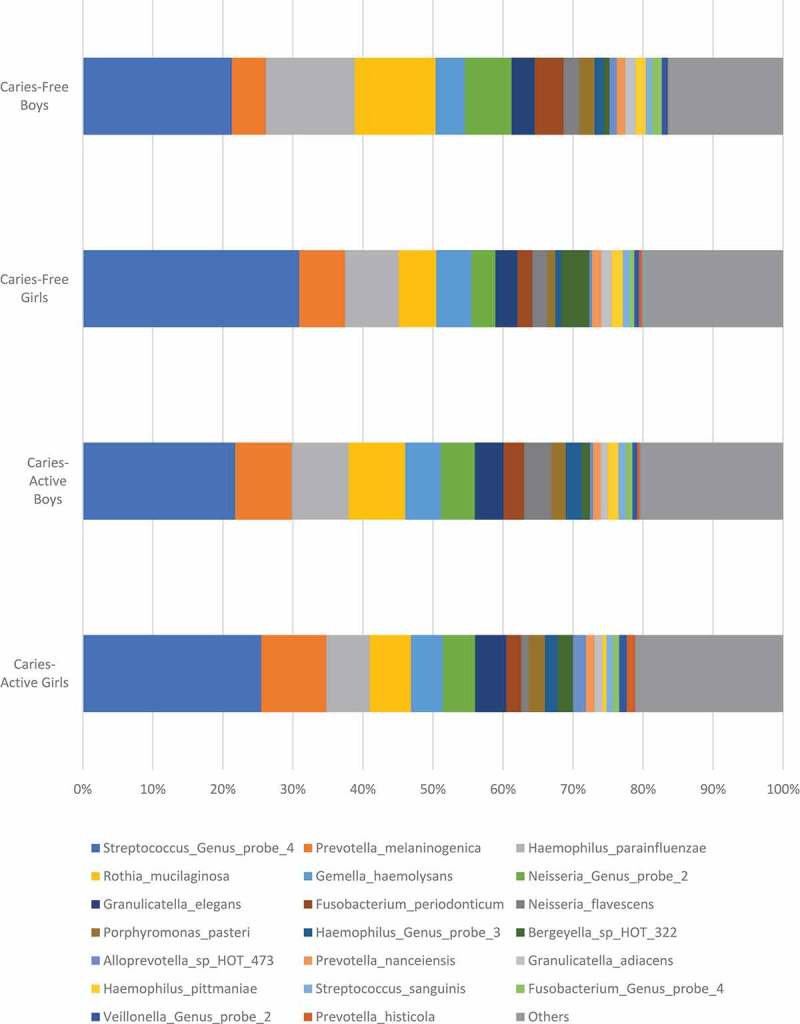
: Dental caries is a chronic disease affecting young children and has multi-factorial risk factors. The purpose of this work was to identify sex-specific differences in the salivary microbiota within caries-active children. : Saliva specimens were collected from 85 children (boys: 41; girls: 44) between the ages of 2-12 years. Salivary microbial DNA was subjected to PCR amplification using V3-V4 16S rDNA-specific primers and next-generation sequencing. : Significant sex differences in salivary microbiota were found between caries-active boys versus caries-active girls. , and were found at significantly higher levels in caries-active boys. In contrast, , species HOT 126, species HOT 183, , and species HOT 473 were found at significantly higher levels in caries-active girls. : We have found the acid-generating, to be much more abundant in caries-active girls than caries-active boys, indicating that this microorganism may play a more significant role in shaping the cariogenic microbiome in girls. In addition, in caries-active girls, species HOT 473 was the only species that exhibited both significant sex differences (4.4-fold difference; p=0.0003) as well as high abundance in numbers (1.85% of the total microbial population).
龋齿是一种影响幼儿的慢性疾病,且具有多因素风险。本研究的目的是确定患龋活跃儿童唾液微生物群中的性别差异。
从85名年龄在2至12岁的儿童(男孩41名;女孩44名)中采集唾液样本。使用V3 - V4 16S rDNA特异性引物对唾液微生物DNA进行PCR扩增,并进行下一代测序。
在患龋活跃男孩与患龋活跃女孩之间发现唾液微生物群存在显著的性别差异。在患龋活跃男孩中,[具体微生物名称1]、[具体微生物名称2]的水平显著更高。相比之下,[具体微生物名称3]、HOT 126菌属、[具体微生物名称4]、HOT 183菌属、[具体微生物名称5]和HOT 473菌属在患龋活跃女孩中的水平显著更高。
我们发现,产酸的[具体微生物名称6]在患龋活跃女孩中比患龋活跃男孩中更为丰富,这表明该微生物可能在塑造女孩致龋微生物群方面发挥更重要的作用。此外,在患龋活跃女孩中,HOT 473菌属是唯一既表现出显著性别差异(差异4.4倍;p = 0.0003)又具有高丰度数量(占微生物总数的1.85%)的菌属。