Cruciani Sara, Santaniello Sara, Montella Andrea, Ventura Carlo, Maioli Margherita
Department of Biomedical Sciences, University of Sassari, Sassari 07100, Italy.
Laboratory of Molecular Biology and Stem Cell Engineering, National Institute of Biostructures and Biosystems - Eldor Lab, Innovation Accelerator, Consiglio Nazionale delle Ricerche, Bologna 40129, Italy.
World J Stem Cells. 2019 Aug 26;11(8):464-475. doi: 10.4252/wjsc.v11.i8.464.
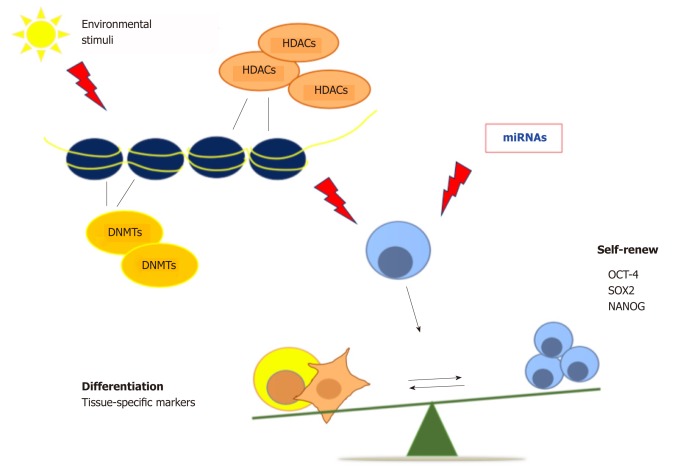
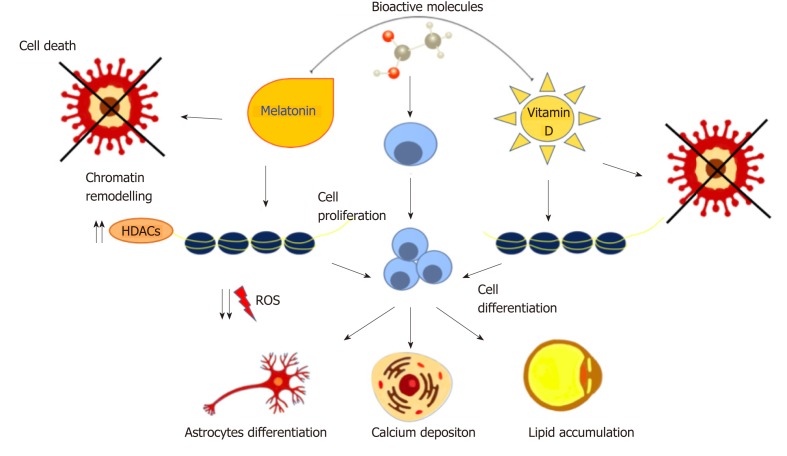
Mesenchymal stem cells are undifferentiated cells able to acquire different phenotypes under specific stimuli. manipulation of these cells is focused on understanding stem cell behavior, proliferation and pluripotency. Latest advances in the field of stem cells concern epigenetics and its role in maintaining self-renewal and differentiation capabilities. Chemical and physical stimuli can modulate cell commitment, acting on gene expression of Oct-4, Sox-2 and Nanog, the main stemness markers, and tissue-lineage specific genes. This activation or repression is related to the activity of chromatin-remodeling factors and epigenetic regulators, new targets of many cell therapies. The aim of this review is to afford a view of the current state of and stem cell applications, highlighting the strategies used to influence stem cell commitment for current and future cell therapies. Identifying the molecular mechanisms controlling stem cell fate could open up novel strategies for tissue repairing processes and other clinical applications.
间充质干细胞是未分化细胞,能够在特定刺激下获得不同表型。对这些细胞的操作主要集中在了解干细胞行为、增殖和多能性方面。干细胞领域的最新进展涉及表观遗传学及其在维持自我更新和分化能力中的作用。化学和物理刺激可通过作用于主要干性标志物Oct-4、Sox-2和Nanog以及组织谱系特异性基因的基因表达来调节细胞定向分化。这种激活或抑制与染色质重塑因子和表观遗传调节因子的活性有关,而这些因子是许多细胞疗法的新靶点。本综述旨在概述干细胞应用的现状,并强调当前和未来细胞疗法中用于影响干细胞定向分化的策略。确定控制干细胞命运的分子机制可能为组织修复过程和其他临床应用开辟新策略。