Department of Immunology and Infectious Disease, The John Curtin School of Medical Research, The Australian National University, Canberra, Australia.
Yale J Biol Med. 2019 Sep 20;92(3):481-498. eCollection 2019 Sep.
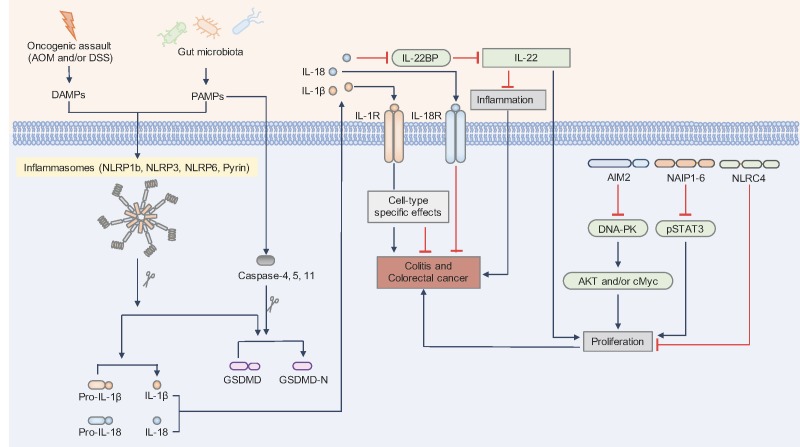
Colorectal cancer is a multifactorial disease and a leading cause of cancer-related deaths worldwide. Inflammation is a driver across multiple stages in the development of colorectal cancer. The inflammasome is a cytosolic multiprotein complex of the innate immune system central to the regulation of inflammation, pyroptosis, and other cellular processes important for maintaining gut homeostasis. Studies using mouse models of colitis and colitis-associated colorectal cancer have highlighted diverse and sometimes contrasting roles of inflammasomes in maintaining a balance between intestinal barrier function and the gut microbiota. In addition, persistent and/or dysregulated stimulation of inflammasome sensors finetune inflammation and tumorigenesis in the intestine. This review highlights the emerging role of inflammasome signaling in colitis and colitis-associated colorectal cancer. We also review the key mechanisms by which inflammasome signaling modulate inflammation and tumor development. Finally, we speculate the importance of using more tightly regulated experimental approaches to examine the role of gut microbiota in colorectal cancer.
结直肠癌是一种多因素疾病,也是全球癌症相关死亡的主要原因。炎症是结直肠癌发展过程中多个阶段的驱动因素。炎症小体是先天免疫系统的细胞溶质多蛋白复合物,是调节炎症、细胞焦亡和其他对维持肠道内稳态至关重要的细胞过程的核心。使用结肠炎和结肠炎相关结直肠癌的小鼠模型进行的研究强调了炎症小体在维持肠道屏障功能和肠道微生物群之间的平衡方面具有多样化且有时相互矛盾的作用。此外,炎症小体传感器的持续和/或失调刺激可微调肠道中的炎症和肿瘤发生。本综述强调了炎症小体信号在结肠炎和结肠炎相关结直肠癌中的新作用。我们还综述了炎症小体信号调节炎症和肿瘤发展的关键机制。最后,我们推测使用更严格调控的实验方法来研究肠道微生物群在结直肠癌中的作用的重要性。