Beim Graben Peter, Jimenez-Marin Antonio, Diez Ibai, Cortes Jesus M, Desroches Mathieu, Rodrigues Serafim
Communication Engineering, Institute of Electrical Engineering and Information Science, Brandenburg University of Technology Cottbus - Senftenberg, Cottbus, Germany.
Computational Neuroimaging Lab, BioCruces-Bizkaia Health Research Institute, Barakaldo, Spain.
Front Comput Neurosci. 2019 Sep 6;13:62. doi: 10.3389/fncom.2019.00062. eCollection 2019.
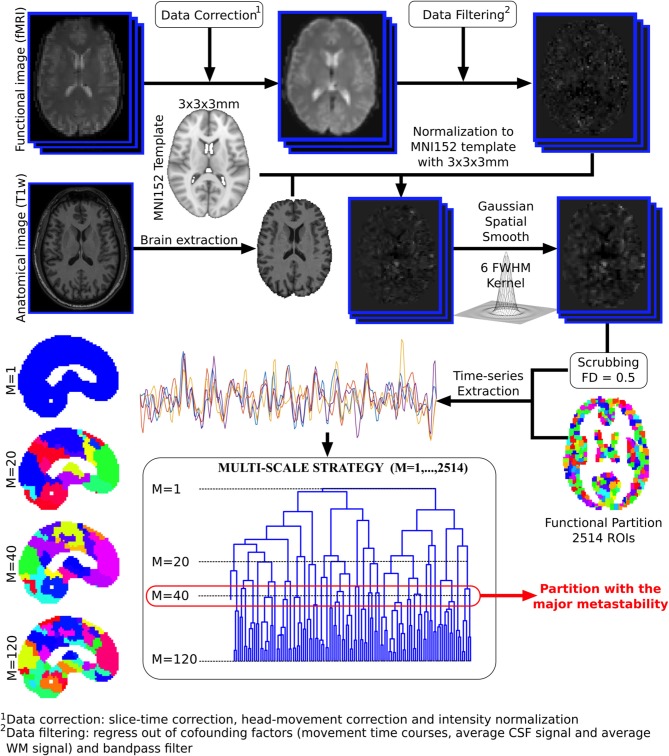
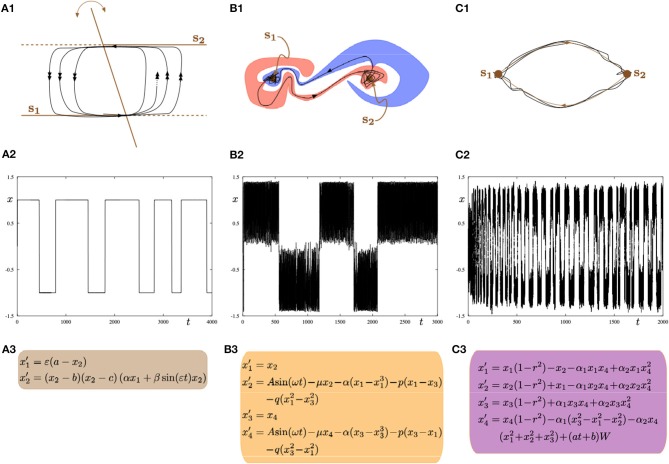
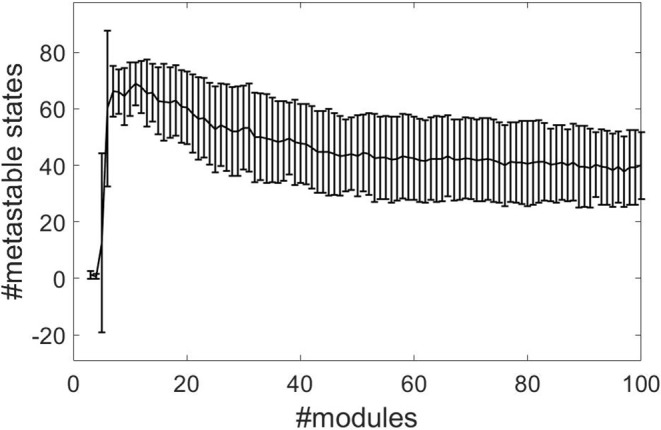
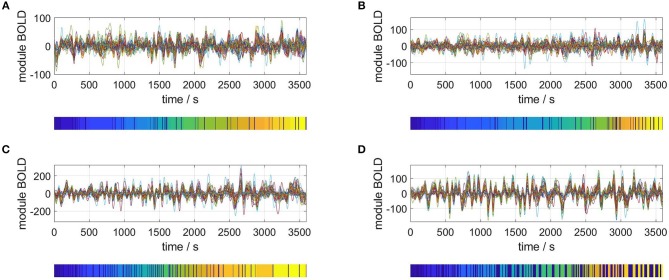
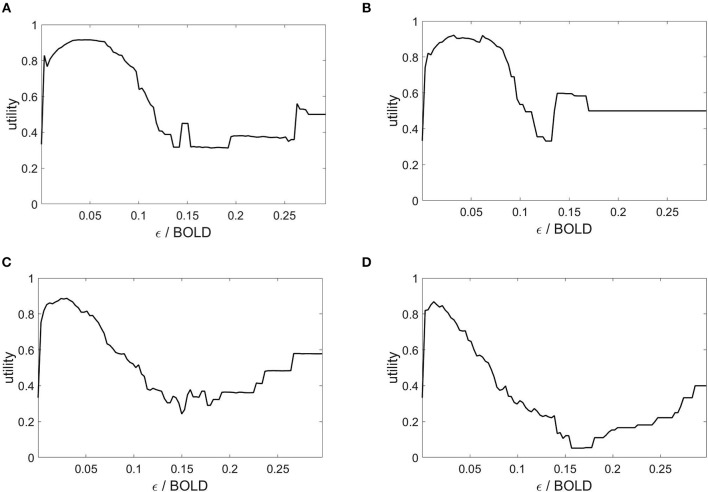
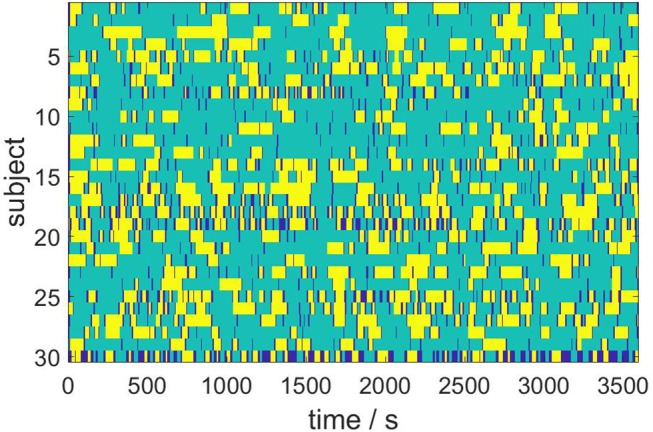
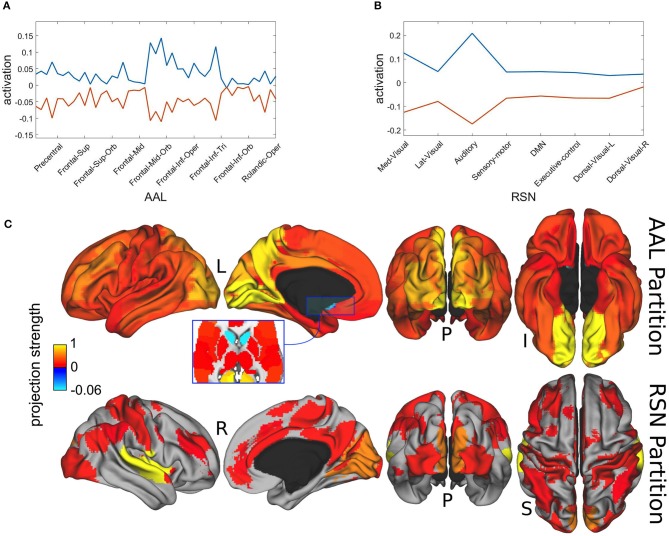
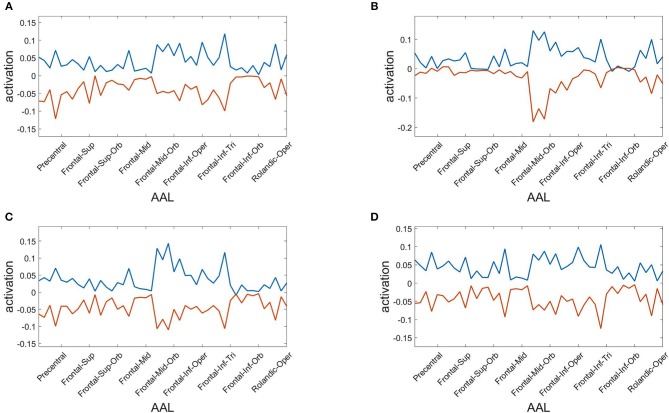
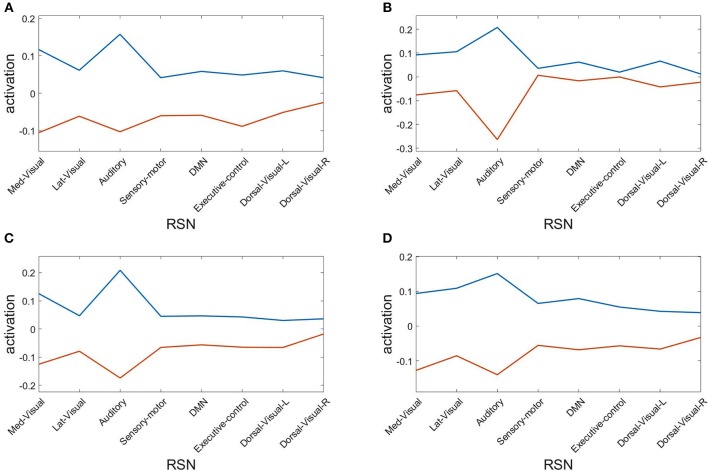
Metastability refers to the fact that the state of a dynamical system spends a large amount of time in a restricted region of its available phase space before a transition takes place, bringing the system into another state from where it might recur into the previous one. beim Graben and Hutt (2013) suggested to use the recurrence plot (RP) technique introduced by Eckmann et al. (1987) for the segmentation of system's trajectories into metastable states using recurrence grammars. Here, we apply this recurrence structure analysis (RSA) for the first time to resting-state brain dynamics obtained from functional magnetic resonance imaging (fMRI). Brain regions are defined according to the brain hierarchical atlas (BHA) developed by Diez et al. (2015), and as a consequence, regions present high-connectivity in both structure (obtained from diffusion tensor imaging) and function (from the blood-level dependent-oxygenation-BOLD-signal). Remarkably, regions observed by Diez et al. were completely time-invariant. Here, in order to compare this static picture with the metastable systems dynamics obtained from the RSA segmentation, we determine the number of metastable states as a measure of complexity for all subjects and for region numbers varying from 3 to 100. We find RSA convergence toward an optimal segmentation of 40 metastable states for normalized BOLD signals, averaged over BHA modules. Next, we build a bistable dynamics at population level by pooling 30 subjects after Hausdorff clustering. In link with this finding, we reflect on the different modeling frameworks that can allow for such scenarios: heteroclinic dynamics, dynamics with riddled basins of attraction, multiple-timescale dynamics. Finally, we characterize the metastable states both functionally and structurally, using templates for resting state networks (RSNs) and the automated anatomical labeling (AAL) atlas, respectively.
亚稳定性是指动态系统的状态在发生转变之前,会在其可用相空间的一个受限区域内花费大量时间,该转变会使系统进入另一个状态,之后系统可能会再次回到前一个状态。贝姆·格拉本和胡特(2013年)建议使用埃克曼等人(1987年)引入的递归图(RP)技术,通过递归语法将系统轨迹分割为亚稳态。在此,我们首次将这种递归结构分析(RSA)应用于从功能磁共振成像(fMRI)获得的静息态脑动力学。脑区是根据迪埃兹等人(2015年)开发的脑层次图谱(BHA)来定义的,因此,这些区域在结构(从扩散张量成像获得)和功能(从血氧水平依赖的氧合-脑血流动力学信号)方面都具有高连通性。值得注意的是,迪埃兹等人观察到的区域是完全时间不变的。在此,为了将这一静态图像与从RSA分割获得的亚稳系统动力学进行比较,我们确定了所有受试者以及区域数量从3到100变化时的亚稳态数量,以此作为复杂性的度量。我们发现,对于归一化的脑血流动力学信号,在BHA模块上进行平均后,RSA收敛于40个亚稳态的最优分割。接下来,我们在豪斯多夫聚类后汇集30名受试者,在群体水平上构建双稳态动力学。与此发现相关联,我们思考了能够允许这种情况出现的不同建模框架:异宿动力学、具有布满吸引子盆地的动力学、多时间尺度动力学。最后,我们分别使用静息态网络(RSN)模板和自动解剖标记(AAL)图谱,从功能和结构上对亚稳态进行了表征。